The sanctuary of Santa Maria della Quercia(Oak Tree) is located in the town of Viterbo called La Quercia where two miracles occurred, from which one of the most well-loved cults in Italy began, that of the Madonna della Quercia.

It all starts thanks to miracles from which the whole cult originates.

In 1417 the blacksmith Battista Juzzante asked the painter Martello, called Monetto, to paint a Madonna on a tile to put on a branch of an oak to protect his land.

It is said that more than a few people in the village had tried to steal the tile, but the Madonna would always return to the branches of the tree that had bent in such a way as to protect it from the elements.

In 1467 the first miracle took place: a knight chased by rival gangs took refuge under the branches of the oak and suddenly became invisible to his enemies.

The second miracle, still the same year, is that of having stopped the plague after about 30,000 people had gathered to pray around the tree.

At the end of the plague a great pilgrimage immediately began and Pope Paul II decided at that point to build a church that was entrusted to the Dominican fathers who chose it as their protector.

Thanks to the great arrival of offers, after two years the church was completely built with a project designed by the great architect Giuliano da Sangallo.

Another episode that contributed to the growth of religious interest around the Madonna della Quercia was the proclamation of Pope Pius V who had elected her protector of the Christian army at the battle of Lepanto in 1571.

The battle fought near a Greek island was decisive for blocking the Turkish and Muslim advance in the West. Upon returning from the battle, the commander of the Christian fleet John of Austria placed a small box with two Turkish flags at the foot of the Madonnna.

While the history began in Viterbo, its national importance over the centuries is due to the Dominican friars, who have guarded her for those centuries and elected her as their patron, and to the Brotherhood of Butchers whose members were Maremma meat merchants.

These merchants used to go to Rome to sell their meat and decided to transfer their headquarters to a small church in the centre of Rome, transforming that of Nicola de Curte in Campo dei Fiori dedicating it to the cult of the Madonna della Quercia.

Over time the Macellari (Brotherhood of Butchers) decided to rebuild the church and thanks to the Dominican Pope Benedict XIII began the work in 1727.

Another miraculous event then occurred during the Second World War when all the bombs that fell on Viterbo and the surrounding areas left the sanctuary intact.

In 1873 the sanctuary, already elected as a basilica, was declared a National Monument by the Italian State.

The church presents notable differences in style between the sober Renaissance exterior and the richly Baroque interior.

The façade from the early 16th century is finished with ashlar facing and has simple forms with three entrance doors, a central rose window and a closing tympanum with a bas-relief depicting the oak and the lions (representing Viterbo).

On the three doors there are three ceramic lunettes made by the great Andrea della Robbia, obviously the central one shows the Madonna della Quercia and the side ones San Tommaso d'Aquino (St Thomas Aquinas) and San Pietro (St Peter).

On the right side of the church stands a rather low bell tower with three levels of openings made by Ambrogio da Milano, with two original bells of 1578 and 1655.

While on the other side of the facade you can see a small balcony from which the Pope sent the blessing to the faithful, dating back to 1483 by the artist Vincenzo da Viterbo.

The church has three naves divided by columns with round arches and a precious gilded coffered ceiling designed by Antonio da Sangallo.

But all the attention is captured by the central marble aedicule (shrine) made by Andrea Bregno in 1490 and which guards the tile with the image of the Madonna.

A magnificent inlaid choir from 1514 and a precious organ from 1613 complete the image of the church.

The adjoining convent is also an architectural masterpiece with its two cloisters from the 15th and 16th centuries and a refectory designed by Antonio da Sangallo the Younger.

powered by social2s

The small church of San Marco (Saint Mark) is one of the oldest in Viterbo.

From a plaque on the façade we read that it was consecrated in 1198 by Pope Innocent III in the presence of 15 cardinals.

At that time the pope was busy trying to find a balance with St. Francis and in soothing the souls of the many hermits who asked for a church closer to the people.

The church was built by the Benedictine monks of San Salvatore at Monte Amiata and has still kept its small size of 16 x 8 meters.

Its simple gabled façade appears to be raised above the street level, probably because the river Urcione, then covered, flowed nearby.

The very simple interior is in local peperino stone with a wooden truss roof.

On one wall you can admire a small part of the frescos that adorned the church: a Madonna with Child and a depiction of God between St. Peter and St. Paul in the apse area attributed to Giovan Francesco d'Avaranzano called "Fantastico".

Among the works we note a painting on panel from 1512 by Giovan Francesco d'Avaranzano that represents a Madonna enthroned with the Child.

The church was bombed during the Second World War and later restored.

powered by social2s

The church of Santa Maria del Suffragio was built in 1572 with the demolition of a previous medieval church in Viterbo dedicated to San Quirico.

Its name derives from the Confraternity of the Souls of Purgatory or of Santa Maria del Suffragio that has managed it since 1618 by undertaking various jobs.

The current Baroque façade dates back to the eighteenth century and shows a play of colours between light peperino stone and plaster and is divided into two parts.

In the lower one it is characterized by a large entrance door surmounted by decorations and by a fresco of a Madonna with the souls of Purgatory.

The meaning of the painting refers to the mission of the Confraternity which was to raise funds to celebrate functions in suffrage of the souls in purgatory.

At the sides of the door there are two empty niches while, on the upper part, a series of decorations and architectural plays, typical of the Baroque, are closed with a tympanum with the coat of arms of Bishop Brancaccio of Viterbo.

The interior has a single nave and the space is dominated by a large painting on the ceiling that once again represents God in glory between the Madonna and Jesus with the souls in Purgatory.

The church has a baroque appearance with rich decorations and games of multicoloured marble.

In addition to the main altar, there are four side altars embellished with important works such as a 1730 fresco by Luigi Vanvitelli depicting the prophet Habakkuk and the Angel and the prophet Daniel in the lion pit.

Above the high altar there is an altarpiece by the painter Francesco Maria Bonifazi of Viterbo that represents a Madonna with Child and an Angel who presents a soul that leaves Purgatory.

The painter is also the artist of a painting of 1630 inserted in a large baroque aedicule and representing Saint John the Baptist baptizing Jesus.

Above the entrance door there is a choir with an interesting organ from 1777 created by Raffaele and Domenico Fedeli di Camerino.

powered by social2s

The small church of Santa Maria della Carbonara is located right in the medieval part of Viterbo.

It owes its name to the ancient custom of digging defensive ditches that were called charcoal pits or carbonare.

The construction dates back to the 12th century and was the seat of the Knights Templar, the most famous Christian religious knightly order.

It was born in the Holy Land during the First Crusade to defend pilgrims and the Holy Places (Templar comes from the Temple of Jerusalem) and became a monastic order in 1129 with Bernardo di Chiaravalle.

The knights therefore had a double role as a soldier-monk and over time they entered every aspect of western social and religious life until the king of France suspended the order in 1312.

The church was then entrusted to the Knights of Rhodes, who settled for a few years in Viterbo after the conquest of the Turks.

The church today appears with a very modest and simple aspect.

The ancient painting of the Madonna della Carbonara is today in the Museo del Colle del Duomo.

powered by social2s

The church dedicated to Saint Ignatius, founder of the Jesuits, was built in Viterbo by the Bussi family around 1671, as reported by a plaque on the façade.

But over the years many other families have contributed to its construction such as the first Spadensi who was the protagonist of a rather complex affair.

In fact, the heirs contested the will of Donato Spadoni in 1638 and went into argument with the seminar: the controversy ended with a reduction in the sum given to the seminar.

For the construction of the seminar it was permitted to close an alley and the complex appeared appropriate for its importance.

The façade was then rebuilt in 1837 by Vincenzo Federici .

Today it appears to us with an austere nineteenth-century style, in peperino stone and plaster and the only form of lightness is given by the play of colour between the stone and the plaster.

The interior was restored in 1893 by Castore Costantini and is a unique environment with side chapels and a frescoed dome.

In this church, Pope Leo XIII received the first communion on June 21, 1821, when he was a seminarian. The episode is remembered with a fresco of the Pope's coat of arms.

Today the church has been entrusted to a therapeutic community and to the Romanian Orthodox parish of "San Callimaco di Cernica".

powered by social2s
Viterbo. Church of San Pellegrino

The church of San Pellegrino is located in the medieval Pellegrino district, the most characteristic and beautiful part of the city of Viterbo.

It is one of the first churches and is mentioned in a document of the Abbey of Farfa from 1045 which tells us that at that time it depended on the Abbey of San Martino al Cimino.

The church has lost its original Romanesque character having undergone many alterations.

In particular, in 1889 a new neo-gothic façade was created which clearly distinguishes itself from the style of the neighborhood but which characterizes it differently as a superposition of life experiences over the centuries.

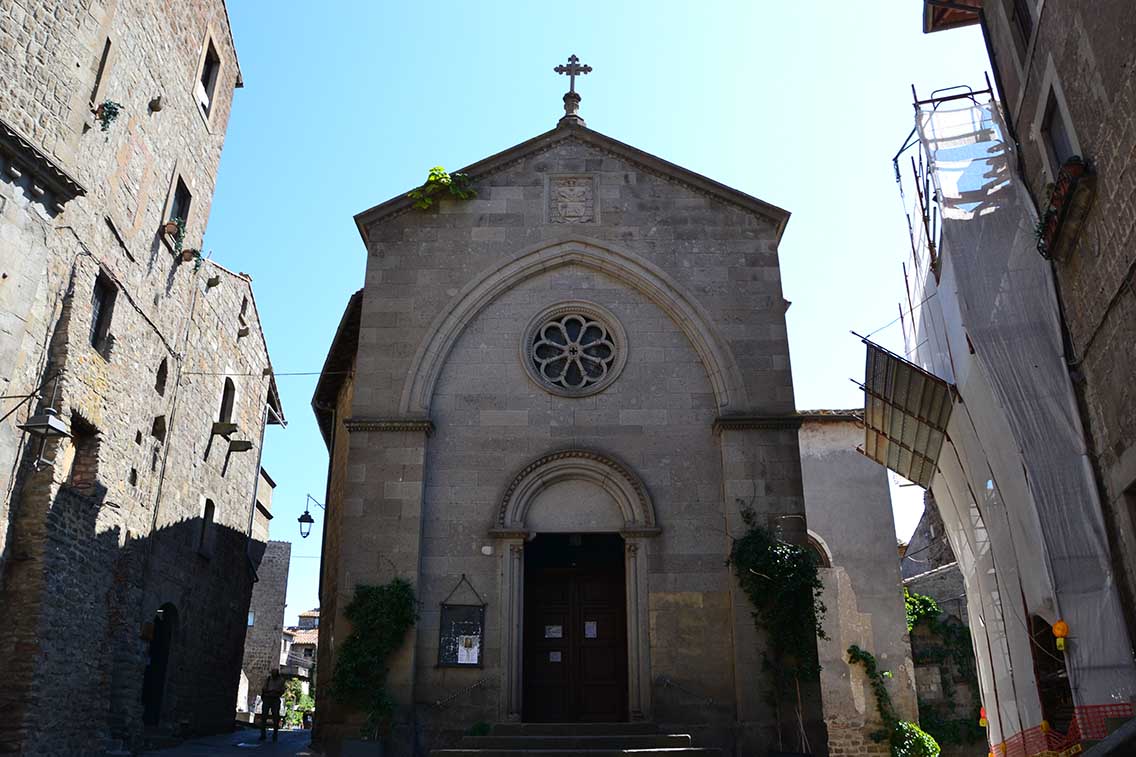
The façade is in peperino stone and plaster and is characterized by a very large neo-gothic arch that encloses the main door and the central rose window.

You can enter the church through some steps thereby entering a unique environment with frescoes such as an Annunciation of the XV and others of the XVIII century.

The last restoration of the church took place after the bombings of the Second World War.

powered by social2s

The church of Sant' Andrea Apostolo (St Andrew Apostle) is located in the medieval district of Pianoscarano in Viterbo.

It dates back to 1148 when the municipality received land from the Abbey of Farfa to enlarge the city and build a church.

Over the centuries the church has had changes such as those following the collapse of the crypt in 1564.

From what appears it seems that the crypt was adder to the church later to turn it into a cemetery.

In fact its appearance is late medieval Gothic, and this could be one of the reasons for the collapse.

Another important architectural intervention was in 1902 when an attempt was made to restore the ancient Romanesque aspect of the church.

The facade of the church appears to be covered by a massive masonry portico with three small entrance arches and is characterized by a bell tower with two bells.

The interior has a single nave in simple stone without frescoes and this situation highlights the light that penetrates through the openings such as those in the apses.

The altar area is raised, a sign of the presence of monks, and is accessed via a staircase that occupies the entire church.

Some portions of the original frescoes can be admired in the left wall with "San Lorenzo and Santo Stefano" and in the underlying crypt, these date back to 1270 and are attributed to Ranuccetto da Viterbo.

The last restoration of the church took place after the bombings of the Second World War.

powered by social2s

The Romanesque church of San Sisto is located just behind Porta Romana.

It was one of the first churches built in Viterbo, probably in the ninth century where the village of Vico Quinzano had formed.

Perhaps the church was built on an earlier pagan temple dedicated to the Fortune Goddess.

The fact that the church is the result of successive modifications immediately becomes evident by observing the internal difference in height between the altar area and the rest of the church which are separated by a large staircase and an arch.

Under the church there is a crypt and in general this also indicates a previous building.

Today in the crypt there is a monument in memory of the war dead.

The church was bombed for the first time by French soldiers in 1799 and a second time during World War II.

Later restorations brought it back to its original appearance, eliminating all the decorations and modifications made during the Renaissance and Baroque periods.

The church ends with an apse attached to the city walls and it has two bell towers.

One in Romanesque style is connected to the church but is no longer accessible and one with a clock has been made from a transformation of one of the towers of the walls.

On the right side of the church, a large organ was placed in 1964 and the central altar was made using a capital of a column.

powered by social2s

Recommended

Subscribe to Newsletter

Discover a territory through the emotions of the people that have lived it.