Chiesa di San Pietro

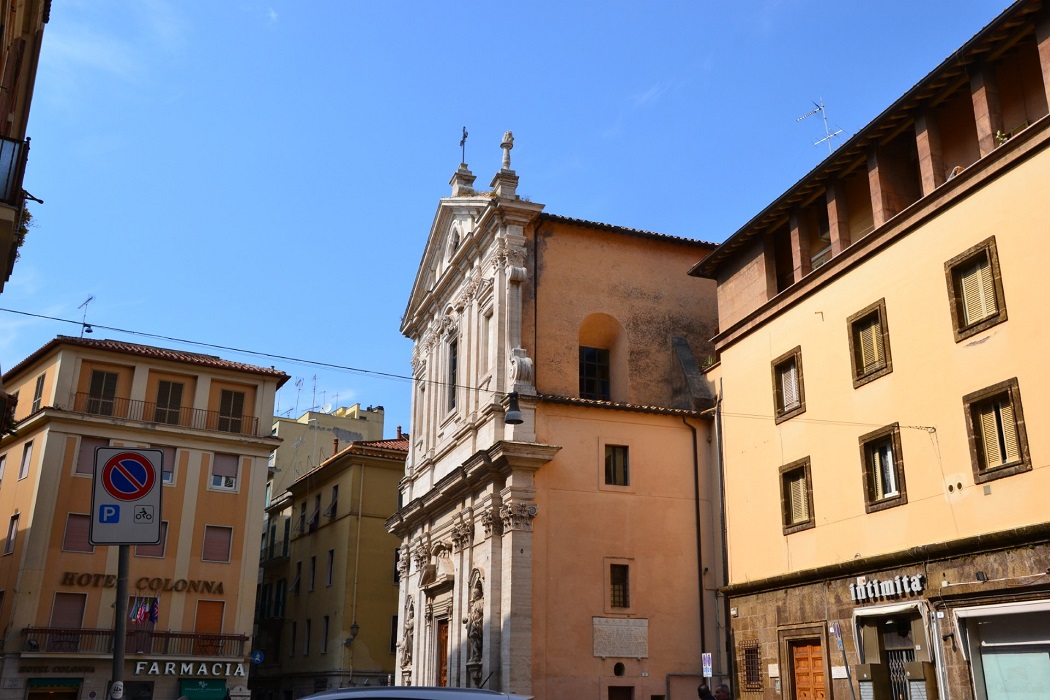
The church of St Peter is the cathedral basilica of Frascati, built starting from 1598 to a design by Ottaviano Nonni, known as il Mascherino.

The travertine spur stone facade was miraculously saved from the bombings of 8 September and is attributed to Girolamo Fontana and was completed in 1700. It is a clear example of a Baroque facade, divided into niches where statues of saints are housed while two orders of columns scan and divide the façade.

The entrance portal is underlined by a high relief.

The plan is a Greek cross, three naves with eight side altars which preserve valuable works of art.

Very interesting are the high relief of Pompeo Ferrucci in the central apse, the bronze cross of the Jubilee of 1750 and the funeral monument of Carlo Edoardo Stuart.

Fontana is buried near the baptismal font.

powered by social2s
Chiesa del Gesù
Chiesa del Gesù

The church of Jesus was built around 1630 in Frascati as a Jesuit residence, and was built on a site previously dedicated to the Blessed Virgin Mary.

Its elegant and sober facade is attributed to Pietro Da Cortona and is inspired by the church of Gesù in Rome. It has a double order of overlapping pilasters, framing two niches below with the statues of St Ignatius and St Francis Borgia.

The entrance portal is enriched by an interrupted pediment and a plaque commemorates the dedication of the church to San Gregorio Magno.

The Baroque interior of the church is a perfect synthesis between architecture and painting, the spaces spread out and at the intersection of the single nave with the transept there is the fake dome painted by Andrea Pozzo. Standing on a black disk drawn on the floor, you can enjoy the artfully designed perspective show.

Even the skillfully painted apse suggests perspective effects and takes up the decorative motifs of the church.

powered by social2s
Chiesa di Santa Maria in Vivario o San Rocco e Campanile
 Chiesa di Santa Maria in Vivario o San Rocco e Campanile

The church of Santa Maria in Vivario is the ancient cathedral of Frascati, built around the 8th and 9th centuries on the remains of a Roman villa attributed to Lucullus.

In 1296 the first restoration works were carried out, and in 1305 the famous Romanesque bell tower was erected on the back of the church.

On 11 May 1495 the church was reconsecrated after the restoration work financed by the Estoutevilles, then feudal lords of Frascati.

While the town was invaded by the plague in 1656, two frescoes came to light in the church reproducing Saints Roch and Sebastian, who on 28 January 1656 were proclaimed protectors of Frascati.

The church was renamed in honor of St Roch and today the two names of Santa Maria in Vivario and St Roch coexist to indicate the same church.

The structure has three naves divided by beautiful spur stone columns and the altar is a magnificent early Christian sarcophagus found in the Camaldoli wood.

powered by social2s

The church of the Madonna of Capocroce is located in the place where there was a small aedicule dedicated to the Madonna.

Legend has it that in 1527 this image had miraculously stopped the horde of Lanzichenecchi from the Sack of Rome which was about to attack Frascati thanks to the apparition of the Madonna. The church was built in 1612 by Girolamo de Rossi as a thank you.

Only the facade and the bell tower were saved from the ferocious bombings of the Second World War which destroyed a large part of the historic center of Frascati. The whole church was then rebuilt in the fifties following the original Baroque style of the interior.

The facade is very simple in plaster, it is enriched by an image of the Madonna and ends with a tympanum. The interior has a Latin cross plan with the single central nave overlooked by four chapels, two on each side.

The image of the Madonna and Child painted in oil on a metal plate is the object of devotion of the faithful and reproduces the ancient fresco destroyed by the bombings.

powered by social2s
Viterbo. Church of Saints Faustino and Giovita (known as San Faustino)

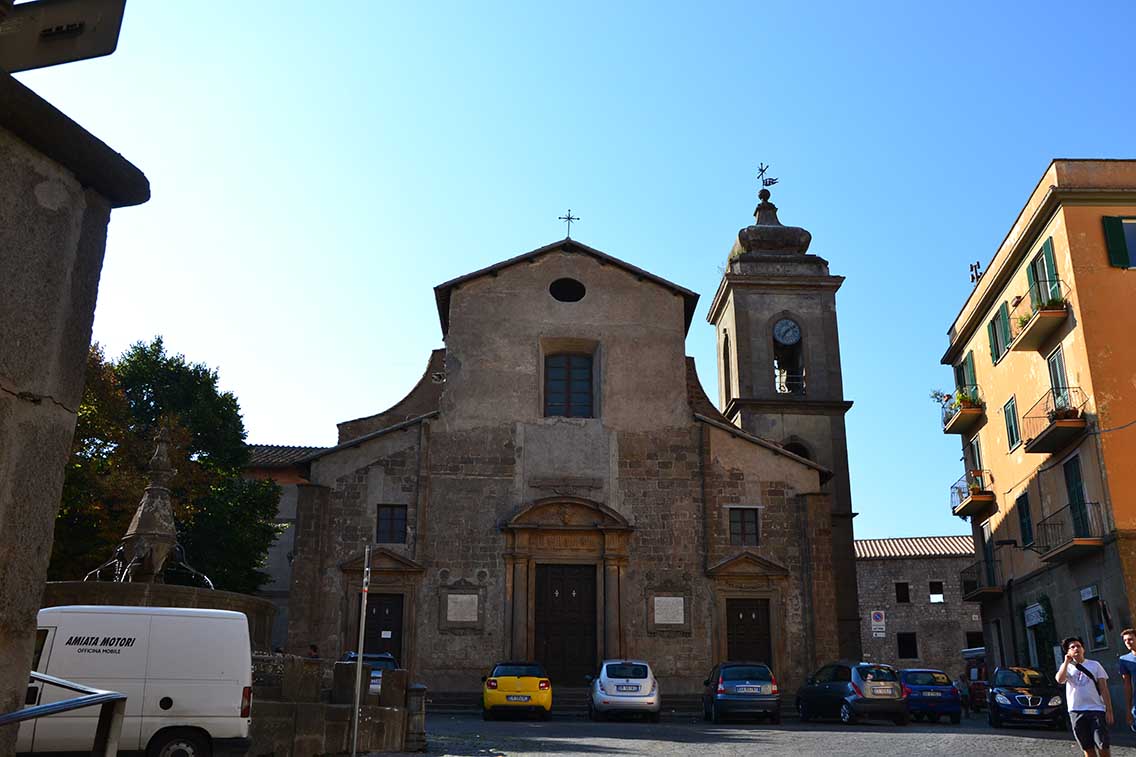
The church of Saints Faustino and Giovita, with its elegant late Baroque bell tower with clock, is located in one of the historic areas of Viterbo and its origins date back to the 13th century. 

It is dedicated to Faustino and Giovita, two nobles from Brescia who lived n a daring manner and were martyred in the second century under the emperor Adriano (they ended up at the Colosseum but the beasts knelt at their feet). 

Their worship was brought to Viterbo by the Lombards, and Saint Faustino is now considered the patron of the "singles".

The first records of the church date back to 1236 by Pope Gregory IX, when the church used a lot of energy to counter the phenomenon of heretics in Tuscia favouring their grouping together, like the case of the Augustinians of the church of the Trinity, or their involvement in the life of the city.

For years it was one of the religious but also socio-economic centres of Viterbo, to the point that in 1523 it hosted the Order of the Knights of Rhodes: a plaque and a cross of the Order on the façade recalls the story. 

The knights had been driven from the island of Rhodes when the Turks arrived and Pope Clement VII granted them the fortress Albornoz of Viterbo and this church until 1527 when they then decided to settle in Malta.

At their departure, the Knights donated to the church a precious image of the Virgin and Child, the Madonna of Constantinople, which for years has been a place of pilgrimage. 

Some knights are buried in the left aisle of the church and in 1655 the church enjoyed the indulgences and privileges of the order also called Gerosolimitano or Saint John of Jerusalem.

The church then had many alterations and the current late Baroque-neoclassical form dates back to the 1759 works of the architect Giuseppe Antolini.

The interior has three naves at the three entrance doors, ending with apses and are divided by pillars with round arches. 

Above the entrance door, the bigger one with a neoclassical frieze, is a large window and an oculus let the light penetrate the church.

The church houses many works of art, in addition to the Madonna of Constantinople which has been celebrated for centuries. Another painting is that of the Madonna della Luce or Madonna dell'Aurora (Dawn) because it was worshiped early in the morning (at dawn) by the peasants going to the fields.

Two other works of particular effect and value are paintings by the artist Stringelli: a Massacre of the Innocentie the painting Faustino and Giovita in prison dedicated to the two saints of the church.

In the square in front of the church there is the Fountain of San Faustino from 1250, as reported in the inscriptions on the peperino stone, financed by the inhabitants of the neighbourhood so they would have access to public water.


powered by social2s

In the medieval heart of Viterbo there is the church of Saint John Evangelist which is immediately recognized by two large buttresses that connect the facade with the opposite building. They were probably built to stem a static problem in the building and unload its weight on neighboring buildings as well.

The church dates back to the 11th-12th century and owes its name Zoccoli to the ceramic cladding that once decorated the facade and which in the local language was called 'Ciocola'. Some of these majolica decorations can be seen in the large rose window that adorns the facade, if you have a telephoto lens.

In addition to the Romanesque rose window with its lateral sculptures of eagles, representing St. John the Evangelist, in the facade there is a door with an elegant frame with floral and geometric decoration and a lunette with a fresco of the saint.

The interior is simple and the church has three naves, which end with 3 apses divided by a series of columns made with overlapping elements, and a wooden hut roof.

Although the general style of the church appears Romanesque, this is partly desired with two restorations, one in 1880 and one after the bombings of the Second World War.

Among the works of art you can admire a Gothic style polyptych of 1441 made by Francesco d'Antonio Zacchi known as Balletta, a painter from Viterbo who represented a Virgin among the saints.

On one side St. Peter and St. John the Baptist and on the other St. John the Evangelist and St. Paul.

powered by social2s
Viterbo. Church of the Holy Trinity or Sanctuary of the Madonna Liberatrice

The first church of the Holy Trinity dates back to the 13th century and was built in Romanesque style by the Augustinian friars who dedicated it to the Trinity. 

The Order of the Augustinians was born in Tuscia at that time from the union of eremite communities and in 1244 under the influence of Pope Innocent IV it was officially recognised for the first time in Rome.

The church of the Trinity of Viterbo was consecrated in 1258 by Pope Alexander IV as reported in a plaque in the cloister.

Its second name of Sanctuary of the Madonna Liberatrice is due to a miraculous event that took place in 1320: it was May 28 when, in the suddenly dark sky, demons appeared in the form of crows, eagles and bats. 

The frightened population saw at a certain point the image of the Madonna appear, which had the appearance of that of a fresco that was found in the church of the Holy Trinity, and chased away the evil. 

The Madonna asked the citizens to pray to her in the church and since then she has been invoked by the Viterbesi, every time they feel threatened and from 1344 on Pentecost Monday there is a procession (today moved to the last Sunday in May).

The fresco of the Madonna and Child by the itinerant painters Gregorio and Donato d'Arezzo is protected by a shrine in a right side chapel.

The church was then destroyed by a fire and had its first reconstruction thanks to Pope Martino V Colonna in 1421. 

But the late Baroque-neoclassical style comes from the extensions of 1727 by the architect Giovan Battista Gazzale who also modified the orientation of the building.

The façade is made harmonious by a play of colours between the brick-red plaster and the decorations in gray peperino stone and is divided into two levels distinguished by columns in different style.

4 niches then exalt the figures of saints: the niches with Saint Augustine and Saint Thomas of Villanova in the lower part near the main door and the female ones of Saint Rita of Cascia and Santa Monica in the upper part. 

All the statues were made by Camillo and Vincenzo Pacetti, while at the centre of the church there is a balcony with the symbol of the Trinity in white travertine.

The interior appears in a late neoclassical style enriched with polychrome friezes and marbles with three naves and a cross plan.

It is surmounted by a dome frescoed with the scholars of the church among whom is Saint Augostine, illuminated by 8 recesses.

Among the other works of art we note the funeral monument to Cardinal Raimondo Perrault of 1505, a basin from the 1600s and paintings of the XVI, XVII and XVIII centuries.

But the true work of art is the Renaissance cloister of 1513 spread over two floors with a central fountain in peperino and enriched by 36 columns. 

On the lunettes of the inner walls of the cloister at the cross vaults and the openings of the cloister, it is possible to admire a pictorial cycle that tells the whole life of Saint Augustine. 

44 works created by the Roman painter Marzio Ganassini and by Giacomo Cordelli from Viterbo. 

The works were made thanks to a legacy of Giacomo Nisini, knight and nobleman, whose coat of arms is found in the cloister.

powered by social2s

Recommended

Subscribe to Newsletter

Discover a territory through the emotions of the people that have lived it.