


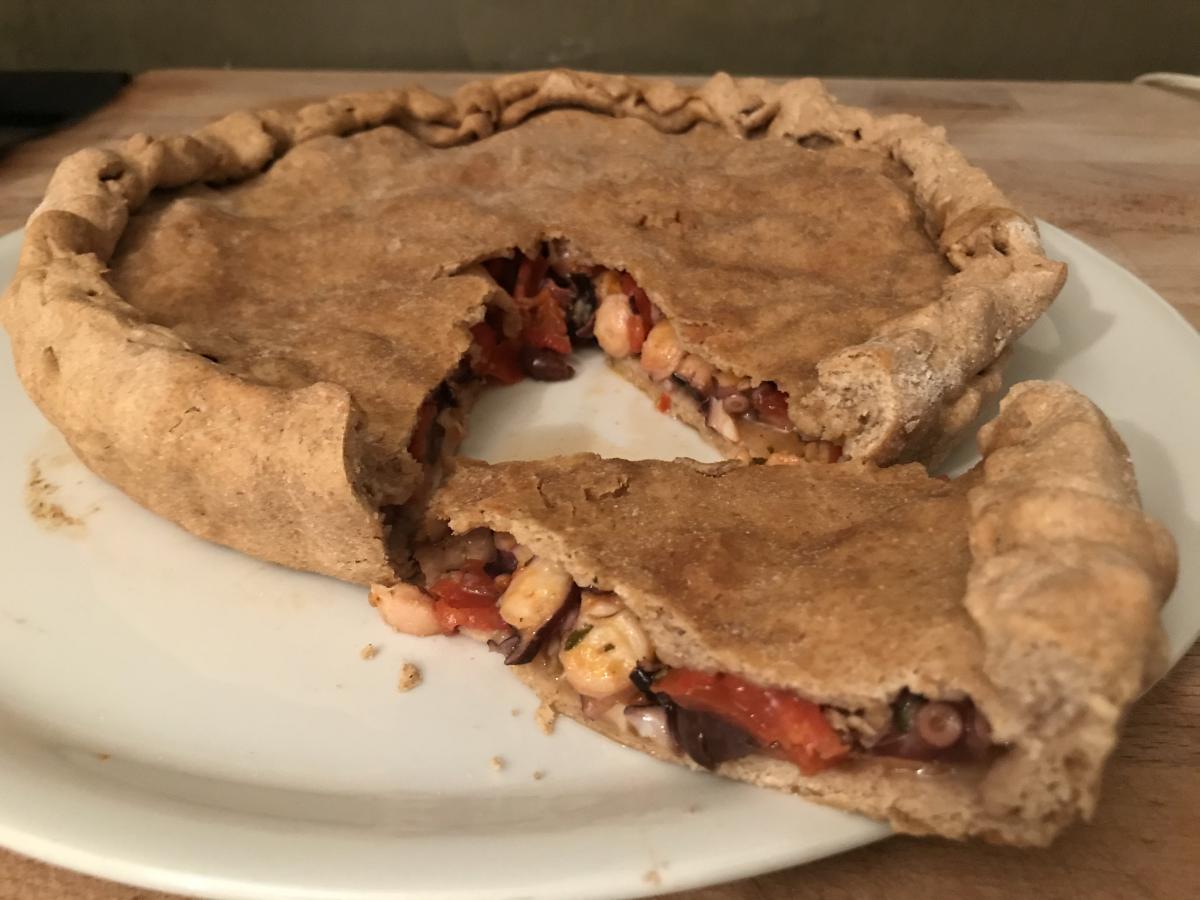
Gaeta's Octopus Tiella and the memory of the last Bourbon king
- Dario Magno
- Category: Typical Dishes
The last stronghold of the Lazio coast holds a gastronomic treasure, the Tiella di Gaeta, made with octopuses and fantastic olives. (This Tiella is a hand sized pizza filled with favoured octopus). Gaeta is also the last promontory of the Aurunci Mountains, the rugged Mediterranean reliefs that reach the sea.

As I prepare it, I sip a white Lacryma Christi, Vesuvius is not too far away and preparation begins the evening before just in time for the aperitif. This wine is said to come from the tears shed by Jesus when Lucifer stole a piece of paradise and brought it to earth creating the Gulf of Naples before falling into hell and giving birth to Vesuvius.
The Gulf of Gaeta has breath-taking beauty and history has created surprising intertwining features since the Roman period, and then the Middle Ages had the magic of having designed a city in which from the alleys you reach large castles, churches and sanctuaries from which the gaze is lost in the light and horizon of the sea.
Gaeta has always been in the southern kingdoms outside of Catholic interference, even if the family of the famous pope of the ‘Slap of Anagni’ takes his name from this city: Pope Boniface VIII Caetani (of Gaeta). Jokes of fate.
The port and military fortresses were one of the strengths of the Bourbons and this was the last fortress to capitulate to the unity of Italy, and its siege in the Risorgimento was epic. Francesco di Borbone (Francis of Bourbon) and the beautiful Maria Sofia surrendered only after he was granted the honour of arms and abandoned Gaeta with in a royal procession.
It seems that on this occasion the saying "either in Naples in a carriage or in the bush to make coke " was coined, as if to say "half measures are not accepted". You have to try to live like a lion, always try to be great because this is the essence and flavour of life.
And all those who passed through Gaeta also had the pleasure of tasting the local cuisine where local products were enhanced.
La Tiella: a middle ground between a pizza and a cake filled with seafood and vegetables.
There are two most common variants: with octopuses or escarole (bitter lettuce), the first in my opinion has top value. The only thing that unites the two are the Gaeta olives in brine of the local cultivar, the Itrana.
Then I am forced to specify that the Itrana olive is known all over the world with the name of Oliva di Gaeta because this was the port from which they were shipped to reach markets all over the world. They were so sought after that they were finally called by the name of their port of embarkation: Gaeta olives.
But if you go to Itri, Sonnino or all the towns in the area you must specify that you want olives or oil of the Itrana variety, otherwise they look at you with arrogance. This is Italy: many treasures and many bell towers that have continued their rivalry for centuries. A strength and a weakness depending on how we look at it.
If you visit the fortress of Gaeta, stop in the various "tiellari" (like pizza stalls) near the port: a top-notch tasting experience. Or get the right products and try to make it following tradition.
My recipe for the Tiella di Gaeta
Ingredients for the dough:
500 gr Wholemeal flour that I get in the Cilento park from a very small producer of ancient grains (always stay in the Bourbon state and in a park of absolute beauty)
20gr of brewer's yeast
250cc of water
Sea salt
EVO oil (Extra Virgin Olive)
Ingredients for the filling:
An ½ kg octopus
Gaeta Olives
Garlic
EVO Oil
White wine
Datterini tomatoes from the Piana di Sant’ Agostino in Sperlonga (bordering Gaeta a little further north).
Let's cook!
It all starts the night before when I prepare the dough and first I dissolve the brewer's yeast in barely warm water.
On a pastry board (a wooden board used to make and flatten the pasta or to spread polenta) I prepare the classic fountain with flour and add water and a little oil. Then I proceed to knead with energy until it forms a homogeneous compound which I leave to sit for at least 12 hours covered by a damp cloth.
The next day we start the real tiella and prepare the filling. Let's boil the octopus, but first massage it carefully with a meat mallet or a rolling pin to soften it. The ritual of the three dives is important to make it curl well. This means stuffing the octopus and immersing it three times in boiling water (as the biscuits are soaked in milk) to curl the tentacles.
Let's cook it for forty minutes and then let it cool in its water.
At this point we can cut it into small pieces to make the real filling. In a bowl we put a finely chopped clove of garlic and add it to the octopus together with the datterini tomatoes, pitted olives, oil and wine. We adjust the salt and leave to macerate for an hour in the fridge.
With the dough we make two ½ cm thick sheets: one for the bottom of the "Tiella" pan and the other to cover. Basically the word tiella comes from the Latin 'tigella' and meant a container with a lid. The tigella in this case is a saucepan in which we cook the octopus with a lid made of pasta.
Then we lay the first sheet on the bottom of a circular baking tray with the edges protruding from the pan. We put in the seasoned octopus and cover with the second layer of pasta and finally close the edges of the pan with the first pasta.
We put everything in the oven for 30 minutes at 180 degrees Celsius and wait to feel the scent of the sea that floods the kitchen.
Tiella is good both hot and cold. I drank more of the white Lacryma Christi from Vesuvius while I kneaded and continued with that. A perfect match that takes you back to the ancient Bourbon Kingdom





Follow us