


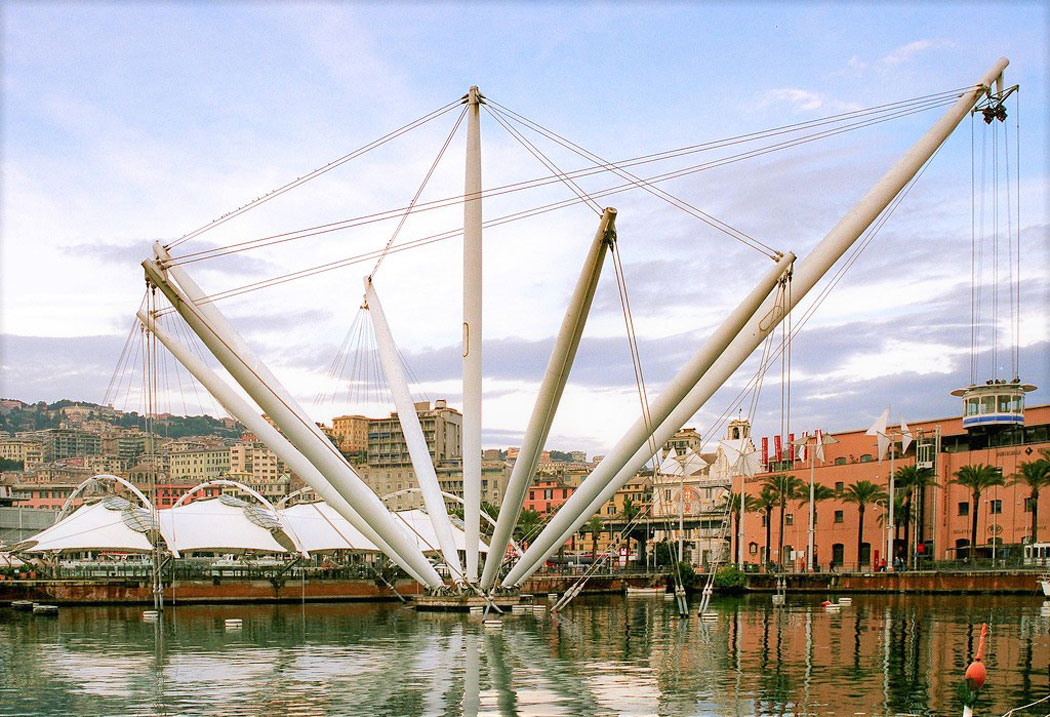
Genoa is a city of the sea, with a glorious history and a thousand facets. The great port on the Mediterranean has made it international and made it a city of merchants and bankers, known by all as 'La Superba', the most English city in Italy. Its most important historical period, the 16th century, has marked it forever, with its stately palaces alternating with humble houses, its beautiful churches with their austere black and white striped marble facades or opulent in their Baroque lines.
The origins of the city of Genoa are ancient and still obscure.
Findings of a Bronze Age village, a pile-dwelling from 5000 BC and an Etruscan necropolis have confirmed that Genoa's first settlements extended along the right bank of the Bisagno stream.
It is known for certain that it was founded by the Ligurians, a population of isolated families who gathered only to defend themselves from enemy attacks, who settled in the 6th century B.C. on the hill where the Castle now stands imposingly.
Its name seems to derive from the Celtic word 'genua', meaning entrance, as it was an outlet to the sea and a gateway to northern Italy and central Europe.
In 205 BC, the Carthaginian Magon, Hannibal's brother, invaded it from the sea and sacked and destroyed it. Two years later the Romans, led by the praetor Spurio Lucretius, brought 8000 workers to Genoa and rebuilt the city, enlarged the port and built a protective wall. From then on Genoa became the commercial and maritime centre of Ligura, loyal to Rome.
After the fall of the Roman Empire in 641, Genoa was conquered and destroyed by the Lombard King Rotari and in 773 it became part of Charlemagne's Empire, still enjoying great privileges.
Both the Normans and the Saracens had great ambitions for Genoa and its important port. It was the Saracens who attacked Genoa in 934 with a huge army, but Genoa defended itself bravely and the Saracens were forced to retreat. After two years the Saracens reached the city again from the sea with a large fleet, attacked, sacked and took many prisoners.
But the Genoese did not give up: they chased the Saracens with their ships as far as the island of Asinara and managed to recover their goods and free the hostages.
Around 1100, the "Compagna Communis", i.e. the Commune of Genoa, was established for commercial purposes, from the union of the various associations operating in the mercantile and military field, called "Compagne", in which the highest religious, political and commercial offices of the city participated.
This historical period is especially important for the Crusades, in which Genoa participated, driven by the desire to conquer new markets in the East.
In 1099, during the First Crusade, the Genoese, led by Guglielmo Embriaco, distinguished themselves for having sent numerous ships, for having largely financed the expedition and for having obtained great victories, above all the conquest of Jerusalem.
Between the end of the 13th century and the beginning of the 14th century Genoa reached its maximum splendour with a dominion that went from the Mediterranean to the Black Sea and that practically controlled all the main sea traffic.
Naturally, these expansions were damaging to the other maritime cities: hence the terrible war between Genoa and Pisa, which ended in victory for the Genoese. Then came the war with Venice, where Marco Polo, among others, was taken prisoner and languished in Ligurian jails for four years. It was here that he dictated his travel memoirs, later called Il Milione, to a fellow prisoner, Rustichello da Pisa.
In contrast to the previous period, the 15th century was for Genoa a century of ferocity, infighting, murder and massacre, famine and plague reappeared that desolated Liguria, and foreign domination also began.
Genoa was ruled first by Charles VI, King of the French, from 1396 to 1406, then by the Marquis of Monferrato Theodore II Paleologus, who in 1409 became Captain of Genoa.
Between 1421 and 1436 it was under the rule of the powerful Milanese family of Filippo Maria Visconti, before returning again to French hands in 1458 with Charles VII of France.
Between 1464 and 1499 the Milanese Sforza family (Francesco Sforza and Ludovico il Moro) returned to Genoa, with alternating fortunes. Finally, in 1499, Louis XII of France regained power.
It was during this period that a great Genoese, Christopher Columbus, after being abandoned by his fellow citizens, discovered America in 1492, financed and protected by Spanish royalty.
The 16th century is known in European history as the 'Century of the Genoese'. It all began with one of the most controversial figures in Genoese history: Andrea Doria, known as 'the prince'. In 1528, tired of serving France and the constant internal struggles for control of the city, Andrea Doria allied himself with Charles V of Habsburg, King of Spain and Emperor of the Holy Roman Empire, who promised the Genoese the restoration of the Republic of Genoa.
Andrea Doria prepared a fleet of twelve galleys and conquered his city. From that moment on, Genoa became independent and sovereign again, and a period of great splendour and wealth began for the city, which was called 'La Superba'. The city was embellished with extraordinary buildings and works of art of great value.
In 1580 the Republic of Genoa was called 'Serenissima' by Emperor Charles V, on a par with Venice. It was during this period that the construction of the Ducal Palace began, still today the most important monument in the city.
In the 1600s there were two important events that marked Genoa's destiny: the great plague of 1656/57 and the bombardment of the city by the fleet of French King Louis XIV in 1684, which brought Genoa back under French influence.
Genoa's last illusion of freedom came in the French Revolution. Hoping for independence, the city allied itself with Napoleon Bonaparte: the Republic of Genoa ceased to exist and was replaced by the Ligurian Republic.
In 1805, with Napoleon's proclamation as King of Italy, Genoa became a de facto province of the French Empire.
Then, following Napoleon's defeats in 1814-1815, the Congress of Vienna established the annexation of the whole of Liguria to Piedmont and the Kingdom of Sardinia. From this moment on, the destiny of Genoa and the region would be linked to that of Italy.
On the night of 5 May 1860, Garibaldi launched the expedition of the Thousand from Genoa, from the famous Quarto rock, thus beginning the enterprise that would lead to the Unification of Italy.
With the advent of Fascism, the creation of the Grande Genova (Greater Genoa) began in 1926, that is the Genoa that extends for over 35 km along the coast from the cliffs of Nervi to the stony coasts of Voltri, and inland in the valleys of the Polcevera and Bisagno.
The city was hit in World War II and reborn in the splendour of modern architecture with the Morandi bridge, and Renzo Piano's Aquarium and harbour accommodations for the Colombiadi.
On 14 August 2018, the collapse of the Morandi bridge brought Genoa onto all the world's televisions but once again the city reacted by managing to build a new bridge in record time thanks to Renzo Piano.




Follow us