Norma. Chocolate Museum

The Chocolate Museum in Norma is associated with the Antica Norba chocolate factory founded in 1956 by Italian immigrants who were returning after living in America.

The museum was founded in 1995 to tell the story of the factory but also of chocolate.

The charm of chocolate, arrived in Europe thanks to the Maya, does not stop attracting adults and children and the museum also teaches how to taste chocolate in all its nuances and characteristics.

Check the opening hours of the museum because the factory has a seasonal production

powered by social2s

The Abbey museum in Cassino traces the history of the abbey, from medieval art to Baroque reconstruction, up to the archaeological finds of the twentieth century.

Among the most famous works is the Nativity by Botticelli, one of the most famous artists of the Renaissance.

The medieval section includes the cloister, with the well and the staircase, symbolic images of the Abbey, and the Chapel of St. Anna with its precious paintings.

The Abbey archive, open to scholars and researchers, contains documents from the entire history of southern Lazio starting from the Middle Ages. Also here you can find prints and engravings, choirs, books of hours, incunabula and sixteenth century.

It continues with the section dedicated to sacred vestments, ecclesiastical furnishings and ivories, donated to the abbey over the centuries.

The exhibition itinerary ends with an exhibition dedicated to the Battle of Montecassino and the reconstruction.

powered by social2s
Vallemaio. Museum of ‘Shadows’

The Museum of ‘Shadows’ (museo delle ombre) is located in the deconsecrated church of SS. Rosario.

It is inspired by the story of the battle between French and German that led to breaking the Gustav Line on 13-14 May 1944 with the conquest of Monte Maio.

The ‘Body of the French Expedition’ consisted of 130,000 men.
 

powered by social2s

The Art of Embroidery Museum of Vallecorsa consists of three rooms and is located within the building of the convent of the Sisters of the Precious Blood (Preziosissimo Sangue).

It collects tools, equipment and antique embroidery, with a special room reserved for Santa Maria De Mattias.

The first room is dedicated to weaving of linen, with a vintage frame and typically Vallecorsani embroidery. The second room is dedicated to Maria De Mattias and the third is a showroom of farm implements and tools typical for rural culture.

powered by social2s

Museum of the Battle of Montecassino di Sant'Apollinare is in memory of all the atrocities of the war not to forget.

The Gustav Line was built by the Germans to fight the Allies landed at Salerno and on their way to Rome after the armistice signed in Brindisi with the Italians on 11 September 1943.

The Allies thinking to encircle the Germans landed at Salerno and Anzio, but the Germans barricaded themselves in Cassino opposing with great resistance. The battle in Ciociaria, then, was bitter and long with a '' melee” in many towns.

Today these places are an "outdoor museum" because the caves, tunnels, trenches, bunkers are preserved: the most true and real testimonies of that war.

Next to small personal museums, such as that of Cav. Giuseppe Di Cicco, are public museums like the Historiale in Cassino.

powered by social2s

The Museum of Energy of Ripi is a laboratory to illustrate the complex world of energy.

The idea comes from the presence of some oil wells as a result of concessions that date back to the second half of 1800.

The museum traces the history of energy and comes to a moment of reflection on renewable and alternative sources.

It is equipped with multimedia and interactive demonstrations and models.
 

powered by social2s
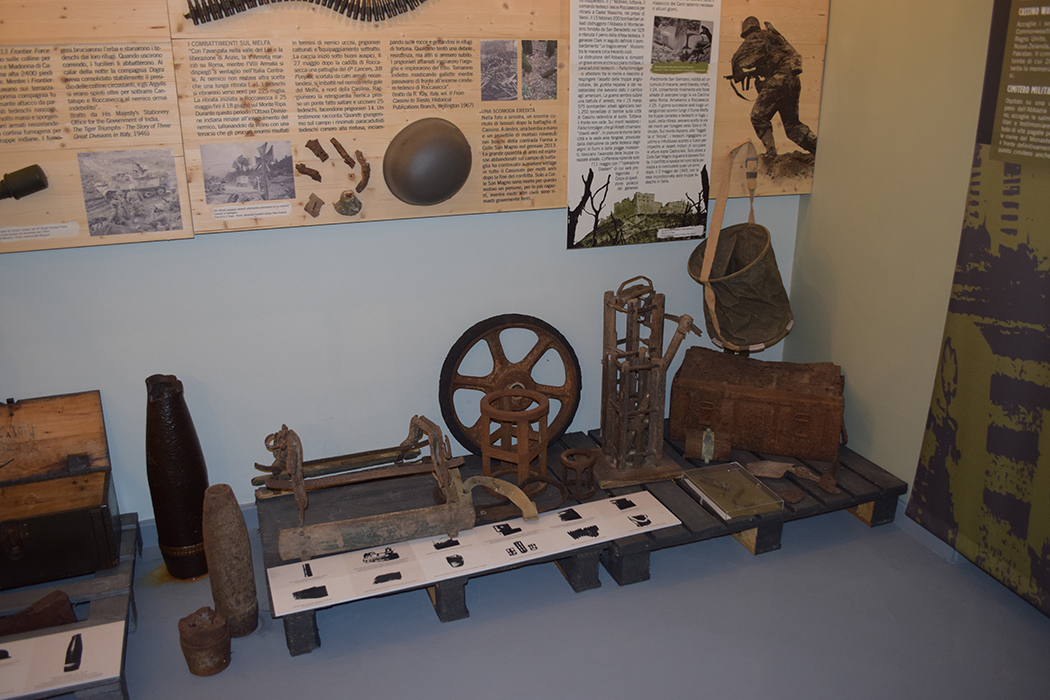
Colle San Magno. Living Museum of Memory

The Living Museum of Memory in Colle San Magno was opened in October 2013 in a former eighteenth-century convent.

The museum traces the experiences of the Second World War, through the memory and stories of the people who lived through it.

In fact, Colle San Magno hosted the German defence of the Cassino front for nine months: from October 1943 to May 1944.

The exhibition itinerary is divided into six rooms and reconstructs the war events starting from the direct testimony of the population, in audio and in video.

The museum displays objects and memorabilia spontaneously donated by the citizens.

On the ground floor, two rooms host temporary exhibitions. The Museum exhibits are also explained in English.
 

powered by social2s

The Historiale Museum in Cassino was inaugurated in 2004 on the occasion of the sixtieth anniversary of the Battle of Montecassino, to honour the fallen of all the nations of the Second World War.

Its layout was designed and produced by the creative genius of Carlo Rambaldi, the Oscar-winner for special effects in the movies King Kong, Alien and ET.

The itinerary takes the visitor through the most significant stages of Cassino: the evocation of the work of St. Benedict and the two world wars.

It shows the history of the bloodiest battles of World War II, the construction of the Gustav Line, the bombing of the Montecassino Abbey, military strategy, civilian witnesses, the rebirth of the area, and the strength to rebuild.
 

powered by social2s

Subscribe to Newsletter

Discover a territory through the emotions of the people that have lived it.