la ciociara

Sophia Loren is hardly part of an unknown Italy. This most famous Italian movie actress, with close to 100 appearances, also has the honour of being the subject (not just object) of adoration by men from all countries and walks of life from the relatively young to the aged who can still remember.

For many, Sophia Loren ranks as the perfect woman. And many understand in their hearts Sophia’s famous quote: “Sex appeal is fifty percent what you've got and fifty percent what people think you've got.”

So who is The Woman from Ciociaria? She started life as a book by Alberto Moravia in 1957 and then became a film directed by Vittorio De Sica and produced by Carlo Ponti in 1960, starring Sophia in which she played a widow in Ciociaria, towards the end of the second world war, trying to protect her daughter.

Not your classical sensual movie starring a beautiful lady, but a somewhat tragic and real to life movie in which our heroine proved her acting talents to the world. The film became the first non-English language production to be awarded an acting Oscar for Sophia’s performance. Yet nearly uniformly, English speakers do not know ‘La Ciociara’ – the film was retitled ambiguously ‘Two Women’ for American audiences.

Sophia Loren was the actress of choice for many movies starring the heroes of the silver screen, Cary Grant, Clark Gable, Marlon Brando etc etc etc. Her opportunities to find a lover on the screen seemed endless, yet it is granted that from the late 50’s her love life revolved nearly exclusively around Carlo Ponti. Did this reflect her Neapolitan heritage? It certainly wasn’t an arrangement driven by financial insecurity or lack of suitors and Sellers.

Sophia seems to be a pragmatist: “Everything you see I owe to spaghetti” is surely unnecessarily humble, as I know of no other southern Italian lady who can claim such success with this favourite repast and we hold her following quote to be a truism that she is proving: ”You have to be born a sex symbol. You don't become one. If you're born with it, you'll have it even when you're 100 years old”.

Certainly, Sophia’s view that: “A woman's dress should be like a barbed-wire fence: serving its purpose without obstructing the view” is a challenge that most men would have been thrilled to test with sensual wire cutters.

Sophia Loren showed her timeless permanence as an actress some 28 years after La Ciociara, when she starred as Cesira again in a television remake. Now just 82, the lady carries her age with magnificence and Sophia is a positive reflection of her declaration that:

“I've never tried to block out the memories of the past, even though some are painful. I don't understand people who hide from their past. Everything you live through helps to make you the person you are now.”
powered by social2s
Greek Common Good

NO !!! Enough!

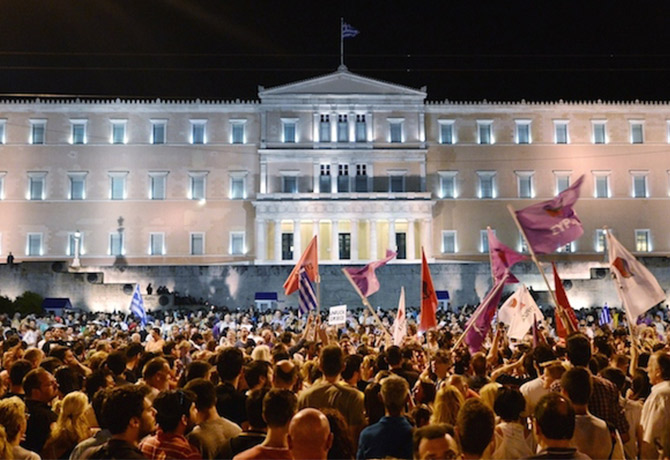
A cry from the souls of the people who invented democracy to the world that uses ‘democracy’ as a word to mean greed.

Is today the renaissance?

Is it the catalyst for another rebirth of the values of humanity?

Is it the first day of the end of the curse of fiscal greed?

Is it a day that all bankers dreaded? The thin edge of the wedge?

Who will follow?

It is for certain the first day of a chance for the little people to become important again, for their work to be valued, for them to no longer be fodder for the bankers, for us to recollect other renaissance events such as how the Medici valued the ordinary people.

The ordinary people have revolted at the ballot box. They must win this war against the corruption of the IMF, the ECB, the power oligarchies of the EU and the world of hidden agendas that lead to one thing - power through money and theft of birth rights.

Humane society is all that matters for the survival of the human race. A society that respects all people, shares with grace and without self-interest for a ’fair deal’ for all, protects our environment for our grandchildren and theirs beyond, thrills to the beauty of creation, supports artistic and technological endeavour, and debates differences without rancour.

We must not forget, the oligarchy of power does not respect human values – or even human life. We are but the cheapest of pawns in their game of domination.

It is not even chess, it is cruel monopoly where all the free squares are ‘Gaol’.

The gates of the prison are open. Do the people want to exit their cells and start a new life in an ancient land – renewed by democracy and resolve to create Greek Common Good.

powered by social2s
Sculptured Gold Exclusive Chess Set

Discovering Roberto Scardella’s exclusive chess set gold finished brought to mind the tale by Lewis Carroll, ‘Through the Looking Glass’, the story of Alice and the magic chess set.

I dreamed I heard words crying out from somewhere on the chess board as a sandy beach appeared:

"The time has come," the Walrus said,

"To talk of many things:

Of shoes and ships and sealing-wax

Of cabbages and kings;

And why the sea is boiling hot,

And whether pigs have wings."

The voices faded away as ‘The Walrus and the Carpenter’ drifted on down the beach, rhyming together about the joys of oysters and the consumption thereof.

This enigmatic poem is recited by Tweedledum and TweedleDee when they meet Alice on the square that she occupies as a white pawn, on the fourth row of the magic chess board, where she is seeking promotion to be a Queen (a common ambition of young women). Having been informed that she may be just a figment of the dream of the dormant Red King, and hearing that all the oysters had been eaten, she moves on without further ado to further adventures on the chess board.

Through the Looking Glass. Lewis Carroll immortalised in this tale the mind of a chess player in an exclusive chess set – a mind filled with wonder and creativity and a smattering of Jabberwockian madness in every move.

How is it that a game not invented by the Chinese but arising from Persian inventiveness and European refinement should attract so much verbal volubility and artistic interest? What sort of artistic mind is bent to sculpt beauty in the form of a chess set?

Roberto Scardella is one such sculptor, a man whose love comes with casting bronze and engraving; and whose happiness comes from the sculptured works in his hands. This exclusive chess set was firstly designed in the mind of this freelance sculptor,creating designs that bring metal to life – a Lewis Carroll of the sculpture world but without 'uffish thought' or 'eyes aflame'?

Each chess piece is cast in bronze by the ‘lost wax’ process. This method requiring intricate sculpting in wax, is from the sixth century BC, and the technique has been increasingly used in the production of bronze sculptures, the result of long and laborious manual work. After being cast, the pieces of this exclusive chess set were finished, always manually, by engraving and then underwent an electrolytic process that allowed the gilding and silvering, respectively, with 24 K gold and 100% silver. The chess board was made with a thick and rigid Plexiglass plate, laser engraved to create the dark squares (all 32 of them).

This exclusive chess set is part of Roberto Scardella’s sculpture series DeSaRtes, created at his Rome studios. It makes a wonderful present of elegance. Contact Energitismo for further details This email address is being protected from spambots. You need JavaScript enabled to view it.

powered by social2s
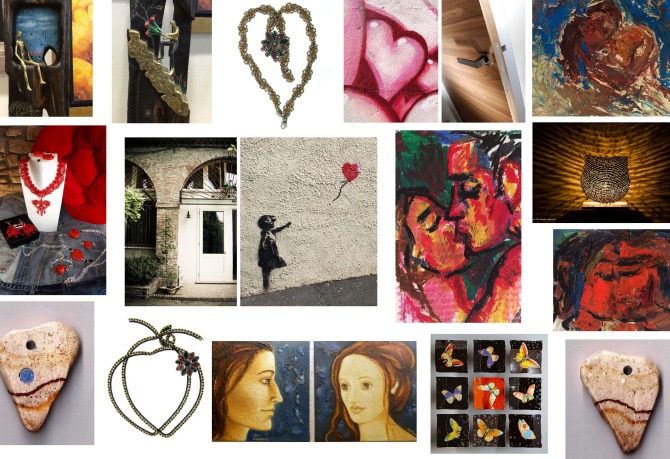
Saint Valentine and the birth and death of Love

The celebration of St Valentine’s day on February 14 is one of courtly love. The historical reality of St Valentine has some similarities to the reality of earthly love as there is some doubt that Valentine was one man, but possibly that two saintly men were martyred on this day from whom the name Valentine was generated.

It is to the English Chaucerian era that we must look for the creation of romance in connection with St Valentine. However, in that period, romance had its linkage with the concept of courtly love, a form of love that usually excluded connection of the flesh. The love of a lady at a distance seems to have left both parties in a state of unrequited passion, but gave authors and composers an open page for creation of romance in verse and song.

The gradual development of ‘Valentinian’ love into ‘Erotic’ love seems to have been associated with gifting that commenced in Victorian England. The connection of physical gifts, whether just heart shapes as became the norm for Valentine’s Day or more expensive trinkets of diamonds and gold, makes an obvious linkage with love of the flesh.

Yet after ‘Americanisation’ of Valentine’s Day created another world-wide gifting ‘spendfest’ parallelling Christmas and Easter, maybe it is to the Americans that we can turn for the opportunity to reduce the value of Valentine’s Day through that technique of marketing mastery – trivialization of the great.

And who but Marc Zuckerberg have we to thank for trivializing all emotions and human contacts. The glory of Facebook is that every pre-pubescent girl is sending hundreds of hearts, hugs and kisses to every second person who becomes a casual acquaintance - Facebook, where to win means maximizing the number of people who ‘love’ you. Facebook love, so easy to access, so prevalent for all, is just the opposite of true love and 180 degrees opposed to Valentinian love.

From an arithmetic viewpoint it must be challenging for a girl who sends 16 kisses one day to a new friend to know how many to send to her latest boyfriend, connected one week ago, and for each of them to know how to value those gargantuan commitments in the lifetime of heart swapping sponsored by Mr Zuckerberg’s behemoth.

 
powered by social2s
Pools and Hot Tubs

The didgeridoo is something more than a musical instrument and is surrounded by many legends and eons of history.

Created by the Australian Aborigines thousands of years ago (rock paintings have been found from 40,000 years ago depicting men with instruments in the mouth) its sound helps to achieve trance states. It is a door to The Time of Dreams - Dream Time.

With this background, didgeridoo players have a special relationship with their instrument and a few allow you to "re-invent” it. It takes a lot of love to intervene on the object of one's passion and make changes.

Marcello Bellardini is a man who deeply loves the didgeridoo and the Aboriginal culture and has found his way to spread this culture by personally creating these musical instruments.

His love was born in 2000 during a trip a year in Australia where he spent two months in the Maningrida community in contact with Aboriginal culture. When he returned to Italy, a piece of his heart was still tied to the traditions and culture represented by the Aboriginal didgeridoo.

He began to build his own instruments using Italian Eucalyptus trees (the Australian native tree, brought to this part of Italy about 100 years ago to dry up the swamps in Lazio, that is used to form the didgeridoo) from his area, Latina, working on the branches and trunks just like termites, i.e. emptying them slowly from the inside.

Then he began to teach music courses and seminars through his association Didj Italy. At that point he realized the difficulties of beginners in handling a tool so heavy and started to think of different solutions.

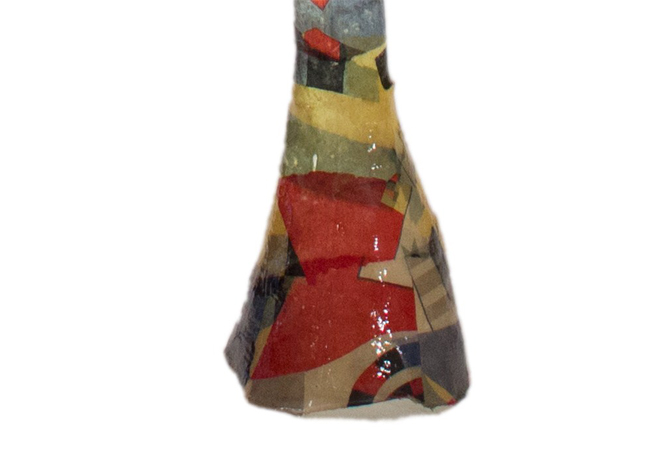
This is how the idea was born for instruments in translucent GRP, which are painted outside with various native designs. These didgeridoos can be easily lifted and are beautiful objects to display and collect in different designs, tones and shades.

They are particularly suited for musicians who perform on stage in a band with other instruments. Cultural contamination spreads the acceptance of the didgeridoo and music lovers can appreciate sounds like the blues by didgeridoo afficianado Florio Pozza.

For those wishing to enter the enchanted world of the Australian Aboriginal, without having to make a long trip to Australia, one good solution is to attend one of the courses and seminars by Marcello Bellardini and be guided by him through the door of Dreamtime.
 

powered by social2s
Savona overnight - paradoxes

We ventured into the restaurant for breakfast, all modern, floors shining like a hospital waiting room in Berlin, each table square without a cloth, one knife and fork outside a solitary napkin. Across to the right, carafes of different coloured juices with little advice as to their origin, ahead to the left a smattering of cut fruit and grapes.

Obviously we are late, condiments aplenty and a few rolls, but not a vast selection of interesting consumables for such a well-advertised quite new 4 star hotel on the rebuilt Savona pier. We took our selections of fruit, juice, green tea (after queuing patiently for hot water while others learned how to operate the café latte function) and a mini-croissant or two, captured a table and settled down for a quick nosh.

Outside to the right maybe 40 metres away stood another newish glass building about, the Savona standard, 6 levels high. My wife, looking at this unremarkable neat green glass building, exclaimed to attract my attention. I looked across and my gaze was drawn upwards. Above the building loomed a hulking yellow and black shape reminding me of a coloured Staypuft Marshmallow Man of Ghostbuster’s fame – surely it could not be dangerous.

Then concentrating on details I spied to the left, between this building and another, an even higher structure directly behind the building and realized that this was a Costa cruise ship lurking in the port to absorb thousands of last minute summer holiday seekers from around the world, many of whom must be our partners this morning at breakfast. Given the rate of food disposal observed at breakfast, the galley on board will have a challenging few days.

We had arrived in Savona after 10pm the previous evening on the ‘all stations’ Intercity from Rome, not one of Trenitalia’s more salubrious vessels, one where you stare at the tracks below when attending the toilet, and muse on the state of cleanliness of the tracks after a long weekend of festival revelling. Arriving at the hotel after 1030 pm we were in a rush to find a restaurant.

Yet a paradox of Savona waterside is that it has a plethora of virtually full cafes, discos and bars plus a few meat specialist eateries on the waterside. Maybe all the fish have flown to less noisy ports? Fortunately, in a side street we found a fish café whose chef was prepared to re-open the kitchen to serve us. We chose fried calamari and prawn appetizer, spada and bacala, plus a bottle of Soave and parted with less than €25.

Before sitting outside, the waitress informed us that she would not be serving us but would call us when the fish was ready as the café was only licensed for take away. Bemused, I borrowed her corkscrew and opened the wine, and Claudia, listened to the conversation with another recent guest, who was informed that the café would change to a meat bistro in October for 6 months and then revert to a fish café at Easter.

We shared the appetizer and varying quantities of Soave, that was excellent value, and we noticed that a large sign above the door tells us in blue on white that the café is named Sapore d’amare, Fish Grill. When our fish were ready, Claudia, in her normal investigative mode, sought explanations.

Apparently lovers of fish are summer souls, while meat eaters thrive in the wet months of winter, thereby allowing next season’s spade and perch to ’fatten up’ in the Med. But what about the sign and the name? It was then that the ‘penny dropped’ and Claudia realised that the name of the fish grill is Flavours of Love (amare) not Flavours of the Sea (mare).

So very soon, the oil in the kitchen will change, more vino rosso will be stocked and the nameplate will be replaced by a red one with the only word to change being to replace ‘Fish’ with ‘Meat’.

Very sustainable and economical!

powered by social2s
A Sculptor’s Panegyric on Ceramic Pangea

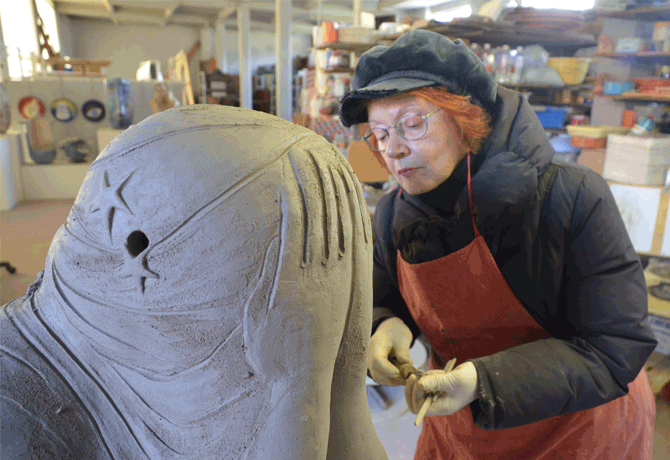
The art and sculpture of Luciana Bertorelli has evolved in grandeur of expression while maintaining a theme that has been within her throughout her artistic life – a theme of describing through her art the inner self of mankind, art that comes from her soul, art of the Ceramic Pangea.

Luciana expresses herself in sculpture with a variety of forming materials and techniques as well as different finishing materials such as glazes, slips and engobe. She has often applied Raku techniques involving quenching the work directly from red heat in a reducing atmosphere, a technique that yields sometimes surprising colours and textures depending on the surface coating.

Pangea, the name of the supercontinent, is derived from the two roots Pan and Gaia, in which Gaia means Mother Earth. Luciana started her affair with small Gaia (Pangea) where she developed her feeling for colour, shape and balance. The first grand Pangea was the Red Pangea (PANGEA ROSSA) which had a long pregnancy while Luciana grappled with the images coming in her mind until she understood that this project must be her panegyric, a dedication to Mother Earth, to Gaia.

The Red Ceramic Pangea is the smallest of six resultant grand Pangee and it is the model parent for the others. This figure is of a squatting mother with the bulk being below the waste who carries on her back a small child, Mankind, in a rucksack. She rests her elbows on her knees and her hands cover her face in an instinctive gesture of protection, or maybe withdrawal. The red colouration represents a paradox of both a cry of pain, the colour of blood and violence, contradicted by the power of Love.

Following display of this first grand Ceramic Pangea in Gubbio in 2013, Luciana was encouraged to complete her primordial Pangee series.

Fire Pangea carries a volcano on her back, emitting lava and red-hot ashes, symbolizing the immense riches contained in Earth’s depths: gold, silver, platinum, precious gems and perpetual heat; all stolen by Man without any consideration or respect. The colours of this Pangea change from black to ochre and gold.

Water Ceramic Pangea is a young woman who carries on her shoulders a large amphora in which her long hair falls forming a fluid cascade - the water, seas, rivers… in a series of turquoise, blue, and aqua greens. Her uplifted big toes suggest lightness and sensuality.

Rocky Ceramic Pangea is rosy, changing its colors as do the river stones, with faded reds and a patina of light moss. Her rucksack is bulging, filled with heavy rocks that form their own sculpture shape.

Floral Pangea has one of the hands over her face hidden by a flower that covers it almost completely. Her rucksack carries flowers and leaves that appear as carved in the stone, gently softened from the bright red and orange colors flashing on her surface and spread along her neck.

Air Pangea is the ultimate, dominating all the others in dimensions. Her legs and knees are closely joined; a tendency for upward movement is suggested by her head inclined toward her left. The feet are bigger, solidly resting on the ground. The hair chignon is wrapped in veils that hide the rustling from the many birds flowing out of the rucksack and perched on her.

Each Ceramic Pangea has a hole in each ears allowing observation of the play between the empty and solid spaces contained inside the works. The six Pangee are all in the same position, sitting with face covered and each carrying her own different aspect of the riches that Earth offers to mankind.

Luciana attests that the Pangee ensemble represents a scream of pain from Mother Earth: a scream that compels to be heard! Only a female artist could be able to understand the pain of Mother Earth.

To know more: www.lucianabertorelli.com

powered by social2s
Castelli - a pleasant search for art ceramics

You cannot find Castelli by accident, unless of course, you take the wrong turn about 20 times on the San Gabriele exit from the L’Aquila expressway east of Gran Sasso.

But if you do just happen to arrive at Castelli, you will have some pleasant surprises. The first is the magnificent hulking walls of Gran Sasso towering above you, like the black skirts of a Victorian dowager. The second are the remnants of clay mining that form the backdrop of the hill overlooking the town. The third is to see the town perched on a rock massif above a verdant valley.

And the fourth is the most interesting as, when you drive slowly around the multiplicity of bends and turns into the town piazza, apart from cafes, a few restaurants, a church and town administrative buildings, the only shops all sell local pottery, the famous art pottery of Castelli.

To understand Castelli and its ever-dwindling population, you need only to enter a bar or a pottery gallery and engage the owner in friendly banter. The ceramics and ceramic art of Castelli date back about 1000 years, and the gullies are what remains of the clay quarry of many centuries before. As with many artisanal towns, the artists grew in stature in the shadow or on top of the mine.

The population now is just over 1000 souls, most with clay coursing through their veins. There are a few remaining pottery producers yet, as in other centres in Italy, there are many painters and glazers testing their artistic skills. In the Saturdays of August every year, these artists exhibit their works everywhere along the main street, as soon as you turn the corner which leads from the village to the high mountains.

The shops "spring up like weeds" in different corners of the town: in its ancient "Ruve" on the main street or in the Piazza Rome, and one needs to venture in to realize the wide range of artistic styles that are modern Castelli. The styles reflect the different artistic interests of the family members, as all are involved in the generation of new ceramic art.

In Art & Décor we find a range of cubism inspired pottery painted with la donne nude; plates and ornaments each with a thick veil of crystalline glaze creating a crazed mist over the scene; traditional enamel-painted brick with the subjects of the 'second heaven' of San Donato.

Yet, for us the highlight experience is to view the traditional ceramic art of Castelli by Marco Carbone, art that could be on a canvas, art that allows no mistake in the artist’s portrayal of many figures in rustic and erotic scenes.

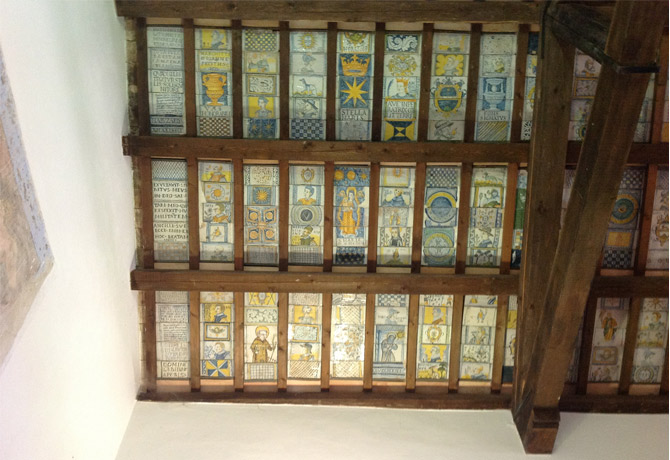
What keeps Castelli alive is the famous school of ceramics founded in 1906 and its associated museum. But the pride of Castelli is about 1 kilometre up the hill from town, a renaissance period church – San Donato - that 400 years ago was given its ‘second heaven’, a roof of glazed bricks, 800, many of them with a different scene, floral and geometric motsif, animals and portraits of people in many colours. Apparently, Carlo Levi was moved to describe this small ceiling as the ‘Sistine Chapel of Majolica’.

Castelli is a truly Italian rustic town. We found one restaurant, named after Iolanda, where the repast comprised all locally produced fare (and verdure from the owner’s private ‘orto’ – vegetable garden), and the home-made ‘rosato’ tempted one to abandon the drive home to Rome. We understood why one group of four had ventured from Tivoli to sample the lunchtime fare and atmosphere. Apparently, there are more restaurants of similar quality, all nearby.

Our summary, is that Castelli is a must for those who admire art pottery, it is in a magnificent lush location, lulled if I may say so, under the imposing north face of Monte Camicia , and its fare will sate the palate. So do not rush headlong through the Gran Sasso tunnel down to the Adriatic, slow down a little and venture off to spend a day, and a few euro, sampling the arts of Castelli.

powered by social2s

Subscribe to Newsletter

Discover a territory through the emotions of the people that have lived it.