
strega Befana
Which witch is the Befana Witch?

What is it that attracts mothers in Italy to the spirit of the Christmas witch, the Befana witch?

Why is it that so many mothers wrap themselves in a black shawl and, cackling at their offspring, present an image of an old hag, one whose femininity has been lost or destroyed by the ravages of time and an unhappy life. Is this the reality for aging motherhood in Italy, or is there some different story? Is it real or is it fake?

We visitors watch, as strangers, the habits and traditions of Christmas in Italy, and particularly of the womenfolk, the mothers. Maybe, it is the once in a year opportunity to laugh when disciplining the children, to give horrid little presents that let the ‘venom’ out in an acceptable way.

For 364 days of the year, mothers pretend that their children are the princes and princesses of fairyland and that the temper tantrums and bad behaviour of the children are solely representations of the failures of their fathers/husbands to provide a perfect family environment.

Then, for just one day, the mother, the Befana witch, can ‘dip her finger in the bile and share it with a smile’ casting a old stick or lumps of dark candy, representing coal, and bitter vegetables just to say that, ‘I am fed up – eat this’.

This is the joyous event of Epiphany the manifestation of divinity that has in Italy become the celebration of the Befana witch (shortened from Epifania) commencing on the night of January 5 before the feast the following day. The tradition declares that children will receive candy if they have been good all year (so there should be a dearth of candy) and coal if they have been bad (so the coal mines should re-open to meet the great demand from this festival).

The witch classically rides on a broomstick and is covered in soot from the chimney (just like Santa Claus who somehow manages to stay clean through this chimney entrance). It seems that the broomstick has two practical advantages, it is not just a means of travel from rooftop to rooftop, but also enables her to clean the floors of every house she visits, and this while also leaving the sock filled with ‘rewards’ for the children.

Yet it is a two-way street (one must not forget the power of the Befana witch), she is rewarded by the families, who traditionally leave out a glass of wine and a few local snacks.

It seems that Befana witch has a great tolerance for alcohol as she visits thousands of households and somehow still navigates her broomstick through the tortuous alleys of medieval (or is it evil) towns around the country. Fortunately the local police choose to turn a blind eye to any broomsticks that may exceed the speed limit or be seen flying in a dangerous manner.

One could view this gift for the mother (witch though she may be) from a different perspective; she has spent the year avoiding the sins of alcohol so often visited by her husband, brothers, father and their male friends, so finds an excuse to down a glass of grappa at the cost of a few candies and retain her righteousness.

Another outcome of this tradition of the Befana witch is the universal Italian preference for garlic and onion as taste sensations in most culinary creations. The Befana tradition calls for bitter vegetables such as garlic to be in every stocking of a child who has misbehaved. Obviously, every Befana gifted sock in Italy should be overflowing with garlic and onions that, of course, must be consumed by the child, and it appears to be habit forming.

We wait now for the 7th when normality returns and the little ‘brats’ become princesses and princes again in the dreams of their mothers. Oh for a year of Befana!

(This article is reproduced under licence from Energitismo Limited)
powered by social2s
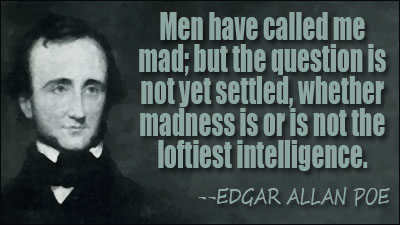
Edgar Allan Poe pithy sayings and more

Once upon a midnight dreary, while I pondered, weak and weary,
Over many a quaint and curious volume of forgotten lore—
While I nodded, nearly napping, suddenly there came a tapping,
As of someone gently rapping, rapping at my chamber door.
“Tis some visitor,” I muttered, “tapping at my chamber door—
 Only this and nothing more.”
So begins The Raven, the most famous of the poetry of Edgar Allan Poe, a poem of some 19 verses that flows a little like the bawdy Great Plenipotentiary collected by Robbie Burns sometime after the 1845 publishing of The Raven, though I also sensed a connection in song to the simpler verses of the Rhyme of the Ancient Mariner penned by Coleridge a few years earlier.
Yet Poe was much more than a poet in his 40 or so years spent mostly in the north east of USA. He invented the detective story ‘breathing life into it’. The Mystery Writers of America have named their awards for excellence the ‘Edgars’. Poe's work also influenced science fiction, particularly Jules Verne  who wrote a sequel to Poe's novel The Narrative of Arthur Gordon Pym of Nantucket called An Antarctic Mystery. To what extent the other great detective/mystery story writers such as Georges Simenon and Agatha Christie owe their tools of trade to the ‘toolbox’ created by Poe must await further study.
Edgar Allan Poe was born to Bostonian actor parents close to 210 years ago. His parents denied him a normal upbringing by firstly his father abandoning the family when Edgar was but a toddler, and then his mother thoughtlessly dying a year later within about 2 years of his entry into consciousness.
Leaving aside the boring problems of his youth with foster parents who blessed him with his moniker, somehow, Poe conceived that an income could be made as an author and literary critic. The acidity of some of his criticisms limited his attractiveness to journals that were themselves seeking to capture a broad audience. Meanwhile, possibly as a result of the early departure of his mother he had a passion for the fairer sex and eventually married his cousin, who was just 13 at the time, and who died of consumption within 10 years.
Poe himself died in Baltimore on October 7, 1849, at age 40; the cause of his death is unknown and has been attributed by persons of differing respect for his memory to alcohol, brain congestion, drugs (though he was not a drug addict as so many of his fellow poets of that period were), cholera, rabies, heart disease, suicide (though it took him several days to breath his last), tuberculosis, and just about anything else that eliminates immortality. Interestingly, for six decades, from 1949, every January 19, three roses and a bottle of cognac were placed on Poe's original grave marker by an unknown visitor affectionately referred to as the "Poe Toaster". Last appearance was in 2009. Even spirited mourners pass away.
Edgar Allan Poe had a touch of the genius, combining intellectuality and emotional creativity in his works. Eureka was a prose poem written in 1848, that included a cosmological theory that predated the Big Bang theory by 80 years, though it avoided some realities of Newtonian physics. In his spare time Poe was a cryptographer of some note
Should you scan a book of pithy sayings, the authorship by Edgar Allan Poe will appear regularly; a few I like are:
All that we see or seem is but a dream within a dream.
I became insane, with long intervals of horrible sanity.
They who dream by day are cognizant of many things which escape those who dream only by night.
I have great faith in fools; self-confidence my friends call it.
There are few cases in which mere popularity should be considered a proper test of merit; but the case of song-writing is, I think, one of the few.
Beauty of whatever kind, in its supreme development, invariably excites the sensitive soul to tears;
So I will leave you to your own search of the work of this Poe(t) with the final verse from The Raven, foreboding to the earthly departure of the soul of Edgar Allan Poe.
‘And the Raven, never flitting, still is sitting, still is sitting 
On the pallid bust of Pallas just above my chamber door; 
    And his eyes have all the seeming of a demon’s that is dreaming, 
    And the lamp-light o’er him streaming throws his shadow on the floor; 
And my soul from out that shadow that lies floating on the floor 
            Shall be lifted—nevermore!
(This article is reproduced under licence from Energitismo Limited)
powered by social2s

Subscribe to Newsletter

Discover a territory through the emotions of the people that have lived it.