Beautiful women

It is a hot summer afternoon at the beginning of August in Santorini. It is the middle of tourist season when all the young beautiful women parade up and down the Old Port road in Fira seeking ‘selfies’ on the escarpment overlooking the caldera.

While they have a penchant to expose most of their wonderfully tanned bodies, sometimes unfortunately garbed in semi-transparent sashes, inevitably their eyes are appropriately hidden by sunglasses, a seeming inversion of the Muslim dress custom.

I am sitting underneath the canvas awning of the Santorini Art Gallery near the Energitismo display of ’wearable sculpture for beautiful women’, wonderful artistic jewellery for all to admire from Ascione (Mediterranean Coral), Roberto Lanaro (Contemporary Steel and Copper), Roberto Perziano (Murano Glass) and Antonis Karakonstantakis (Stones of Mt Olympus), each to complement the epitome of femininity. We are consuming a wonderful fresh Santorini melon and sipping a fine grappa, imported from Veneto very recently.

I am considering the absolute limitations to assets – the true meaning of consumables – noting that, when I consume just two more portions of melon, it will be exhausted; and I wonder if there are any materials in the universe that are self-replenishing, totally sustainable. I ruminate that, of course, not even the sun can fulfil this specification, this wish for eternity.

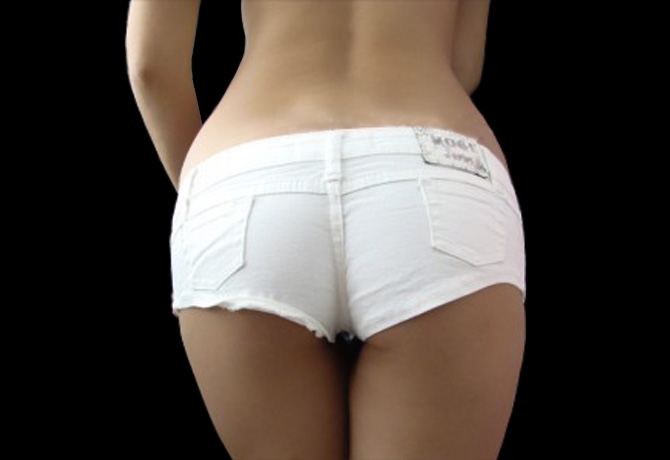
My attention is taken by a young couple who enter the forecourt. He, I am not sure, but she is a glorious specimen of young beautiful women at the peak of youthful femininity. She is wearing a white short top, flowing over and just below her breasts, and white lace ‘short shorts’, that accentuate the curves and suppleness of her derriere and related female assets to perfection. She walks with sensuality and confidence. I gaze wistfully at her with more than admiration at her fortune (and his). I comment to my associate concerning my recommendation that he admire the young lady, and he retorts that ’there are two others already admiring her’ and I reply, ‘there are now four’.

The spark then lights in my otherwise dimmed brain, and I realise that I have found the infinite resource. No matter how many people were to admire her, this lady can satisfy each one, thousand upon thousand, without even a word lost or a touch by her. Through her, admiration is an infinite resource, unlimited in its quantities of beholders.

In my geriatric reverie I return to eat the last piece of melon and lick the bottom of the grappa glass – a finite asset - and I settle back for eternity awaiting with pyrrhic hope another of the beautiful women to admire.
powered by social2s
Garfield Sobers, 80 not out

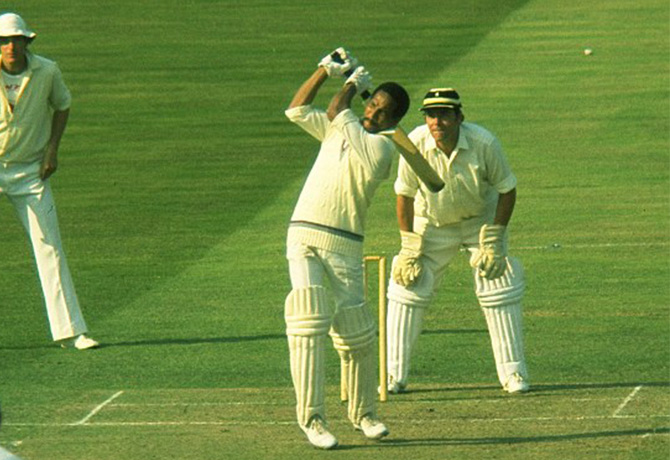
Garfield St Aubrun Sobers (nee 1936), Garfield Sobers, Garry (Gary) Sobers, Sir Garfield Sobers (1975) is now 80. A great innings which has left more happy memories for more cricket fans than probably any other cricketer.

Yet, most of his fans are over 60, but there are a lot of us out there. We are Australians, Barbadians, from all over the West Indies, British, Indian and from all the cricketing countries, even Pakistan against whom, as a young man in 1958, Garfield Sobers plundered 365 runs (NOT OUT).

Nevertheless there have been some discussions over which was his best cricket performance. Not having seen enough of them in the early-TV era and being limited to days on the hill at the SCG, Adelaide Oval and the MCG, maybe I accept Sir Donald Bradman’s edict that Gary Sobers’ 254 at the MCG for the Rest of The World team vs Australia in 1972 wins the Oscar, and this feat came somewhat late in his test career.

Garfield Sobers played with the statistician in every aspect of cricket. Undoubtedly, he was the greatest all-rounder in the history of cricket and was probably the foundation of the great era of West Indian cricket (not withstanding Frank Worrell). The tireless Wisden stats show 8032 test runs, at average close to 58, and 235 wickets at 34 each. Yet for the average man his six sixers in an over at the end of August 1968 for Notts in Swansea is the indelible memory.

The examination by Wisden for the greatest cricketers is exacting. Garfield Sobers won the annual award eight times, way ahead of everyone else but Sir Donald (10). In the final exam, Don Bradman was awarded 100%, Garfield Sobers got 90% and the best of the rest, all great cricketers, were awarded about 30%. A difficult test and one that only the finest two cricketers of all time could master.

Sir Garfield Sobers, a master artist of the game, a man who through his talent brought together art and sport, thanks for the memories from your grand innings.

powered by social2s
Le Tour - Un smorgasbord

At the end of the day in the flat lands of central Veneto, I sat sipping a lager and listening to the thunder rolling down from Montegrappa and wondering about my passion for Le Tour.

This is particularly relevant because over the past year or so other passions such as Formula1 have decayed in relation to my passing years.

What is it about Le Tour that, above even my new ‘home-town’ ciclismo event Le Giro, draws me to the TV nearly every afternoon as I justify abandoning my writing and editing in favour of watching 200 bicycles being propelled by helmeted gentlemen along recently resurfaced or dangerously unsurfaced roads and tracks of France and the flatlands of Europe.

I considered the history of the race from the perspective of an Antipodean. My first awareness of what has become known as Le Tour, came in, I believe, 1976 when I spent the summer in Europe, mainly in Paris, developing new generation batteries. Yet though I am aware of a few names from that period of French pride, my interest did not catalyse until our first star of Le Tour, Phil Anderson, won a stage in the early 80’s.

We welcomed the Hubert Opperman of the new generation, and began the 30 year wait of increasing excitement for an Australian winner of Le Tour - thanks Cadel, and then the Ozzie team Greenedge. So, the magnetism of Le Tour is our heroes, touchable and real, from all over the world. But can we keep it that way?

The early 80’s, those were the days of realisation of how much extra performance an athlete could achieve by ‘chemical enhancement’ yet we did not question whether any cyclists of the great races of Europe were affected by these new experiments in human physiology. Though, we had watched East German female athletes either exposing sufficient to prove their femininity and disguise the doping, or hiding enough to maybe disguise testicular development.

So, in hindsight we were not surprised when the ‘Berlin Wall’ of cycling came tumbling down a few years ago after many years of cracks and leaks and it was realised that more of the recent heroes of cycling may have ‘enhanced’ than didn’t. The excuse for enhancement was the need to face reality, and I still feel for the many young men drawn into that web – if you didn’t perform you missed out on contracts and titles.

The ones I particularly feel for are those who were pilloried for admitting while many more sat retired on the sidelines. So it won’t come as a surprise to know that I believe that the achievements of the testicularly limited Lance Armstrong, were still outstanding and that many have benefitted in their health from his misguided efforts.

It is also a conundrum to sit and consider what will be the next quirk of human physiological management that we will find and subsequently condemn our prime athletes for partaking therein.

Maybe there is a solution. Let’s add no more to the existing tests that measure the impact of chemical enhancement techniques already known, but let us set dietary rules just for the greatest race, Le Tour. I can suggest that for 4 weeks before Le Tour and during the event, every cyclist must consume solely local cuisine de France – a smorgasbord of:

jus d’orange ou de pamplemousse (300 ml), plusieurs croissants, du pain avec la beurre locale, escargots (douze), bouillabaisse (250 ml), caneton d’orange ou pied de cochon (une portion) ou peut-être le Chateaubriand, des pommes de terre à la vapeur, une portion des petits pois, du fromage Brie ou Chèvre, une demi-bouteille de vin (Francais), un petit portion de cognac, armagnac, benedictine ou chartreuse verte, une grande bouteille d’eau minerale (Evian).

The 200 competitors in Le Tour may not ride with such gay abandon and may need to meet more often the call of nature, but the French economy will receive a great agricultural boost in terms of product made and product recycled by the thousands of loyal fans copying their heroes; and the cyclists will be more cautious to avoid missing the opportunity for their evening repast.

powered by social2s
Omar Sharif

Memories Incomplete of Omar Sharif


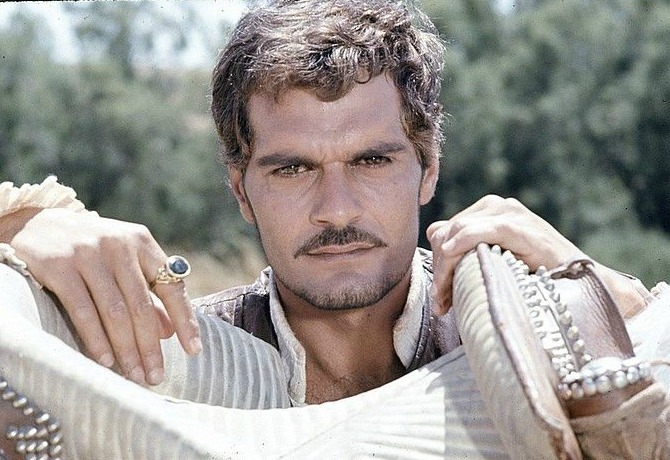
My first recollection of Omar Sharif was his role alongside Peter O’Toole in Lawrence of Arabia in the early 60’s. While the world applauded O’Toole as Lawrence, Sharif as the enigmatic Sharif Ali was the perfect foil and an equally wonderful performer – elegant and exotic, rifle at the ready, charging in from the desert on his dark bay horse (or was it a camel?).
This may have been the first sighting by most of the non-arabic film-going public of Omar Sharif, then in his early 30’s,but it certainly was not the last. The proud bearing and handsome features of Omar Sharif filled the screens in a number of leading roles. But the one I recall most after Sharif Ali was from the late 1960’s when my then girlfriend (and subsequent lovingly loyal first wife) and I thrilled to the movie Dr Zhivago, without realising in advance that the movie contained in its acting list a selection of the greatest film actors of the 20th century. The two faces I recall were those of Omar Sharif as Pasternak’s Dr Yuri Zhivago and the soft and beautiful features of Julie Christie.
The memories last of images of travel in the snow and desperate searches by Zhivago for his love in the streets, trains and stations of Russia. These images have lasted the nearly 50 years since, possibly because the wedding waltz we chose in May 1969 was the theme to Dr Zhivago – ‘Somewhere My Love’:
Somewhere, my love, there will be songs to sing
Although the snow covers the hopes of Spring
Somewhere a hill blossoms in green and gold
And there are dreams, all that your heart can hold
Someday we'll meet again, my love
Someday whenever the Spring breaks through
You'll come to me out of the long-ago
Warm as the wind, soft as the kiss of snow
Till then, my sweet, think of me now and then
Godspeed, my love, till you are mine again
Someday we'll meet again, my love
I said "someday whenever that Spring breaks through"
You'll come to me out of the long-ago
Warm as the wind, and as soft as the kiss of snow
Till then, my sweet, think of me now and then
Godspeed, my love, till you are mine again!
Vale!
(This article is published under licence from Energitismo Limited)
powered by social2s
Nine New Notes in Nove

On a fine balmy late spring afternoon, a Saturday towards the end of the Giro, you may find yourself in the piazza of Nove (36055), one of the Brenta towns in Veneto, downstream from Bassano del Grappa, and one known to pottery ‘afficionados’ for its artistic ceramics since over two centuries ago.

If you did not know this beforehand and had walked along the wide pathway from the far end of the street, opposite the museum of ceramics, you may have noticed a few artisanal shops, and particularly one containing bright coloured and entrepreneurially shaped ceramic art, created by Giuseppe Facchinello.

But maybe you came to Nove from direction of Rosa, over the Brenta at Cartigliano and on towards the town on your way to a chess game in Marostica, stopping at the traffic lights. Unsure what has been the attraction, you turn left and park. Opposite, you notice the Central Café with its tables in the street, and a few locals seated doing what Italians do. It is nearing six, close enough to justify a prosecco so you settle at a table and watch the world go by. You note that you had arrived at the centre of a large piazza yet Nove has no traditional piazza, but a large open space criss-crossed by two of the main provincial roads.

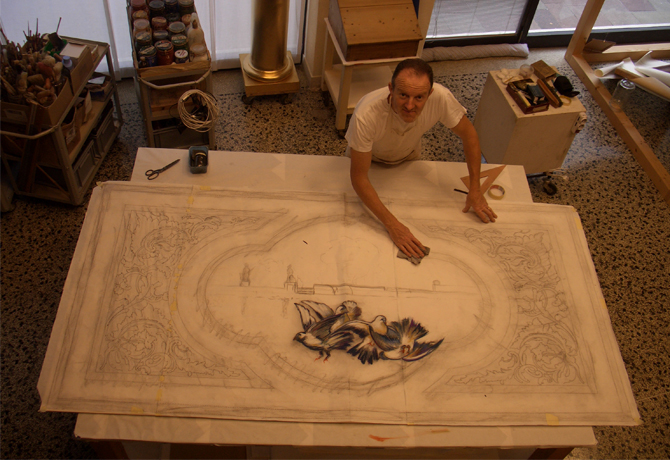
You greet and meet Giuseppe Facchinello, a fine artist though still a young man celebrating his birthday - Vente Nove – somehow appropriate. 

Staring somewhat blankly as you sip your prosecco and nibble on a cracker, you note that the elegant street lights in the piazza consist of three poles each with a stack of coloured ceramic bowls in between the poles, and you conclude that Nove is or was a ceramic town.

You see an unusual jug in a shop window to your left, very ornate but with holes all over the body so it could not hold much liquid or be used to pour prosecco. Your quizzical look attracts a local who says just two word: ‘Bossa Buffona’.

None the wiser but intrigued you continue your scan, past a magnificent blue fir tree still in its adolescence but rising well over 15 metres above the pavement. You note also a restaurant built virtually to the edge of the opposite corner, still shuttered so missing the late afternoon trade.

On the diagonal corner, as a large milk truck navigates the crossing, there is a bank of Marostica. Behind it is a grand oak tree in its late Spring verdant finery with a cumulus cloud bank swelling above it and threatening the peacefulness and false security of the recently acquired bank.

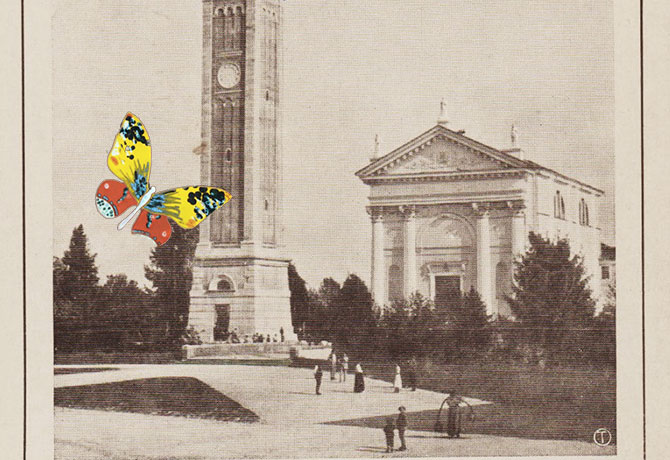
And now your eyes are drawn to the right upwards further into the sky as you find, directly opposite your cafe, on the edge of the square, a magnificent bell-tower. It is six and it starts to peal – loudly. The two largest of the bells visible near the top seem to be in a state of uncertainty as they turn nearly fully inverted before slowly falling back down to launch another note.

As we pop another cork, Giuseppe tells of his grandfather who, as a young man, after one or two beers one evening, climbed outside the bell-tower and walked around the cupola without any support except the grace of God and sure feet. It is not recorded how he descended, but he did live to have another beer. We wait for the evening peal to decline enjoying unheard words and the prosecco.

To the right of the base of the bell-tower is an unusual building, half hidden behind the well-loved firs, what the English may refer to as a Masonic Temple, yet it is a smaller version and I leave its purpose unchallenged settling back to listen to the evening birds and the continual chatter of the natives.

Nine notes on Nove.

(This article is published under licence from Energitismo Limited)
powered by social2s
A time to Live

For the amateur western cosmologist yet with time to live, there are (at least) two interesting and complementary verses in the Bible.
Genesis 1.1: When in the beginning God created the heavens and the earth, the earth was untamed and shapeless.
John 1.1: In the beginning was the Word and the word was with God and the word was God
Each of these statements refer to a unity, the moment of creation and neither of them refute Big Bang creation, they just deal with cause. Whether the word is ‘God’, ‘Om’ or even ’Bang’ is an intellectual exercise, though the rapid expansion of nothingness at unity into a universe may sound a lot more like Om than Bang, depending on how long it takes.
But the limitation of cosmology and religion is the ‘time to live’ before the ‘beginning’. Man’s attempts to describe the universe have always been plagued by mono dimensional time. The linearity of time as in ‘time to live’(as opposed to curved space and time) is a limitation of 4 dimensional thought - and being. If one can accept the viability and desirability of 5 dimensional being, time becomes two dimensional (planar) and, for a six dimensional being, it would become three dimensional. In both of these cases the nullity at unity disappears as it is just a point on another surface.
The beauty of a sine wave explains much in the physical universe from swallows to AC, and so it can in the parallel universe of time. In simplicity, for a four dimensional being, the beginning of a time to live may just be, for higher dimensional understanding, an inflexion point as time passes through another zero.
Similarly, the apparent continuing expansion of the universe has been considered analogically and simply to be just the expansion of a spherical surface, such as a balloon whereon points on the surface separate as the balloon expands to reach its elastic limit. Also simply, does the universe have an elastic limit at which point it begins to collapse to a new nullity? The expanding and contracting of the balloon when viewed in two dimensions may be seen as but a sinewave.
In this commentary, we will not attempt to describe the ‘breath of the universe ‘in the negative or unreal component as time passes once again through a zero.
A further satisfying thought is that of Aristotle that ‘Nature (or God) abhors a vacuum’ and similarly, nature abhors a continuum – of energy or matter. The universe is observedly, a discontinuous body of ‘black and white’, stars and blackholes, density and ’lightness’. Each is a necessary element for universal energy balance. It is with this in mind that we can consider the universe to have been inaptly termed.
So what is life, a time to live, but just an element of the discontinuous universe in which immortality (a continuum) cannot exist, and in which the energy is continuously transformed? Unless, of course, you subscribe to the view that God put us here to give the few the chance to ‘go through the eye of the needle’ and leap a dimension or two, but that is another philosophy.
(This article is published under licence from Energitismo Limited)
powered by social2s
Will to Change

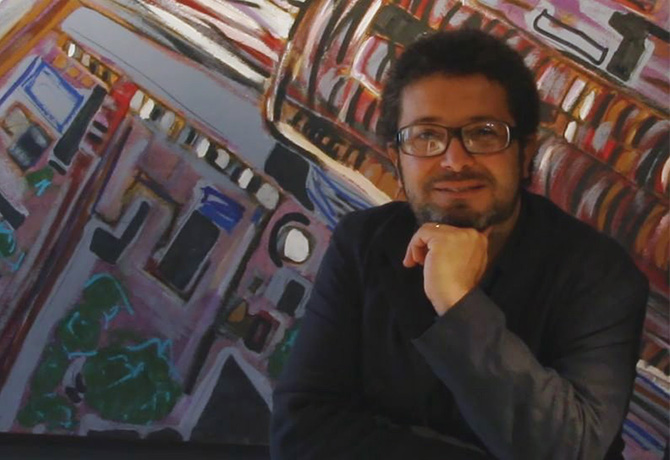
Everyone knows that to overcome periods of crisis and to succeed again there has to be a will to change, but not everyone can understand the direction of change: Claudio Ferri did.
Who listens? In the chaos of communication, which signals should we believe?
We went to Pesaro to find Claudio Ferri one of the few with sensitivity to pick up these signals. His family was among the founders of the famous brand Febal, which for years has been a world style brand for Italian kitchens and home furniture.
Claudio belongs to the second generation and was in charge of international marketing. He understood the effects of the global socio-economic crisis (GFC) and tried to change the strategy. But too many others had entrenched practices from the previous periods of growth and there was no will to change, so the family sold the business. Claudio began his search for a new approach to furniture.
Having realized that during a crisis people return to fundamental values, they return to their core and evaluate things with different parameters, 10 years ago Claudio’s will to change resulted in looking for particularly different furnishing products, in the border between craftsmanship, art and design.
His store "Primo Piano" is an apartment, appropriately on the first floor, in which people who want to furnish their homes are welcomed in a very warm and informal atmosphere, with enough time to observe each piece and the environ. His native ability to match the apparently incongruous excites the viewer.
After 10 years, now his customers are more demanding and begin to ask a lot of information about each piece, they want to be told the stories of those who have made the furniture and how it was conceived. They now have a will to change.
And it is at this point that the story of Claudio is intertwined with that of Energitismo. Energitismo commenced a few years later and perceived the need to focus on these values and started to tell the stories of the people who create with ‘love’: the people we call the "Treasures of Humanity".
The challenge is intriguing because the big brands are losing the charm of exclusivity and that charm exists in artisanal businesses run by people with interesting stories. The small providers have a great opportunity and this positive atmosphere we breathe every day in Energitismo where, in a short time, many of our stories have come to arouse interest from international media.
Meanwhile, Claudio Ferri, in Pesaro, has become a reference point for those who want to surround themselves with something special and unique.
(This article is published under licence from Energitismo Limited)
powered by social2s
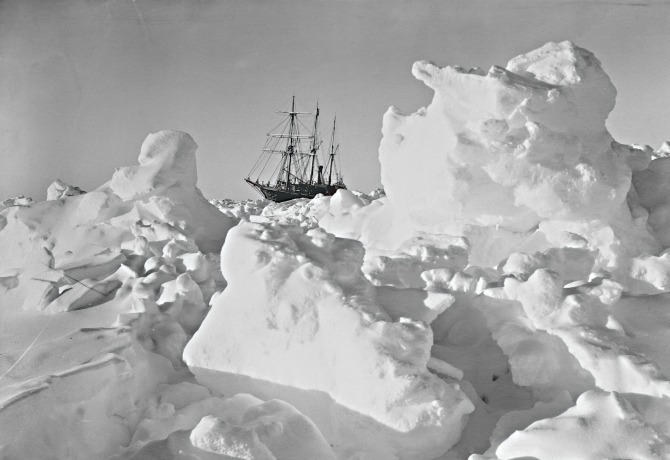
Shackleton - with his heart in the ice floes

In 1901 it is said that an advertisement appeared in The Times of London, possibly placed by Ernest Shackleton on behalf of his future Antarctic expedition leader, Robert Scott.

"Men wanted for hazardous journey. Small wages. Bitter cold. Long months of complete darkness. Constant danger. Safe return doubtful. Honour and recognition in case of success."

This ad seems to personify Shackleton’s life. Yet he did not die of misadventure as did most of the other great polar explorers, unless, of course, for Shackleton, failing to treat an overburdened heart could be termed misadventure.

Possibly, his wife and only legitimate lover, Emily, with whom he seems to have been lucky to have produced his only three children, judged the true love of Sir Ernest’s life when she instructed that Shackleton be buried far away from the arms of others on South Georgia Island, just a hop step and a jump away from the end of the earth – the cold end that is, and a place, at that time, solely inhabited by dead whales and lost Norwegians.

Earlier in his career when Ernest Shackleton was ‘shipping’ home from Capetown in 1903 after falling ill on a Scott expedition, he is said to have become smitten with a lady after whom he later (1908) named a mountain, Mount Hope, somewhere deep in the Antarctic, and his poetic strain left us two lines recording the apparent engagement of hearts (though this did not prevent him wedding Emily the following year).

The poem concludes:

‘Though the grip of the frost may be cruel and relentless its icy hold

Yet it knit our hearts together in that darkness stern and cold.’

Whether this is in memory of his lady Hope or a record of ‘mateship’ will never be known. Somewhat quaintly, Hope’s descendants refer to her as ’a bohemian woman’ so there could have been a strong reason for Shackleton to share a memory or two of the sea voyage back to England.

But, as is so true of the British tradition towards its explorers, Shackleton is remembered more for his exploits in the deep Antarctic waters than his many foibles on land.

There is little doubt that the conclusion by Shackleton was justified - that God walked with them when they walked across the frozen mountains of South Georgia from the south to the whaling station on the north to mount a rescue for his men, left stranded on Elephant Island some 800 miles away.

Having even reached South Georgia, after starting from the middle of nowhere in a small boat and navigating in the dark storms, was an amazing feat by Shackleton and his four companions .

And, of course, once God had decided that Shackleton was a good bet, He stayed with them until the rescue was complete. And then he waited patiently, until Sir Ernest returned to South Georgia, to take him as one of the immortals, leaving his men to follow his leadership for the rest of their lives.

(This article is published under licence from Energitismo Limited)
powered by social2s

Subscribe to Newsletter

Discover a territory through the emotions of the people that have lived it.