The Ozzie - You find them abounding Everywhere

Some species just cannot stay at home; everywhere, whether it be at the club, pub or in far flung corners of the planet, you’ll bump into an Ozzie kangaroo bounding around in the scrub.

It is a windy but sunny Sunday, late in May in what appears to be the dead heart of Sicily, just 30 km north of Caltagirone. It is late for ‘pranzo’ when, having driven up from Catania around the base of Etna, we wind our way up the hill of Piazza Armerina to the piazza to the side of the cathedral (securely locked) and seek repast in a café advertising its wares pleasantly in English.

There are but four people in the square, and less cars. We notice a sign on the opposite side of the piazza ’Art Hotel’, which interests Claudia.

While enjoying a local pasta con melanzane (the staple diet of this part of Sicily) and one or two glasses of a pleasant local white, washed down by multinational labelled acqua frizzante from San Giorgio di Bosco, near Padova, Claudia with her effervescent smile engaged the proprietor with her journalistic queries.

The town is renowned for Roman mosaics, and we collect a guidebook as our tutor. But, it is unfortunate that on this particular touristic day, the museo is closed – possibly a creeping disease in rural Italy. The Art Hotel is given a good review, and we declare our interest based on our pleasure with Nani’s creations at the Alexander in Pesaro, so we stroll over and find that the entrance is in the back while near the sign is only the entrance to a bar.

The hotel manager is friendly and offers to show us two rooms, the furnishings are modern and ‘memorable’ and in each room there is written the ominous message ’nessun dorma’, but yet no sound from a tenor. We are passed at the lift by a guest with his large suitcase.

Downstairs again, while reminiscing with the manager on promotion of what is a distinctly original contribution to hotels of Italy, we are met once again by the 60’ish guest who more plaintively inquires whether anyone can speak English as he cannot make his air conditioner work.

The Ozzie drawl is obvious. While negotiating reduction of his distress I ponder how strange it is to meet a compatriot in this far-flung most non-obvious residence. Our Ozzie Kangaroo guest, the

Australian tourist, hopped out the door on his way to explore.

With a smile we depart and noting just one couple when we return to the square we drive to our agriturismo, a villa once of the medieval ruling lord of this town. We check in finding the reception area quite full with guests ‘having tea’, and are informed that every single one of them condensed here from Australia, each one an unmistakable Ozzie.

I blanche slightly, and escape to our rooms. Later we come down to check the Giro on the reception TV and learn that one group of four retired Sydney-siders just happened to stop here for a night between Sicilian ports. They sat there quietly listening to the Monaco F1 Grand Prix on laptops. Later we chat about Crows Nest restaurants and they bemoan the poor taste of another Ozzie tourist group who were in an adjacent room.

It appears that we can’t even get on with each other when 10,000 miles from home. That sole evening in Piazza Armerina, we took the ‘pension’ and shared dinner tables with a Taswegian Ozzie and his grown-up son.

The father lived the ideal life – summer in Europe and summer in Tasmania, while his son waxed and waned between Nepal and Indonesia when not skiing in France – school language classes can certainly influence your choices in life. We talked politics without drawing swords and following a few reds drifted off to listen to the night birds.


I wondered whether these meetings were just an example of that Adamsian chance from Hitchhiker’s Guide or whether there is something more Machiavelian in the control exercised by Booking.com over travel destinations for the Ozzie.

The possibilities are boundless. And Sicily wins the Ozzie vote.

 
powered by social2s
Where there is Life

You stand in the Piazza di Popolo in Pesaro, it is near Christmas, cold but not bitter, the sun has set and shop owners are wondering whether there is a life before the rush for an aperitif and, away from the loneliness of the shop, an accord at the bar with friends and allies in this desperate toil of retail business.

Where are the art stores, where can I buy some Rossiniana?

Directed down Via XI Settembre, we wander left and right, charmed by a lone saxophonist, well past 60, still creating exquisite tones in the cool of the evening, or is that coming from his recording? Ten minutes go by and we have passed bars and shops on the left and right, and come to the Pescheria Gallery, closed as are all the art centres of Pesaro.

What to do?

We turn back towards the Piazza and choose a bar with ‘antagonistic’ colour selection half way back to the piazza, on the left. But it feels friendly. The manager, and only apparent employee of this modern bar notes our request for ‘negroni’ and red wine and we sit near the entrance. A lady with a ‘dog-getta’ (little dog), dressed for the opera, sits two tables away to our left. Business seems to be slow. But the aperitifs are tasty and the bar is warm.

We watch the changing of the guard as two elderly well dressed men enter, share a beer and a wine, and sit at the table to our right.

We order a wine or two more and accept the mini-pizza nibbles. The bar manager is approached by a lady who reminds him of his duty to provide drinks and aperitifs to a shop opposite. While he fulfils his obligation with pleasure, one of the ‘old gentlemen’ leans over the bar and selects a ‘crostatina’ or two for his private enjoyment. Noting that we watched him with unbridled amusement he enters our space and engages us in conversation.

He is anonymous, a silver haired gent from Pesaro, descending on the bar at his designated hour. We discuss Pesaro, Urbino, Marche, Italy and the galaxy, but fail to find a solution to the travails of being an Italian in Italy. His partner sparks – he was from Calabria, and even in his dotage, he presents a good legal case – possibly solely to protect his voluble partner. They smile and they joke. Mischievous, but good natured, they toy with the bar manager, picking and poking at the patisseries of the day, the chocolates and sweets.

As night falls, reckoning time comes and the Hyde becomes Jeckyll, with a negotiation or two on a fair (or unfair) price. Yet, the game must close for the day, the players must return to the fold of boring wives and RAI TV and, to our joy, we find that these sinners we have shared a sip or two with are none other than the previous directors of the good health and wealth of this fine city.

And we are still looking for Rossiniana or even a sign of Rossini in the air.

powered by social2s
The Fate of Recreation - Asolo or bust

Do not dwell on yesterday’s resorts, on the trumped up pleasure domes of the 60’s or 70’s, look today at what is happening to the desperate few such as Asolo in Italian heritage towns.

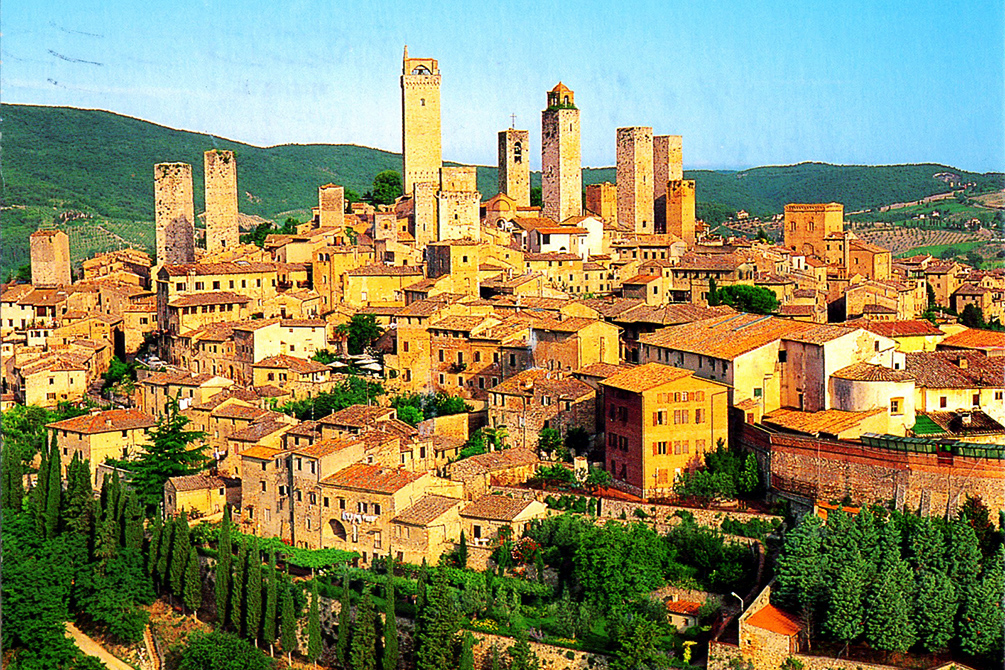
San Gimignano is in every Tuscan tourist guide as a ‘must visit’, and the first time I went there in early summer, it was just that, wine tastings among the towers, artisan shops open late, hotels booming, music in the piazzas, good fare, and late nights for the young in body.

I returned in the cold of early spring to find the town deserted, the towers looking sad and quite unimpressive, only one ceramic shop and one restaurant in the whole town open – we walked the length and breadth to prove this.

Few people trod the stone pavements and, you could park near the town gates – a blessing that was not matched by the joys of the town. How could I explain to my doubting son who I had dragged here from the comforts of music and beer, that this was one of the great towns of Italy. ‘It’s OK, Dad, I understand’.

Asolo, is spoken of as the most beautiful walled town of Italy, tucked away above Treviso at the foothills of the Grappa mountain chain. It is just before Christmas, a Friday at lunch. We deign to risk driving into the square and immediately find a parking space in a crowded park, empty of any people.

We look around and admire the buildings and church tower, and gaze a little longer on the Albergo al Sole with its pale pink and beige façade, dressed up with nowhere to go. Selecting an eatery is not too difficult as Asolo consists of clothing stores, a few jewellers and many restaurants, all ready for the Christmas rush. On the left of the square, you can follow the road and in a few minutes circumnavigate an old shopping and restaurant block.

I led this survey and apart from the inevitable ‘Liquidation’ signs and possibly three shopkeepers, we spied nobody except three locals, dressed for a meeting, standing near a beer seller. On returning to the square, we decided to seek the comfort of a restaurant serving ‘bollito’ and found to our somewhat joy and surprise, a restauranteur who was excited by his menu and by having the drippings of humanity share lunch with him.

Apparently we started a rush as during the next hour three other groups entered and, smelling our repasts of Baccalà – stockfish - (for her) and specially simmered ‘bollito’ (for him), decided to stay.

I dare to say that if these two towns, Asolo and San Giminiano had been of equal size and somewhere else in Italy, without any renown or expectation, the piazza and walkways would have streamed with the to-ings and fro-ings of the populace. We may also have found great Baccalà and bollito, and a splashing of local wine.

powered by social2s
Pesciolini - A Sprat to Catch a Mackerel

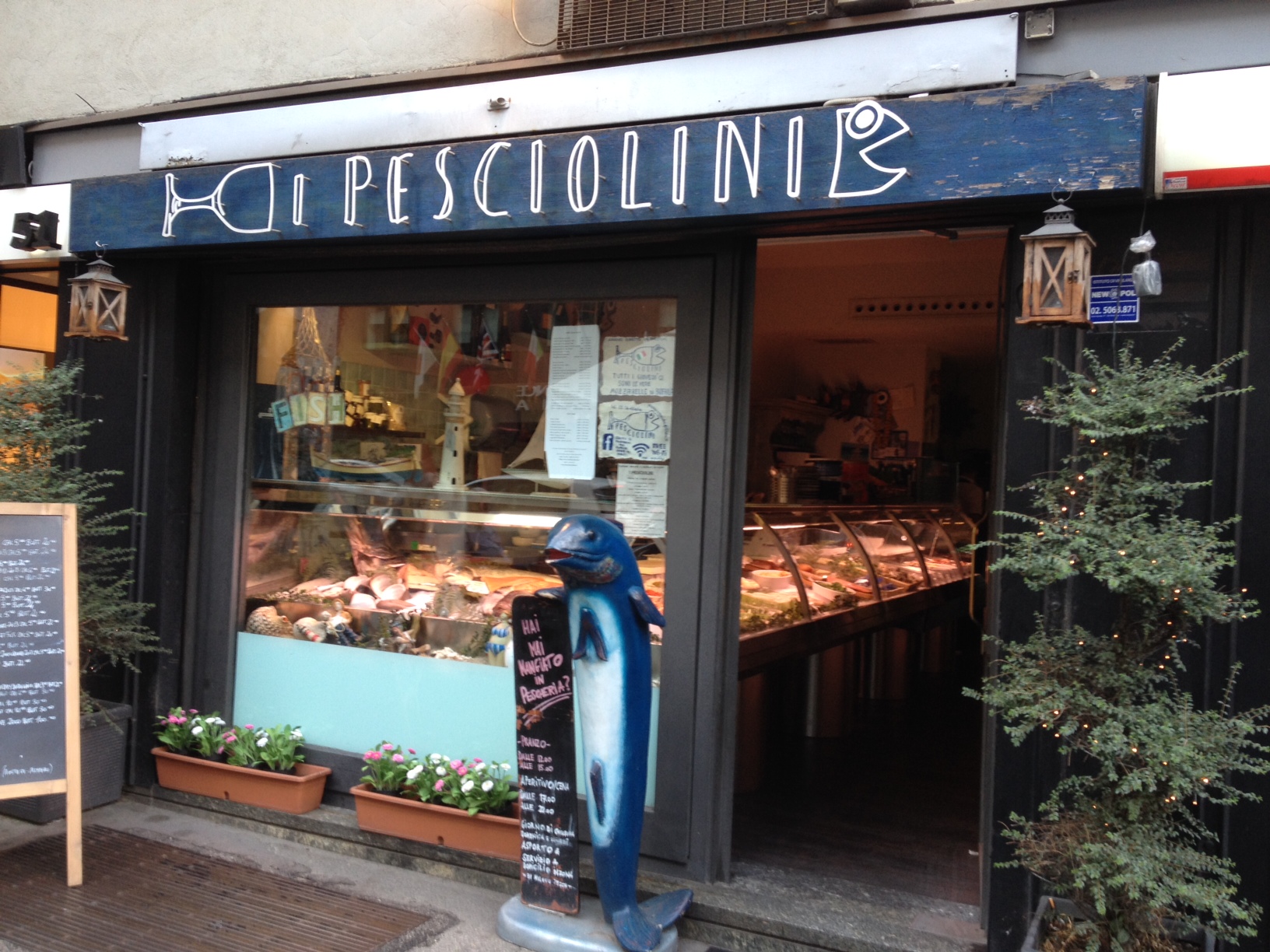
A “pesciolino” to the English is a minnow, traditionally a small carp used as bait to catch a bigger fish. The bait in the case of the Milanese restaurant, Pesciolini, is exquisite fruits de la mer - tartare, grilled or fried that capture the unwary traveller strolling through the ‘waters’ of Milan.

And just as a school of fish will return to their favourite feeding grounds around living reefs and wrecks, so, once captured, fed, unhooked and released to swim again, your fine diner is certain to seek out the reef of Pesciolini again, hidden between the larger structures of the city of Milan.

On our recent sojourn in the Milano, we returned to the Romana Residence and, without testing our room, crossed the tram-lines to find an early evening table on the footpath in front of the narrow shop entrance that barely is large enough for the swimming ‘Pesciolini’ sign.

It was fortunate that we did arrive before dusk as we gained the last unreserved table at their ‘reef’. After gazing at the “spada” and smaller fresh fish in the front window, we navigated inside past the unopened oysters usually, but not tonight, the delicacy of my better half, to the salads de la mer with traditional accompaniments from Sardinia and Sicily and up the Tyrrhenian coastline and the Adriatic coast to Veneto.

With a deal of uncertainty we settle on a pinot grigio from Friuli to assist the selection process. It was surprisingly sweet compared to similar labels, but finely balanced, enough to help the choice of a tartare selection that was based on spada, salmon and tuna, each balanced with the chef’s selection of salad vegetables, herbs and spices – and each competing for flavour with the others, and each presented with a smile and some fun by Daniele our Friulian waiter.

The details of the secondi selections of grigliata and gamberoni will remain a Pesciolini secret, except to the extent that were blended with the second bottle of the Pinot Grigio which was sipped and quaffed as we watched the patient couples waiting for us to vacate so that they could sate their aroma sensations with their taste buds –a true pavlovian experience. But not yet. There is for this traveller just one dolce, and yes there is a god, it is the only dolce served in this fine ‘fish shop’, Sorbetto Limone con Vodka.

After this eulogy on the joys of dining at Pesciolini, you may be disappointed because I do not intend to tell you where it is. If you are a true searcher you may find the ‘little fish shop’, but hopefully not too soon as the regulars appear to like their little secret, and I don’t like standing watching others in succulent rhapsody while awaiting my turn at the reef.

powered by social2s
The Art Palace of Pesaro

Pesaro is known internationally for two men. One was a magnificent composer of brilliant rhythmic operatic works, and he is celebrated for the month of August each year, Gioachino Rossini, the first jazz composer, his Messa di Gloria from 1820. The other has been celebrated much more recently in another discipline where sound and rhythm are also essential features, Moto, and he is Valentino Rossi (just ‘ni’ short of a great composer).

The beach of Pesaro in summer is still an army of ‘companies’ of umbrellas, all regaled in their captain’s colours, row upon row from the walkway to the sea. Hotels appear full, still with a mixture of Russian, German and English plus a smattering of native Italian dialects. Restaurants serve a smorgasbord of tastes till late and the sound of parties drifts through the night.

But if you are to find yourself at the Rocca Costanza at any time of the year but full summer and you stroll down Viale Giuseppe Verdi towards the beach, coming to Viale Trieste, you look left and right and hardly a person blocks your view. For Italians who came here 30 years ago as children for summer vacation or as young adults chasing the disco craze, you have returned to a ‘ghost town’.

Turn right towards the south, stroll past the bank of hotels, closed after the season, or boarded up permanently. Occasionally a bar or hotel struggles to breathe life into the street, but for whom? Tourists have deserted Pesaro as they did desert Atlantic City in the ‘70s before the casino resurrection.

Eventually you approach the end of the road on this your stroll through ‘memory lane’. And there on your left you find a white Taj, a hotel with a sculpted tower out front, near the entrance, and a name ‘Alexander’.

What is this English name representing?

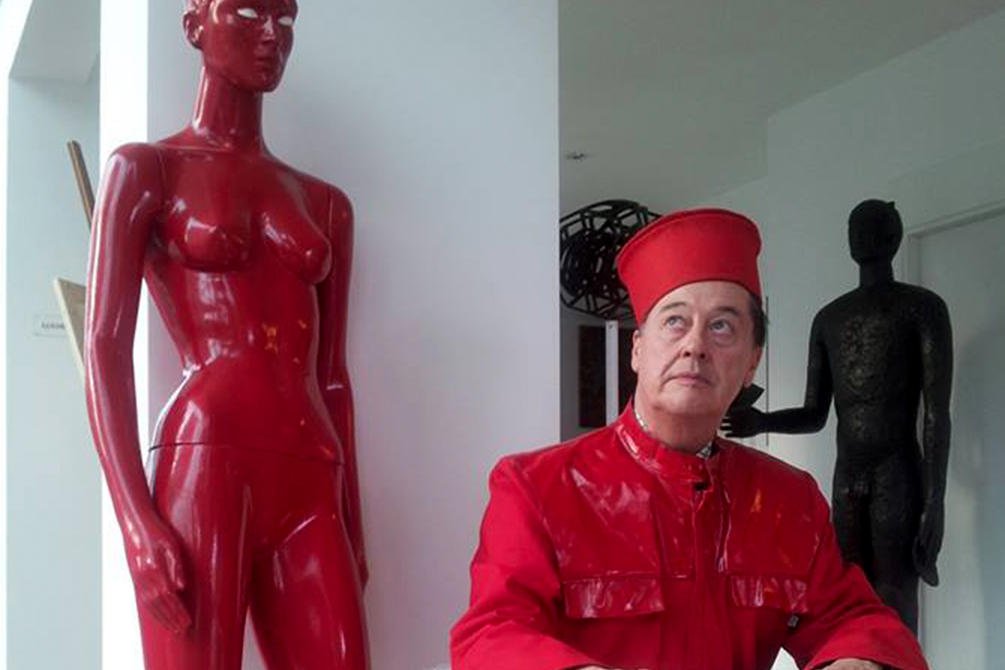
Look behind the tower and you see rank upon rank of red soldiers. The Hotel Alexander attracts attention. Look into the white foyer and past to the open lounge and dining area, and your eyes are captured, not by one but by dozens of works of art, all from different artists. Walk around this area and find a cabinet filled with books and small works of art and photos, all by Nani, Alessandro (Alexander) Marcucci Pinoli di Valfesina, il Conte Nani.

Who is this man? What is this hotel? If you are fortunate enough to arrive in the morning, you may meet an elegant man seated over a cup of tea, reading. Ask at the desk for an introduction to the creator of this wonderful museum that is also a hotel.

A short time with ‘il Conte’ and you are thrilled by the intense eyes and rollicking sense of fun, as well as a devotion to art and the environment. Stay a while, one or more nights, select a room – every one is a different work of art created as a unique piece by an artist selected by Nani.

Come afternoon, you may sit near the windows overlooking the sea and dream until dinner, a delight of culinary excellence. A glass or two of wine and then watch the stars over the sea before drifting to sleep wondering whether this is reality or just a dream.

Thanks to Nani, il Conte Alessandro Marcucci di Valfesina, you have spent a day alive in the art palace of Pesaro, the rebirth of Pesaro – il Rinascita dell’ Arte e del buon arte. Rossini would have been proud.

powered by social2s
At the Table of the Count

As you enter the foyer of the restaurant of the Alexander Palace Museum Hotel you see in front of you a table with a small card sign ‘Conte e Contessa’. Over in the back, one or two couples and a single businessman sit enjoying their repasts, talking quietly.

The dining room is soft and the music non-intrusive this Christmas period, with John Lennon’s ‘The war is over’ tribute reminding us of what Christmas could be. Seated at that first table are an elegant elderly couple, quiet and self assured. She is a grey haired lady, long soft hair. She wears possibly a cashmere gown of muted colours, reminding one of Monet watercolours. And she portrays an enigmatic smile, understanding of the reality surrounding her, and reminding us of what Leonardo may have wished to portray.

You pass your glance to the man, dark haired with intense eyes, full of spirit and challenge. He wears a checked beige shirt, a light blue and Carmen red striped tie and an indigo velvet jacket. His trousers and shoes are hidden below the table, but you can suspect a further challenge of style. He is an image from a forgotten generation or is he portraying a future life? He wears a small gold ring on his lapel.

You watch as the lady slowly selects sectors of mandarins, picks single grapes from the bunch, and slices small pieces of pear for her taste. He pours tea from a small pot into a whisky glass and sips slowly as if savouring a single malt. A nearly empty red wine glass stands nearby.

They welcome you to the table and to the restaurant of the Hotel Alexander Museum Palace, one of the more amazing hotels in the world, not attempting to be renowned for luxury, though every aspect meets a high standard, but for artistic elegance and environmental sustainability. As well as being a museum of contemporary art where every room is its own work of art, the Alexander Palace provides a wonderful table, without pretense but with taste to sate a demanding palate.

And who have you met?

Il Conte Marcucci di Valfesina, Alessandro (or Nani) and his partner and wife, Paula, la contessa. If you are fortunate, you may be offered the time to listen to their tales of creating and sustaining elegance such as the Alexander Palace in Pesaro/Urbino and of their 12 strong family. Listen carefully, as you will find few people in life who have devoted themselves more fully to artistic creation and the environment.

In among the stories of toil and pain watch out for poems, and lyrical jokes that reflect the spirit and lineage of ‘il Conte’ and his family. Ask about “The Patch”, you will not forget this visitto the Alexander Palace Museum Hotel.


(This article is reproduced under licence from Energitismo Limited)


powered by social2s
Benny Hill and Angels boobs and butts

As a percentage of the world’s population, there are not many of us who have been fortunate enough to be brought up on a diet of British comedy from the 1950s through to the end of the 20th century, and nearly all of us who have, and who are still standing, are on the slippery slide of the road to geriatricity, that greying form of non-renewable energy. And we have something else in common, we nearly all lived through the era of television and The Benny Hill Show.

Alfred Hawthorn Hill, born on 21 January, like many show business greats (and probably millions of unknown aficianados of the stage), adopted a stage name: Benny, in honour of his hero of comedy, Jack Benny. Benny Hill instilled in the permanent memories of the maybe millions of men who have been captured by his humour, the chase (or run-off) and with it ‘The Benny Hill Theme’, otherwise known as Yakety Sax by Boots Randolph.

Of the three means to be successful in advertising and show business: sex, drugs and rock&roll, Benny Hill concentrated on the bawdy, bringing music hall and slapstick into the late 20th century with Hill’s Angels, scantily clad voluptuous women.  Not surprisingly, virtually none of our many wives were as impressed by the show and particularly our avid appreciation of it – but maybe my memory is playing tricks – and that is all I recall. Let’s hear from Benny:

I’m not against half naked girls – not as often as I’d like to be.

Girls are like pianos. When they’re not upright, they’re grand.

Benny Hill never married, despite his attractor – wealth. The two ladies to whom he offered that status, declined his invitation.

Why would I make one woman so miserable when I can make so many women very happy?

I guess that he sought praise – nearly every skit involved Benny as the central character. But was that just because his ‘characters’ were so good. I’m the one who gets the laughs.

Ego or reality? That’s what show business is, sincere insincerity.

For some sketches he even made us think.

Just because nobody complains doesn’t mean all parachutes are perfect.

But like many comedians he lived alone, and so he died at the age of 68.

What was his real love?

I thought I couldn’t afford to take her out and smoke as well. So I gave up cigarettes. Then I took her out and one day I looked at her and thought: ‘Oh well,’ and

I went back to smoking again, and that was better.

Live each day as if it were your last…because one day, you’ll be right!

powered by social2s
George Burns in his own words

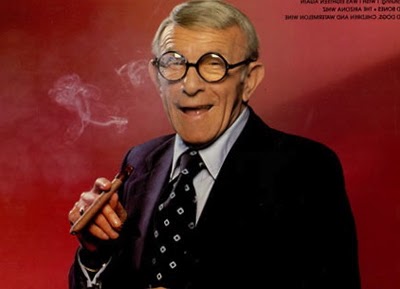
It is 20th January, over 120 years since Nathan Birnbaum was born. Since Jewish boys must become composers or violinists, Nathan (Nattie to his mum) at some stage decided to become George, George Burns. Just over 100 years later, in 1996, George left to spend eternity with Gracie. What better way to celebrate his birthday than to quote a few lines from the script of his life.

Every day of his life George Burns was getting older but he didn’t ever get old. If you live to be one hundred, you've got it made. Very few people die past that age.

Nevertheless, there were some realities that even a stand-up comic had to accept. Sex at age 90 is like trying to shoot pool with a rope. To balance this physical catastrophe George’s optimism was ever present.

I look to the future because that's where I'm going to spend the rest of my life.

George Burns smoked cigars. One compatriot estimated that Burns had supported the tobacco industry to a total of about 300,000 cigars in his 100 years. Happiness?

A good cigar, a good meal, a good cigar and a good woman - or a bad woman; it depends on how much happiness you can handle. But what about a good drink? It takes only one drink to get me drunk. The trouble is, I can't remember if it's the thirteenth or the fourteenth.

George Burns had two careers: the first with Gracie Allen (say goodnight, Gracie) and the second starting with the movie, The Sunshine Boys, for which he received the Oscar for the Best Supporting Actor when he was 80. This was followed by a trilogy of ‘Oh, God!’ movies with George Burns playing an unforgettable Almighty. Acting is all about honesty. If you can fake that, you've got it made.

As an actor who loved his profession he sought to get the best laugh from his audience and as such he was a grand success. I'd rather be a failure at something I love than a success at something I hate.

And on the subject of business activity - Don’t stay in bed unless you can make money in bed.

What about politics? Too bad that all the people who know how to run the country are busy driving taxicabs and cutting hair.

George Burns lived to the full with just a touch of the ironic, though always laughing at himself. Happiness is having a large, loving, caring, close-knit family in another city and when I was a boy the Dead Sea was just sick.

His philosophy was poignant and dripped with reality. He had near perfect timing. The secret of a good sermon is to have a good beginning and a good ending, then having the two as close together as possible.

George Burns, whose lines are immortal.

powered by social2s

Subscribe to Newsletter

Discover a territory through the emotions of the people that have lived it.