Paris Hilton & Art

Much has been written and even more images taken of Paris Hilton. Nearly all are, to the great pleasure of the male of the species, devoted to what she achieves in undress and ’fashion’ than in any other form of human activity.

While we understand that exhibitionism is a natural activity of a sexually alert human, and that the male strongly encourages this trend in the female, it becomes difficult to isolate libido when attempting to appreciate art.

The question remains, is Paris Hilton Art?

In Energitismo, we seek the combination of technology and art. Of course, many would propose that Paris Hilton is a work of art, but how can we judge this without personal intervention?

It is said that art sets its own price and cannot be measured like a commodity. On the other side of the coin, art is in the eye of the beholder. In the first instance, given that the appearance fee for Paris Hilton is reputed to be $300,000 per event, there is no argument about her price not matching that of a commodity.

In the second instance, the eye of the beholder may be confused by sexual predilection or input from other senses or even, in the case of some ladies, bias. So we need a more objective tool for assessment.


If Paris Hilton is a work of art, to which category does she belong? Surely not Contemporary as this style decries natural beauty – and there is no doubt that Paris Hilton fulfils the requirement for beauty – uniform lines and matching assets, whether one views the eyes, breasts or buttocks.

No doubt that she is not Cubist or even Impressionist, yet. Paris Hilton, for some, may appear Classical, but she fails the test of an opulent figure. To the same degree, despite her height, she is not Mannerist as, unless my eyes fail me (and I have not had the opportunity to evaluate this category with other senses), she currently fails the test of corporal comfort so evident in Mannerist females.

None of the Asian art forms suffice to assess Paris Hilton, though traditional Indian sexual representation in sculpture and paintings may make her a little jealous.

We have though, one category that Paris Hilton may fit, and that is expressionism. No doubt she is exposed in strong and joyful colours, her expression is overt, she does not allow intellectuality to confuse the impression on the eyes, and, to the touch, she has appeared to date to meet all criteria. So, from the perspective of art, she meets the Energitismo criteria.

In this review, we will not attempt to understand the role of technology in the 4D corporal identity that is Paris Hilton or to establish a definitive commercial value.

Nevertheless, we can consider the concept of Living Art, an art form that changes with time, an art form that requires regular maintenance to satisfy the ultimate client, and an art form that may even require the work of art to be re-assessed as to its category as years go by.

One task then is to forecast the value of this work of art for future potential collectors. For this, I can only offer the strains of an old song:

“Well, the last time I saw Paris,

Paris was soft and grey,

And every time I see Paris

I always see Paris that way”

It could be a fine impressionist finale both for a ‘work of art’ that stimulates the erotic copyist, and for the longevity of the value of Paris Hilton.
powered by social2s
Anniversary Bazaar - Stars of the Show

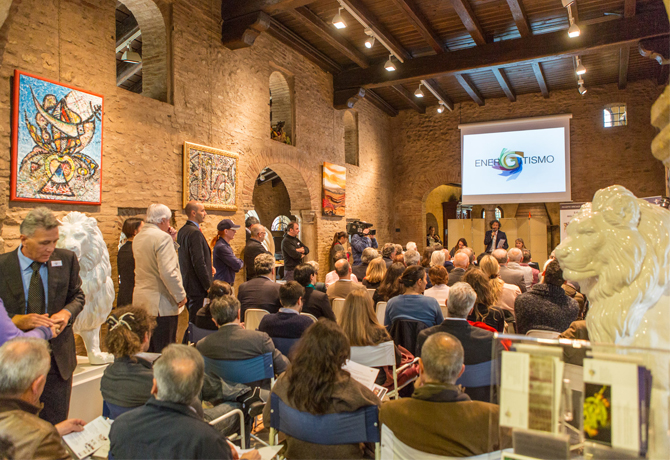
The 2nd Anniversary bazaar in Marostica was a celebration of culture where the over 100 guests engaged in enjoyment of the works on display and animated discussion. The stars of the show were the Energitismo partners who proudly displayed their works from Our Discoveries and Our Collection and told their stories.

The entrance was guarded by the grand Ahura lions crafted by Ezio Zanardello. To the left in the ‘Bazaar Hall’ Ilario Tartaglia displayed range of his fine textiles next to a sensational Dreamtime lamp part of the exciting display by Florio Pozza. Fabio Scapin‘s wonderful Drumming up Elegance armchair and mobile shelf stood alongside the sensuous lips on Les First - the enigmatic Chair by Massimo Marcomini.

Lucio Marin presented Elegance and Security Dressed in Red – Murano glass art safety signs and the Marinstyle exotic extinguisher. Against the outer glass wall, Maurizio Signorini presented his Venetian “Briccole” table with his light sculptures in stone lamp on the glass tabletop.

Along the wall hung the lyrical lithographs of Giancarlo Busato, and nestled below rested the Tondin bambino bike of Nicolas Lunardon. Proudly displayed on an easel was the impressive icon ‘Annunciation’ of Anna Maria and Mariangela Tondello. The culmination of the standing displays of starsof the show was a magnificent full height flowing sculpture in wood by Toni Venzo.

Counterpoised to the Tondin bike were examples of the natural woods, structures and shapes that form the basis of Tondin furniture. Above, on the wall, hung two of Giuseppe Facchinello’s large expressionist ‘Picasso’ period ceramic sculptures.

In the middle of the hall, a long table held displays of eight Energitismo partners.

Living Stone mosaic sculptures from the Greek mountains of Antonis Karakonstantakis sat beside an elegant silk shawl woven with fine coral jewels, created by the Ascione family from Naples. Adjoint sat a glazed lava stone bowl for bath or ornament from Sabrina Zibellini of Made in Lava. Four exquisite drop necklaces based on Murano glass were presented by Roberto Perziano.

Rita Dal Prà presented one of her beautiful ceramic model Italian gardens. Luciana Bertorelli was represented by two ends of the spectrum of her ceramic sculptures, though both drawing on the same philosophical approach, a blue Pangea and an open glazed sphere.

The entry by Giampietro Zonta and Daniela Raccanello in stars of the show was Living Jewellery, the glorious gold necklace created around two arms of cells producing powered by emulation of photosynthesis, worn initially in elegant style by Manuela Lunardon and subsequently, in a show of youthful joy, by Maria Vittori.

The stars of the show are remembered by thousands of images, many of which will be available on the Energitismo site and on our Facebook page.

powered by social2s
w furlan

I cannot quite remember how his name is spelt. Forgetfulness does not allow me to know whether it sounds as if it should be French but is pronounced incorrectly by an ill-bred Englishman,or not. He was a famous British conductor of the war periods and one who did not take fools gladly, except himself when he would make an occasional gaffe.

Memory does play tricks on us, and especially the names of the famous or beautiful whom we encounter. This be-knighted conductor, Sir Thomas Beecham, of the LPO and goatee beard fame, recounted in his biography a meeting with an elegant lady in a Manchester hotel foyer.

For his life he could not remember her name but had an inkling that she had a brother. After the opening pleasantries he had still not connected the polished voice to a name so he ventured a question.

”And Madam, how is your brother and what is he doing now?” To which she replied with aplomb: “He’s well thank you …. and still King”.

Why is it that the ridiculous takes so little effort to remember while the most normal of words and names drift aimlessly into the wells of forgetfullness? I have no difficulty with:

And as in uffish thought he stood
The Jabberwok with eyes aflame
Came whiffling through the tulgey wood
And burbled as it came

It seems like a record of my entrances to parties and functions, and how I must be remembered.

Why is it that on meeting a beautiful lady whose smile is only matched by the beauty of her bust, waste and calves, I can recall all those assets and even the flow, texture and colours of her dress, but from the instant of introduction, her name has gone to the mists of time.

I can recall forever her mobile number, but would have no idea who I am calling.

Fortunately, my embarrassment can be masked by a glass or several of any of many alcoholic accompaniments, and I stand in the shadows rustling through my memory searching for names – even dredging up the faces of my several ex-wives, I have little ability to put a name to those well remembered (and often frowning) faces.

Usually this search ends with my turning away from anyone who approaches me and darting to the toilet while doing an alphabetical search from Abigail, Andrea, Anne, Ashley, Ayesha …. all the way to Zara, but without any recognition to match the smile.

I am left just to escape, hoping that few will notice my departure without the niceties of thanking the hosts, whose names have now become unknownin a veil of forgetfulness. All I recall is the wonderful flow of a memorable lady as she danced with another, a tryst in the making. I guess that I won’t make a good salesman, or Casanova.

powered by social2s
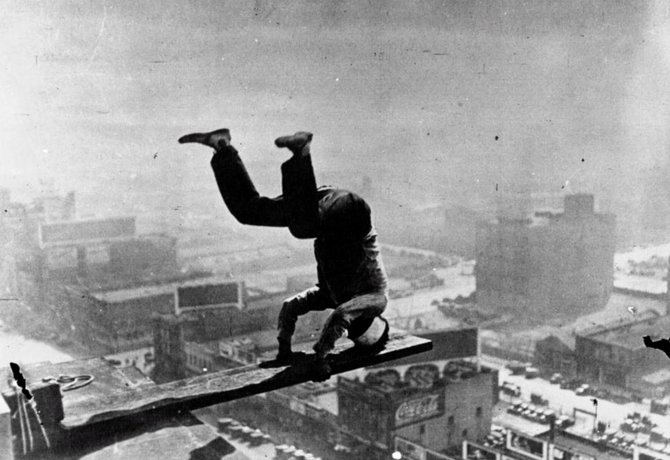
Pragmatism of falling, or 'the bricklayer's story'

For the student of pragmatism, falling is the perfect activity to differentiate an optimist from a pessimist. The optimist steps off the edge of a tall building. As he falls past the 30th floor window, he is heard to yell – ‘Still OK’ and seen to be calling a bookmaker on his iPhone.

His chances of landing safely are recorded in Hitchhiker’s Guide, but it has happened. Does this justify optimism? Meanwhile the pessimist falling is heard to yell ‘It’s not my fault’- not exactly pragmatism.

Which is it to be? Of course, if you are British, neither optimism nor pessimism is acceptable –just pragmatism.

One of the greatest stories of pragmatism amid disaster is the ‘Bricklayer’s Story’ as retold by late great racconteur, Gerard Hoffnung some 56 years ago at the Oxford Union debate.

Dear Sir:

I am writing in response to your request for additional information in Block #3 of the accident reporting form. I put "Poor Planning" as the cause of my accident. You asked for a fuller explanation and I trust the following details will be sufficient.

I am a bricklayer by trade. On the day of the accident, I was working alone on the roof of a new six-story building. When I completed my work, I found I had some bricks left over which when weighed later were found to weigh 240 lbs. Rather than carry the bricks down by hand, I decided to lower them in a barrel by using a pulley which was attached to the side of the building at the sixth floor.

Securing the rope at ground level, I went up to the roof, swung the barrel out and loaded the bricks into it. Then I went down and untied the rope, holding it tightly to insure a slow descent of the 240 lbs of bricks. You will note on the accident reporting form that my weight is 135 lbs.

Due to my surprise at being jerked off the ground so suddenly, I lost my presence of mind and forgot to let go of the rope. Needless to say, I proceeded at a rapid rate up the side of the building.

In the vicinity of the third floor, I met the barrel which was now proceeding downward at an equally impressive speed. This explains the fractured skull, minor abrasions and the broken collarbone, as listed in Section 3, accident reporting form.

Slowed only slightly, I continued my rapid ascent, not stopping until the fingers of my right hand were two knuckles deep into the pulley which I mentioned in Paragraph 2 of this correspondence. Fortunately by this time I had regained my presence of mind and was able to hold the rope, in spite of the excruciating pain I was now beginning to experience.

At approximately the same time, however, the barrel of bricks hit the ground-and the bottom fell out of the barrel. Now devoid of the weight of the bricks, the barrel weighed approximately 50 lbs.

I was now heavier than the barrel. As you might imagine, I began a rapid descent down the side of the building.

In the vicinity of the third floor, I met the barrel coming up. This accounts for the two fractured ankles, broken tooth and severe lacerations of my legs and lower body.

Here my luck began to change slightly. The encounter with the barrel seemed to slow me enough to lessen my injuries when I fell into the pile of bricks and fortunately only three vertebrae were cracked.

I am sorry to report, however, as I lay there on the pile of bricks, in pain, unable to move and watching the empty barrel six stories above me, I again lost my composure and presence of mind and let go of the rope.

The barrel came down and hit me on the head causing me to lose consciousness. I awoke here in hospital.

I respectfully request sick leave

True pragmatism, where not only his upperlip was stiff.

powered by social2s
poltrona elegante

Stylish modern furniture is the dream of most, but what is style?

Fabio Scapin is an artisan of stylish modern furniture, a metalworker, and a craftsman who works with metal to create high quality professional and commercial fittings.

His work exposes him to a wide range of designs and applications where metal is the skeleton or even the final product. And he notices the value of the waste that returns to the recycler for melting and refining. Particularly, he noticed the large quantity of empty 200 litre (44 gallon) drums that were the source of cleaning products and dispersants. And he dreamt.

What he saw was stylish modern furniture from recycled drums.

Recycling of these large industrial drums is not new. Fifty years ago we created Rot-B-Cues with a drum cut in half, hinged down one side and mounted sideways on two tripods.

A small electric motor was connected to a shaft that then turned in slowly in two bearings, one on each end. A whole piglet or lamb was placed on the ’spit’, the bottom half of the drum was partly filled with BBQ coals which were lit and, 5 hours later, after copious quantities of beer had been consumed, the roast was ready for consumption.

On the Pacific Northwest coast of USA, the same principle was used to smoke salmon, freshly caught – and it was not surprisingly called a Smoke-B-Cue as the lid was closed during cooking. Yet, while these ’inventions’ were utilitarian and engaged young men in creativity and companionship, they were hardly elegant, often unreliable, and not particularly attractive to the gentler sex.

Whether Fabio considered these limitations of prior applications of recycled drums is not certain, but more likely, from his background he instinctively understood that quality is the ground rule for all sustainable, stylish and modern furniture products.

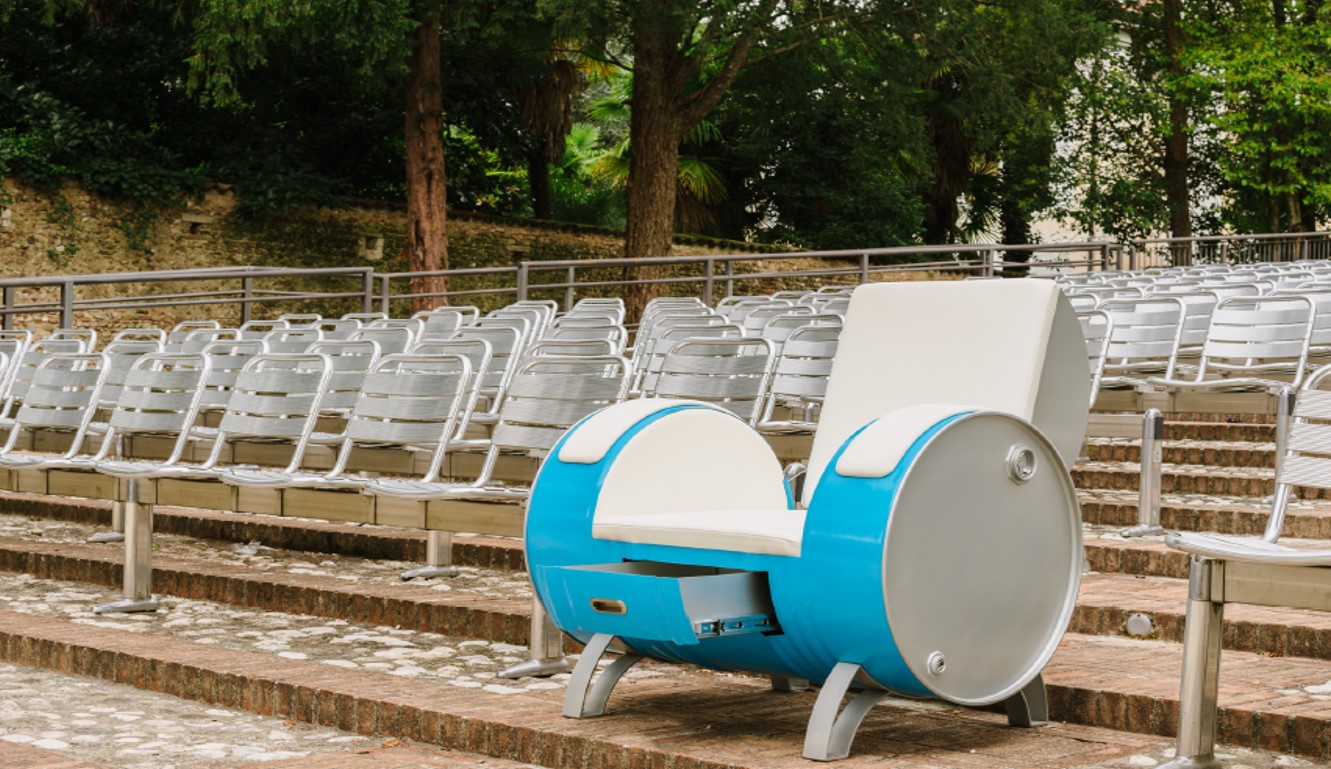
When we first visited his workshop near Vicenza, we were astonished by this fine bright blue and white arm chair standing on a pedestal in front of us.

The only recognition of the original drum was the shape.

Each drum is selected and carefully cleaned to bring up the fresh metal. The required shapes are cut out. All metal components such as hinges and handles are hand-made in the metal workshop. The engineered metal skeleton for the chair is installed and welded in place.

Metal drawers, cup holders and shelves are incorporated. The final metal assembly is then painted according to the customer specification with a high gloss finish. Finally the furnishings are added, cushioning and upholstery of top quality once again to suit the design wishes of the client.

Fabio has designed and produced a range of stylish modern furniture that sets a unique style message. Complete lounge room or recreation room settings can be produced to suit any colour scheme, theme and atmosphere. Double sofas, children’s chairs (created from smaller drums), tables, sets of shelves, what you want Fabio Scapin can create the solution, and the outcome is your unique indoor or outdoor setting of stylish furniture.

powered by social2s
The Role of Mankind in a Cynical Universe

Philosophers for thousands of years have pondered and argued the purpose of man’s existence, and come to a smorgasbord of different conclusions. Yet The Hitchhiker's Guide has possibly given all the answers, or is it that currency is what matters?

With respect to the great philosophies, let us consider the existence of man from just two antagonistic cynical perspectives, from each end of the stick of human continuum.

At one end we have the results of pure Darwinian Accident, a chemical trick of step by step statistical survival of the most ridiculous variations on the previous life form. This bears a remarkable similarity to Adams thoughts on the Heisenberg Uncertainty Principal when he proposed the chances of being picked up in space within 30 seconds while holding breath as one in 2 to the power of 276709 to 1 (against) which of course happens to be odds of trillions to one - about the same odds as Darwinian evolution, no matter how long the time scale.

It is interesting that evolution is antagonistic to the apparent universe, as it disobeys the second law of thermodynamics – whereby every system moves towards its lowest energy state (or chaos reigns) – but we are being too simplistic. Physics of dark matter wins in this, the devil’s universe. In any case, who said that light is right? Maybe mankind is best represented by Adams whale.

At the other end we have the God of creation, and there is no arguing with ‘him’. God, as portrayed by his missionaries, sets some simple rules:

•Natural procreation must produce babies, otherwise it’s not legal fun and you must pay penance, in which case you can have fun.

•I am all-loving, but obey my rules or you go to hell, and if you do obey, you have no fun.

•The kingdom of heaven is closer to the front row of the cathedral

•I measure my love in legal (or illegal) currency.

•Have no graven images, I will store them for safekeeping in my vaults.

•The role of man is to build churches to store graven images and collect the taxes of life.

•Pay now, there may be no tomorrow.

You may note that in neither of these models – or in any continuum that connects them is there a role for humans in development of the self or improved living conditions. In the first case we exist by pure accident and in the second we are subservient and effectively irrelevant.

It should therefore not come as a surprise that natural evolution of mankind is directed solely to the creation of currency and that mankind is only required to exist to the extent of recognizing the overpowering importance of currency - currency is what matters.


Where men may try to avoid this responsibility through revolution, poverty or lack of resources, natural disasters or war will arise to reduce the burden by these peoples.


Consequently, since the sole purpose of life must be the creation and expansion of currency, it comes as no surprise that bankers are the keepers of this ‘holy Grail’ and so must be protected above all else, as governments have shown to an increasing degree in recent years. The role of lawyers and accountants is simply to maintain the importance of currency against an importunate revolution against bankers.


The great war of mankind will be, according to the most recent forecasts of the sage, that battle between currencies to create the great unifying force. Mankind may die but currency is what matters and currency will live forever.


(This article is reproduced under licence from Energitismo Limited)
powered by social2s
Why gondoliers sing so well

It may be the most popular tourist resort in the world with towering cruise ships parked at one end, and the Grand Canal absolutely filled with ferries, water taxies, gondolas and cargo boats crawling from station to station, crossing from ‘bank’ to ‘bank’ and each somehow not colliding or dumping their precious cargo of tourists or wine into the turgid canal.

Venice has been for hundreds of years the perfection of salesmanship, selling ‘love’ in all its sensual and sexual splendor in a city half-drowned in water mostly insufficiently refreshed by the Adriatic Sea.

One could be a bit cynical about history and the effects of advertising. One has to remember that the reason Venice exists is because the locals ‘swam’ to the islands to escape Attila, whose warriors were invincible on land, but sank like stones in water.

And what results is the city the Venetians built over the ensuing millennium, once the invading hordes had retired to other pastures and the good folk could gather building materials. What results from this accident of history? What is so romantic about every street being flooded?

To the logistics pragmatist, Venice is a very inefficient site depending on small boats for all practical trade with its local suppliers. The canals are not exactly suitable for fishing so are not a source of fresh food and there can be no vegetable gardens, except perhaps lotus.

Of course, looking out to sea, as the Venetians were prone to do, enabled the progressive creation of the longest lived trading republic of Europe’s history, but a penchant for the merchants of this trading navy was to build their villas firmly planted on the solid soil of Veneto.

And now we return to this day, another hot day in Saint Mark’s square, where children play in the shallow pools on the marble, and a long queue of patient tourists snakes its way to the wooden planked walkway leading into the Basilica, the ‘bank’ for more gold leaf than all the other Venetian banks combined.

But for those of us who were taught the simple gospel that one should not worship idols, the reliquary holding leg bones does leave a bit of an empty patch in the memories of the glories of the Basilica.

Strolling out of the square over tiny bridges in back ’alleys’ barely wide enough for gondolas to pass, we view into ever more high-priced hotels, and note the absolute similarity in the financial proposition between the about 400 active gondolas, many of which, even today, lay empty. At €100 per ride, it seems that romance, as everywhere, is an expensive business for which there is always an over-supply of ‘love boats’ and hence competition.

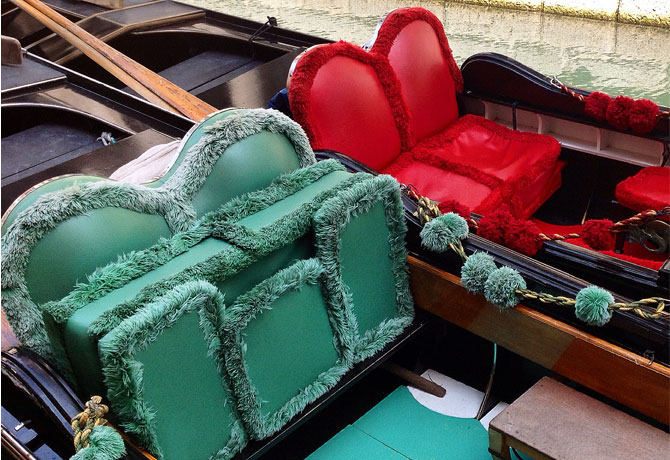
The plucky gondoliers stroll back and forth on their craft to attract the flow of families and more often swooning couples willing to part with their cash. On occasions, these gondolier masters of love are found to serenade their guests, not necessarily with Venetian tunes, but more often with Italian opera arias and Neapolitan songs as they row with their single oar seemingly aimlessly from canal to canal.

Yet it is this little extra that attracts the applause from the nearby craft and the banks of the canal, and we guess ensures a steady flow of clients, as well as reinforcing the image of Venice and its gondoliers worldwide. Any advertising is good and so good that you must visit this 3D love meet.

powered by social2s
One of our 42 favourite books: “A Hitchhiker’s Guide to the Galaxy” by Douglas Adams

“42” has become the answer to every question since Adam’s great book of highways, whales and journalists was granted to us.

Whether you listened to Adams denials of any logic to his selection, or subscribe to the mathematical improbabilities of base 13 or the computational beauty of binary numbers, most searchers have by now found the answer they seek.

But is anybody correct?

Adams’ biography reveals that, from age 7 in '1959 until 1970, Douglas attended Brentwood School in Essex, at which time he was still more interested in the field of science than in the arts.’ This formative love of science may be the link to what even he did not know about the structure of the galaxy. It was inevitable that Adams would compose scientific fiction, as the thrill of science, learned with gusto at school, gradually leaked from his mind as his hands wandered over the keys.

And, if it had only been realized sooner, Mendeleev had given the answer to him in one of his chemistry classes. And that answer is Molybdenum, symbol Mo (no not Moe or even Lucky, as this is a Curley answer), atomic number 42. This means that it has 42 protons. The real clinch that confirms that this is the true answer is that Mo has 54 neutrons (6 times 9 as fans of Adams would know).

But why is this so obvious?

Element 43 is Tecnetium, and it does not seem to exist naturally in our galaxy, while it may only be formed by nuclear ‘magic’ and in some dense stars, ‘red giants’, far off in the universe, stars that are more light years away than the half-life of Tecnetium.

A little more of the Molybdenum magic. Molybdenum containing enzymes are about 6 times more common as catalysts used by a lot of bacteria to break the chemical bond in atmospheric molecular nitrogen (element 7), that allows biological nitrogen fixation. These enzymes are generally cyanobacterial, meaning carbon (element 6) and nitrogen are combined as CN: and while 6+7 = 13, 6 x 7 = 42.

Thus, Molybdenum, with 42 protons, has the highest number of protons and neutrons for stability (96 – note the significance), before natural instability sets in. The lowest number of protons and neutrons in Tecnetium is 98. If the answer to the question were higher than 42, we would have to leap the instability gap and that would create great uncertainty for the continuum, and chemically, it could not be lower, as there are more ‘intelligent’ elements before 42.

I just thought that you would like to know.

powered by social2s

Subscribe to Newsletter

Discover a territory through the emotions of the people that have lived it.