3rd April - Really

According to astronomers, Colin J Humphreys and W.G. Waddington, Friday April 3rd is a special day in history. This year in 2020 according to these eminent researchers is the 1987th anniversary of the death of Jesus Christ. 

This conclusion was published in Nature 306, 743–746 (1983). 

Apparently, the date was confirmed by the occurrence of a lunar eclipse reported to have occurred following the crucifixion, the data having been calculated from study of the Jewish calendar of the first century AD. This may seem therefore a particularly propitious day to depart this mortal earth, especially if you are keen on returning on the following Sunday. 

But not many famous people have followed this approach of striving for immortality and only one pope, Honorius IV, otherwise the Italian Giacomo Savelli, who sat on the Papal Throne from 1285 to 1287, has succeeded in the first necessary action. We are not aware of any subsequent outcome.

Some better known musical talents have gone to their maker on this day. Johannes Brahms, the last great classical composer, who enjoyed some of his summers strolling in Italian hills, did so in 1897after a lifetime devoted to great music and Clara Schumann. His music at least attained immortality. 

Of more modern fame was Kurt Weill, who passed on this day in 1950 at age 50, having been a famous satirical opera composer, unliked by Adolph who banned his masterpiece ‘Rise and Fall of the City of Mahagonny’, composed between 1927 and 1930 based on lyrics by Bertold Brecht and giving the world the wierdly wonderful ‘Alabama Song’ – the moon of Alabama ….

I cannot leave those for whom this was their last day without remembering Graham Greene whose most enigmatic novel for me was Travels with My Aunt and who blessed us until 1991 with over the 86 years of his worldly wandering penning a library full of novels, short stories, plays and travel books most of which captivate the casual reader.

But we should not dwell on the infinite, but also recall the creative spark of human procreation noting one special well-known souls who joined us on 3 April but have since moved on. The Godfather is remembered by bankers for being the most commercially successful movie of all time, while Last Tango in Paris introduced sexual reality to the big screen and Apocalypse Now, a chopping experience of the Vietnam War – all starring Marlon Brando

But my memory is of Don Juan DeMarco with Jonny Depp and Faye Dunaway and the haunting theme song that most men can feel – ‘Have You Ever Really Loved a Woman?'

For those who thrill to historical events, and for whom the crucifixion is not enough, there is not a wealth of dastardly deeds, and I am drawn once aging to the musical genre and the recording on this day in Nashville by the King, of the 1926 composition with the lyrics:

Are you lonesome tonight,
Do you miss me tonight?
Are you sorry we drifted apart?
Does your memory stray to a brighter sunny day…

Just thought you may want to sing along!

powered by social2s
Montecassino and Ciociaria - death and rebirth

My first realisation of the reality of WW2 in Cassino and the area called Ciociaria in central-south Italy was learning the story of Montecassino, the Benedictine Monastery at the end of the Benedictine Way that sits on the spur of Mount Cassino above today’s town of Cassino.

The monastery can be easily seen from the A1 linking Rome and Naples, but a visit is for me essential. The monks knew that their abbey and monastery would soon be destroyed by the allies as it had become a centre of command for the German forces.

The inevitable came on 15 February 1944, the day Montecassino perished after nearly 1500 years.

“The architectural plans for the abbey were removed to Rome, along with the artworks and library, before the bombs and shells reduced the structure to a half million cubic metre pile of rubble. On February 15, 1945, a year after the destruction, the new foundation stone was set down for its rebuilding. 19 years later the Marshall Plan-supported rebuilding was completed and Pope Paul VI consecrated it. All the treasures and archival documents were returned”.

What I have seen along with all of my generation is the renaissance of Montecassino, as if the war had not occurred. But the souls of the tens of thousands of soldiers resting forever in the fields, mountains and cemeteries of this scene of massive warring destruction, know otherwise.

Their screams as they burned in exploding tanks or just their tears as they bled into the mud must not be forgotten.

The Canadian author Mark Zuehlke, noted in his search of this theatre that 138 Canadians died on 23 March 1945 in the Liri valley conflict. In his search through the verdant green of the Commonwealth war cemetery he found messages from home to their sons – “I cannot say/and I will not say/ that he is dead/he is just away”.

Italy remembered the allies and their contribution to freedom despite the fact that these men came in their swarms following possibly the most brutal bombing raids that Italy has seen, raids that eliminated small villages such as Acquafondata, many towns in the valleys and hills, and the larger towns such as Cassino and Frosinone.

For Cassino, the destruction was complete and the town I now drive through a few kilometres off the autostrada, the town where I can enjoy a concert in the Roman amphitheatre, is actually about 2km from the Cassino of early 1944.

And even the industrial investment forces that attempted to rebuild Cassino through a giant Fiat factory have not been enough to breath permanence into the renaissance of that town.

Yet, the creative force of spontaneity, when you are no longer certain of the future, have recreated and rebuilt Frosinone, of which only areas of the old town seemed to survive in 1945.

There was joy among the dread of the destruction, in towns such as Anagni, where the Canadians marched through the town after the Germans abandoned it, being showered with roses of all colours’ by the ladies in the houses along the narrow cobblestone corso.

The Canadians formed up to welcome the approximately 500 partisans who had come in from the hills. ‘The whole affair was most dramatic and colourful, and the square was draped with Italian flags and bunting in Savoy colors’.

Today, in Anagni, the square below the cathedral is open, a memory of the massive bombing while all can view the marvellous crypt of the cathedral that god preserved.
 
(Quotes in Italics are from the book by Mark Zuehlke, ‘The Liri Valley: Canada’s World War II Breakthrough to Rome’)

powered by social2s
Paestum, place of magic for travellers

There is so much to be discovered in life, places of magic for the traveller, and Paestum in southern Campania is certainly one.

For the amateur or trained archaeologist, probably the sites and sight of the temples and city of Paestum are now tame. But for most others this is a site that may even compare with the Acropolis in Athens for the quality of the ancient Greek temples and the awe it inspires.

Maybe the city was founded as Poseidonia in about 600 BC and its current name was given by the Roman conquerors in about 273 BC. In its Roman period, it survived Hannibal, but declined and was abandoned, possibly due to a change in environmental conditions, during the following 300 years.

The decline may have been assisted by Saracen raids, and the population apparently resettled on the hill of Agropoli. Paestum was ‘rediscovered’ in the early 1500s. Probably, the onset of malarial conditions 1000 years earlier was the saving grace for a marvelous archaeological ‘find’.

The reason for our visit? It was the 20th annual ‘Borsa Mediterranea del Turismo Archeologico’, a meeting of archaeologists, museum directors, regional promoters, administrators and parks directors from Italy and mainly southern European countries – a meeting where you could virtually guarantee that there would be no stone left unturned and no dropped rubbish.

The experience was captivating. This is not a report on the meetings and conferences, but a memorial to my first exposure to Paestum. In the late afternoon I sat at a café looking across the foundations of the city.

To my right stood the Temple of Athena, and to my left at a greater distance, stood the first temple of Hera, virtually hiding the larger temple close behind.

The Greek gods had created a wonderful evening scenario. From the palest blue of the horizon, to a perfect clear pale blue sky, the artists of the heavens had painted strokes of cloud in a spectrum from rose in the highest, through pinks to a golden hue closer to the horizon.

As I sat for what seemed a pleasantly long evening, the scene slipped slowly into the lap of the sun, now hiding below the sea. Meanwhile to the east, behind the temple of Athena, the rugged mountains of Mordor were overhung by a pink fire. The evening settled and I arose to venture to the hotel and to sample the local fare.

The next morning, we ventured out after an early breakfast, and strolled through the ancient city foundations to the smaller of the two Hera temples and were excited to find that a visit into the bowels between the columns was allowed.

Each column and the overall structure was awe inspiring, especially as very few other tourists came, and the ‘Roman soldiers’ were just setting up camp in the forum.

However, a couple of American tourists entered the temple and we sought their opinion of this wonderful site. The husband ventured pleasure but commented that it seemed a long way to come for just one archaeological site. Maybe too much Disney in Orlando.

For those of us who are less demanding on the forces of entertainment, maybe a few more visits to Paestum are on the cards.

powered by social2s
Sea Side Walk by David Straight

This is a story of life on the Adriatic coast after the season, the town, Bellaria - Igea Marina, not well known except to those who come in the season. Its sands are clean and near white.

It is mid-October, barely a few days past summer, it is a warm 25 degrees, even more, the sea is calm and blue. Yet the beaches, such as these near Rimini, are empty, not just of the platoons of umbrellas and chairs, but of people. As far as the eye can see not even a stray dog enjoys a run on the sand.

An analogy comes to mind. The shore can be likened to the skin of a man, the interface between the living force of the flesh, and the external elements of water and the atmosphere. With this new concept of our reality we walk along the road beside the shore.  The ‘jewellery’ of this shore, the hotels, apartment blocks and shops are evacuated, shuttered and, where an occasional window allows the afternoon sun to enter, the rooms are empty, all furniture has evaporated. Where has the life gone?

Yet an occasional escapee emerges from a side street and enters this world empty of other life, just as a drop of water may escape from the sea. What are these escapees seeking? Where have they come from? Is there life away from the ‘bookcover’, the skin of the Rimini coast?

Just inside this skin, maybe 100 metres up a side street vein, a few people are coming and going, walking dogs, and some are entering or leaving the foyer of a hotel, the main source of this action, with the quirky name of Edward, no not Eduardo, but the very British regal name of Edward, and no not Edward VIII, the king of the abdication event, just Edward.  A lady sits at the reception desk, and, it is maybe her mother who occupies the lounge watching the TV. Mainly men arrive occasionally, possibly from the labours of doing business on the coast, to collect their keys from the board before re-emerging not much later, changed and ready to tramp off in search of sustenance.

It is close to time for dinner. Turning right we come to a spacious bar across the road with tables set for dinner and, deciding that this may be the only choice we have, enter the ‘Tramps’ establishment and seek a table, maybe with some trepidation given the choice of the name. Your author chooses two fish courses, fresh anchovies and grilled tuna, while others select mainly pizzas. The local wine is more than acceptable and the beer is much appreciated. While we sit there more tables fill with groups of 2 to 8 people, all apparently locals who must know something about this place.

The meal was delicious, with the tuna cooked close to perfection. I then realised what that is. We had obviously by accident found the alternative life that throbs in the Adriatic coast after the season, hidden behind the skin of the coast. Seek, and even if accidentally, you may find something that defies the change of season.

powered by social2s
Maundy Thursday Visit by Papa Francesco to Paliano

It is Maundy Thursday in the Christian week of Easter, a fine warm spring day with a touch of breeze, and we seek the breath of the Lord in the hills around Paliano, in Frosinone Province.

For lunch, we settle to eat a simple but tasty pasta dish with a glass of white wine at Terremoto, a local ‘trattoria’ since 1890 near the castle of Genazzano and afterwards begin our search through this medieval town.

Despite our interest, the Church of San Giovanni and the Colonna Castle are well and truly closed so we venture to the Sanctuary of Mother of Good Counsel noting that April 25 is the 550th anniversary of the founding of the church with the gift by the angels of an image of Mary from a church in Albania.

The facade of the church has six coloured glass mosaics in various states of repair and inspiring cast bronze doors with ‘extraterrestial’ figures in the main entrance. In expectation, we buy an ice-cream each and sit to await the opening of the church but find eventually that the 3pm opening time is void for today. Maybe God is praying alone.

We return to the car deciding to head home without achieving any goals and are reminded that today, Pope Francesco will be visiting Paliano. On arrival below the town of Marcantonio Colonna, we encounter groups of people spread along the road, apparently awaiting the Papa Francesco motorcade. An accord is struck and we park at a corner near home to join the expectant ‘throng’.

There were only about 12 people collected at our corner, but all seemed enthusiastic about the possibility of greeting the Pope. Standing there looking across to the end of the mountains of the Castelli Romani, the mountains of the traditional summer palace of the Pope, I was thrust back to my memories.

It was about 1954 when as a very young school-child, I and my classmates were lined up on the roadside in Sydney, Australia, with three quarters of the population, to welcome our new queen, Elizabeth II, and her consort, Prince Philip, with each of us holding a national flag to wave. On that day, the cavalcade, to my distant memory, comprised an open landau Daimler Landaulette for the Queen, travelling at 10km per hour.

Today the rural road from the Rome-Napoli expressway to Paliano was but a small reminder of those years past, but it still retained some of the aura from seeing a famous person close-by. In common with the Queen’s cavalcade, Papa Francesco was transported in a black, but less ostentatious, vehicle with the supporting cast of Carabinieri in Alfas and on motos in front and aft.

I am not sure if I espied his wave through the darkened glazing of the vehicle, but as he passed I did recall the words of Australia’s great post war Prime Minister, Robert Gordon Menzies, from 1963 during the Queen’s second visit to Australia, when he repeated the words of a 17th century poet with the greatest pride - ‘I did but see her passing by, but I will love her till I die’.

The cavalcade, all too quickly, disappeared up the winding road to Paliano and we moved on to compose our reminiscences. We may not have seen the Lord today in Genazzano but, as Christians, I guess we achieved a good second on the rural roads of Paliano.

powered by social2s
12 April- Yuri Gagarin

One has to be cautious at this important period in the Christian year, Easter, that what self-proclaimed organisations of the truth teach or declare to be heresy may not, in the light of history, be correct.

It was just 454 years ago on the April 12 that an astronomer and physicist, Galileo Galilei, was brought before chief inquisitor Father Vincenzo Maculano da Firenzuola, appointed by Pope Urban VIII, who began the inquisition of Galileo for holding the belief that the Earth revolves around the Sun, which was deemed heretical by the Catholic Church.

Galileo was found guilty and spent the rest of his life under house arrest. Errors of fact of this magnitude are not limited to the Catholic Church but are more often than not related to one or another religion. It is relevant to note that it took the Church over 300 years to admit that maybe Galileo was right and that the Earth is not the immovable centre of the Universe, a relative fact that was known well before Galileo began his Dialogues.

But being relatively right is not protection in history, and we can only wonder what other proclamations by the churches of this planet will be realised, in the next 300 years, to be simply errors of those lacking scientific wisdom but basing their declaration of ‘heresies’ on their positions of power. Of course, we also have the proponents of false science with for instance their ongoing ‘flat earth’ theories, but that is for another day.

This brings us to 1961, April 12, yesterday, just under 400 years after the trial of Galileo commenced, when a young Russian test pilot, Yuri Gagarin flew about 300km above the earth in a space capsule, Vostok 1. Then it was only exactly another 20 years before the launch of the space shuttle. In between those milestones, the Russians and the Americans competed for control of the moon with the Americans landing first though the Russians had the first soft crewless landing.

Today, there are some who, reflecting on religious beliefs or just foolishness, still believe that none of this happened. Similarly, many follow the social media conspiracy theories that are based on false reporting and real ‘fake news’.  Are they right or wrong, deluded or illuded, or just relatively different?

Delusion has no boundaries in time and only death can relieve the deluded of their sins of omission. Interestingly April 12 marks the death of a man of great illusion for his country and the world at large, yet a man whose last days maybe were tinged with delusion.

That man was FDR, Franklin D. Roosevelt. His death came not long after the famous Yalta meetings with Churchill and Stalin, the practical outcomes of which still trouble the world today and provide evidence of delusion that humans in power have about goodwill. Churchill, had been the same man who sent so many thousands of Australians and New Zealanders to their death alongside the defending Turks on the shores of Gallipoli in April 1915.

The only reality is … yesterday? When April 12 changed the world.

powered by social2s
Corteo Storico Fiuggi
Fiuggi Grants Antonio Tajani Honorary Citizenship

Our travel today through the hills of Ciociaria brought us to the famous spa town of Fiuggi in the lower slopes of the Ernici Mountains to celebrate honorary citizenship of Fiuggi for Antonio Tajani, President of the Parliament of Europe.
For Italians, the honour is well understood, but for those of us with English upbringing, it may be similar to the granting of the keys of the city.
Without delving into the powers of the President of the European Parliament and how that role relates to other positions of authority in Brussels, the role is considered an honour and a reward for contribution to the European cause and, in particular, its parliament, and Italians are at least pleased that another of their number is counted among the select group.
One may wonder the connection with Fiuggi, a town spread over the hills with the spas in the lower sector and the medieval town on top of the hill. It was to the old town that we went, to the city hall and in to the ‘Council Chambers’ that we ventured for the celebration, and it was here that a curious analogy became apparent.
On the long-left hand wall of the significant rectangular salon was a large fresco depicting the visit by the citizens of Fiuggi (or Anticoli di Campagna as it was then known) to the chambers of Pope Boniface VIII to present their cleansing water that had the properties to relieve kidney stones.
The citizens are shown in their elegant dress but with facial features displayed in sketch form, apparently to better recall each.
When the President of the European Parliament entered, he was followed by a largish group of mainly local dignitaries who filled the room in a similar manner to that of the citizens at the presentation to the Pope many centuries earlier. It occurred that possibly the award of this day may have an analogous purpose to that of the Fiuggi water.
Of course, there is a connection as Antonio Tajani’s parents came from near Fiuggi, in Ferentino, and more importantly, he counts Fiuggi as his home, residing there when he can escape Brussels and his other interest in Rome.
So, he was evidently at home with many friends and acquaintances, a point that was obvious when we moved to the Hotel School in the old casino for ‘pranzo’. I noted that the Hotel School is named after the great Michelangelo Buonarotti who is reported to have said that Fiuggi water relieved him of ‘the only stones he could not love’.
At one point during the buffet, the President rose and moved to the table where cakes were being served:
The President with a smile
Took his place among the queue
 Idling and chatting a while
Waiting for tiramisu
It was a freeing experience to enjoy such celebrations feeling the warmth of people of Ciociaria, best of the Italian people.
powered by social2s
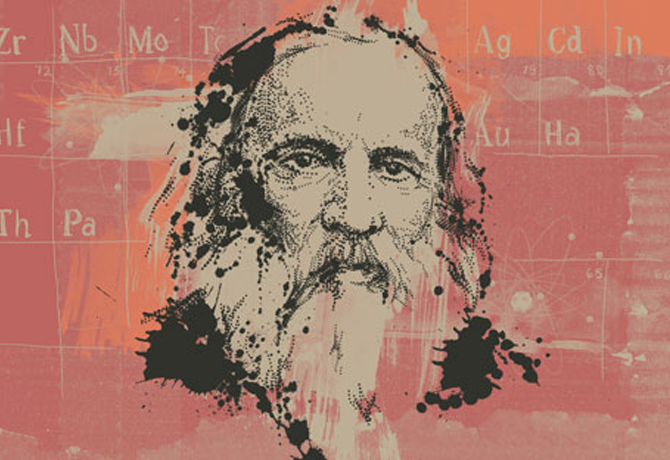
Mendelevium and a crater, memorials to Mendeleev

Mendelevium is an unstable element, number 101 on the periodic table. It is named after the Russian scientist Dmitri Mendeleev who is credited with the formulation of the periodic table of elements.

February 8 is not just Mardi Gras, it is Mendeleev’s 182nd birthday. The periodic table of Mendeleev was published in its first version in 1869. The memorial to Dmitri Mendeleev, element 101, sits snugly between the memorial to Fermi (Fermium) at element 100 and that to Nobel (Nobelium) at 102.

Directly above Mendelevium in the Mendeleev periodic table is Thulium, element 69, named after the ancient Greek site of Thule as remembered in Scandinavian texts.

The difference in atomic number between Thulium (Tm) in the lanthanide series and Mendelevium in the actinide series is 32 representing, in classical electron structure, 2 s shell electrons, 6 p shell electrons, 10 d shell electrons, and 14 f shell electrons. Exciting as this is, it was effectively forecast by Mendeleev that Thulium, which was not known till 1879, should exist, and Dmitri Mendeleev would have had little trouble, brilliant scientist that he was, in predicting not only the chemistry of Thulium but also that of his namesake element.

To the extent that Thulium is a rare element on the earth, Mendelevium is totally scarce except when produced by alpha particles (He) bombardment of einsteinium (named after another reasonably well known scientist).

This technique was developed in 1952 and it was not until 1955, some 48 years after the last breaths of Mendeleev, that scientists at University of California Berkeley synthesized from a target of 1 billion atoms of einsteinium, the magical quantity of 17 atoms of Mendelevium. One isotope of Mendelevium with 157 neutrons (Md 258) has a half life of over 50 days so in the scheme of transuranide elements is moderately stable.

Yet, whereas Mendeleev left a legacy in his periodic table, his element has no use at all except to fill scientific texts. Mendeleev was not the first to attempt to find order within the elements, scientists throughout Europe had been delving into the structuring of the elements since Lavoisier 80 years earlier in 1789.
Mendeleev discovered the Periodic System while trying to arrange the elements in February of 1869, 147 years ago.

He wrote the properties of the elements on pieces of card and shuffled them backwards and forwards until it occurred to him that, by putting them in order of increasing atomic weight, certain types of element regularly occurred. His first table had the elements with similar properties in rows, but he modified it to put them in columns (e.g. Be, Mg, Ca, Sr, Ba).

Mendeleev’s wit was to shift elements around even though this may disrupt the series of atomic weights. Elements had to fit into his pattern. The example mostly given is the rearranging of Iodine and tellurium, because iodine chemistry was very similar to fluorine, chlorine and bromine. He predicted Gallium calling it eka-aluminium, Scandium (element 21) and Germanium (obvious now as a semiconducting element) that sits below silicon. These elements were not physically discovered until 1886. It is pertinent that the discovery of the noble gases (helium, neon, argon, krypton, xenon, radon) was the confirming grace for Mendeleev’s ‘system’.

Though he was not awarded a Nobel prize, Mendelevium is not his only memorial. A large whole in the ground on the moon is named after him. ‘Crater Mendeleev’ is on the other side of the moon.

More regard seems to have been shown by his Russian colleagues. In Moskovskiy Prospekt in St Petersburg, next to the building of the Bureau of Weights and Measures, where Mendeleev had worked as director and famously introduced new standards for the production of vodka, sits a large statue of Mendeleev as an old man. The monument is a short walk from St. Petersburg Technological Institute, where Mendeleev gained his first professorship in 1864.

powered by social2s

Subscribe to Newsletter

Discover a territory through the emotions of the people that have lived it.