Militello in Val di Catania. Municipal Library “Angelo Majorana” 

The Municipal Library “Angelo Majorana” of Militello in Val di Catania is named after Angelo Majorana (1865-1910), deputy of the Kingdom of Italy and Minister of Finance. It is located in the renovated premises of the former Convent of San Domenico dei Frati Predicatori.

The library was established in 1910 and boasts a collection of books of around 40,000 volumes, a collection of over 2,000 ancient books, dated between the end of the 15th and the 20th centuries, and a multimedia consultation room.


The Academy, the Library, the Palatine Typography and an epoch bestseller

During their rule, the princes Francesco and Giovanna Branciforti established a sort of "Accademia", surrounding themselves with brilliant geniuses. Scholars such as Pietro Carrera, historian, librarian and notary court teacher, the chronicler Filippo Caruso, the jurist and poet Mario Tortelli, the painter Filippo Paladini, the cleric, sculptor and painter Giambattista Baldanza, the book binder Francesco Petronio, the silversmith Geronimo Capra

Prince Francesco Branciforti was so fond of science and literature that in 1611 he built a "Palatine" Library alongside the Castle, rich in over 10,000 volumes. Here there was also an art gallery, a collection of physical and mechanical measuring instruments, an armory and a laboratory for chemical experiments.

Unfortunately, nothing remains of the library patrimony of the Palatine Library. At the death of his mother Giovanna, and in contravention of both paternal and maternal wishes, his daughter Margherita sent the entire collection of volumes of the paternal library to the convent of the Teatini fathers in Naples.

The notarial inventory drawn up at the time of the transfer counted 9567 books! In Naples the collection was dismembered, the volumes donated or sold in lots. The militellesi felt so defrauded of their own good that they repeatedly tried to get back at least part of those volumes, through city collections, but without success.

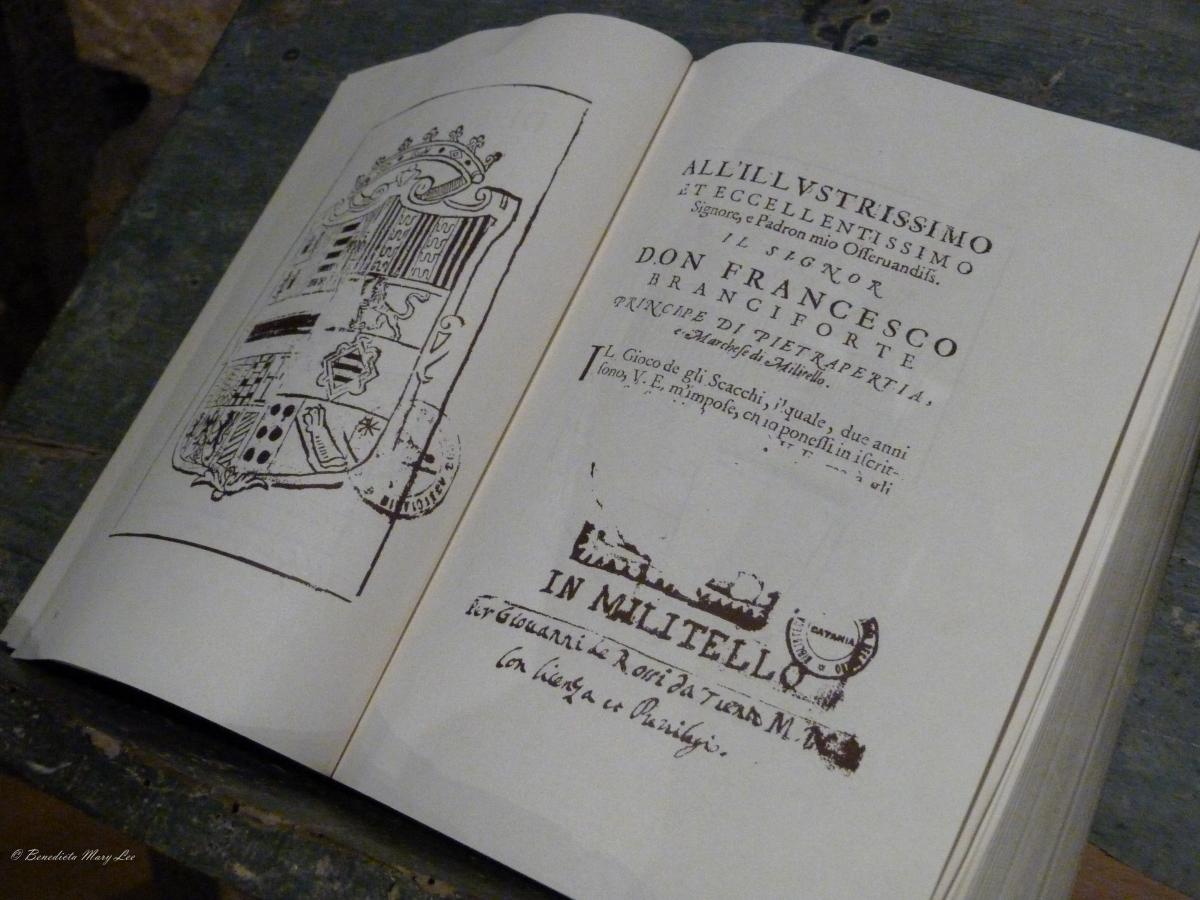
In 1617, Francesco had also founded the first printing press of eastern Sicily, sold by his wife Giovanna in 1622 at his death and then transferred to Catania. The first book published by the presses of typography (perhaps 7 in all) by Prince Branciforti was Il Gioco de gli Scacchi by Pietro Carrera (1573-1647), published in 8 books in 1617.

Carrera is an important source for the history of Militello and of the church of Santa Maria, of which he was chaplain: court reporter, he left some writings remained unpublished until the last century.

The Game of Chess was a real publishing success, a "historical" manual of the discipline, recognized as the largest Italian chess treatise, important both from a theoretical and a social-historical point of view.

powered by social2s

The "Luigi Rossi Dainelli" Civic Museum of Viterbo is a collection of finds that traces some moments in the history of the city from the Roman Etruscan period and a Pinacoteca, collection of paintings from the Middle Ages to the modern era.

Most of the exhibited material comes from the Collection that Luigi Rossi Dainelli donated to the municipality and a collection begun in 1400 by Friar Annio from Viterbo. Friar Annio is famous for having also been one of the first forgers: it was his custom to create artifacts and to place them in order to find them in the hands of illustrious characters such as Pope Borgia, or his collection "Antiquitatum variarum" of 17 volumes in which he recounted an original version of the history of the world in which the Etruscans were made to descend directly from Noah who must have stopped in Tuscia after the Flood".

Another rare piece that comes from Friar Annio is the Osirian marble, a slab created by the  union of two medieval pieces which, according to the friar, was actually the fragment of a triumphal column that Osiris had given to Viterbo during his passage through these territories.

The Roman finds come from Ferento, an ancient Roman city 6 km from Viterbo abandoned with the fall of the empire and the arrival of waves of barbarians when the population preferred to take refuge on fortified hills.

In the Pinacoteca there are two wonderful paintings by Sebastiano del Piombo, a Deposition in 1515, on the back of which is a charcoal attributed to Michelangelo, and a Flagellation of 1517. Also noteworthy is a polychrome ceramic by Andrea della Robbia, nephew of the famous Luca della Robbia.

Another special section comprises 56 sketches of the Carriage of Santa Rosa dating back to the eighteenth century and copies of the frescoes by Benozzo Gozzoli that once adorned the church of Santa Rosa. The ceremony and the Festival of Santa Rosa in Viterbo is part of the Intangible UNESCO World Heritage. 

The museum is located in the former 14th century monastery of the church of Santa Maria della Verità, just outside the walls of Viterbo

powered by social2s

The Diocesan Museum of Albano Laziale is located in the Bishops Palace, or Palazzo Lercari, built in 1727 by Cardinal Nicolò Maria Lercari. The palace is located inside the ancient perimeter of the Second Partic Legion camp, and was built on the Roman ruins of the "small thermal bath" .

The collection is spread over the three floors of the building: a floor entirely dedicated to archeology and two successive ones that house an extensive collection of sacred art. Paintings, sculptures, fabrics and liturgical vestments from the territory of the Diocese of Albano.

The Palazzo Lercari nowadays is an important structure that every year organizes a rich calendar of events, conferences, exhibitions and concerts.

powered by social2s

'La Torre di Dante' (Dante's Tower) is the name of Lorenzo Indrimi's permanent exhibition dedicated to the Divine Comedy which is located inside the tower of the Town Hall of Sabaudia.

The exhibition was inaugurated in 2008 and collects images made with various techniques: 200 engravings, drawings and paintings.

In the 46 meters of the Tower one ideally crosses Inferno, Purgatorio and Paradiso (hell, purgatory and heaven) with some videos made by the director Paolo Pasquini.

powered by social2s

The Educational Museum of Printing is the result of a permanent didactic exhibition of printing that traces the history of the typography brought to Montefiascone in 1695 by Cardinal Barbarigo. The cardinal was the true founder of the Episcopal Seminary that led to socio-economic rebirth of this village of Tuscia, making it an important point of attraction.

Among the endowments of the seminar, the cardinal also wanted to set up the Typographia Seminarii, which at the time was avant-garde and multicultural, being endowed with Latin, Greek, Hebrew and Syriac characters.

In 1892 the Tipografia changed its name in honour of Silvio Pellico and still today operates as an entrepreneurial and cultural activity.

In the exhibition the characters and the ancient typographic machines are displayed and there are rooms from an ancient laboratory with the composition, printing and binding departments having been reconstructed.

powered by social2s
Crafts exhibition
Crafts exhibition

In the historic building that once housed the municipality of Jenne and which is located near the main square in the alley that leads to the fortress, you can visit the permanent craft exhibition.

Along the two large rooms on the ground floor it is possible to admire and buy the products made by local artisans, ceramic works, fabrics made on the loom and knitwear made with irons. Also on display are some paintings by local artists representing Jenne, the Simbruini Mountains and the Aniene Valley.

powered by social2s

The Mariana library is located inside the Seminary Palace (Palazzo del Seminario) of Anagni and is owned by the diocese.

The palace dates back to the beginning of the eighteenth century even if it was built by modifying pre-existing medieval buildings.

There are manuscripts, codices and about 20,000 volumes and pamphlets, as well as incunabula (book printed before 1500).

About 1,000 editions from the 1500s and from the 1600s, 1700s and 1800s.

powered by social2s

Subscribe to Newsletter

Discover a territory through the emotions of the people that have lived it.