In the locality of La Marmotta of Anguillara Sabazia a neolithic village was discovered dating back to about 8,000 years ago.

It is now submerged by the waters of the lake.

During the underwater excavations, important finds were recovered, including five pirogues (canoe) in particular.

One of them is visible at the National Museum of Prehistoric Ethnography Luigi Pigorini in Rome.

Another one is 9.50 meters long and originally split into two parts, was found on 12 July 2005 at a depth of 12 meters.

Today is kept in a 12-meter shrine containing substances that require stabilisation at the Neolithic Exhibition Centre in Anguillara Sabazia, located near the train station, in via Anguillarese.

powered by social2s
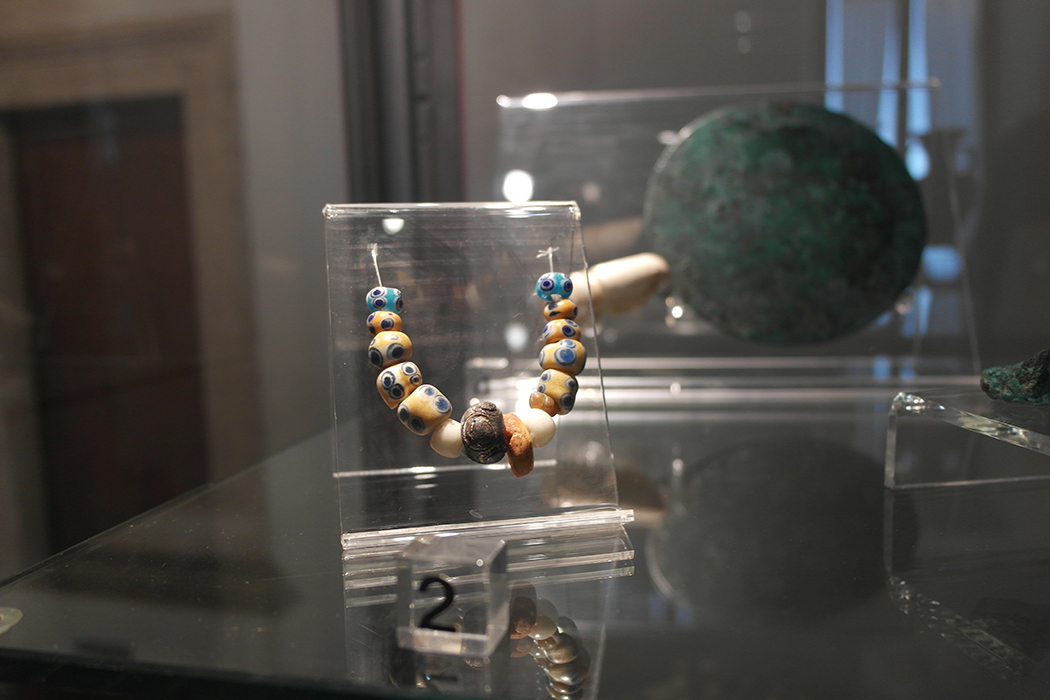
Collana in vetro e ceramica Epoca Romana
Palestrina - Museo della Dea Fortuna - Collana in vetro e ceramica Epoca Romana

The Archaeological Museum Prenestino of Palestrina is inside the Barberini Colonna Palace, at the top of the Ancient Temple of Fortuna. It houses many relics from the important roman city of Preneste and city's cemeteries. The Fortuna Temple was one of the most important roman temple during the first part of the Roman history visited every year by thousands of pilgrims.

Of particular importance is a large mosaic of Nile depicting the exotic landscape of the Nile 80 BC (dimensions 5.85 x 4.31 m) which was in a hall of the Republican Forum. It is one of the few examples of a Republican-era mosaic.
The museum also houses one of the best preserved specimens of the sculptural group of the Capitoline Triad, which depicts Jupiter, Juno and Minerva together.


The Roman Calendar of the National Archaeological Museum of Palestrina

In the Roman world the day count was linked to the lunar phases. Every month had three main days: the calends were the first day and coincided with the new moon, the nines fell with the first quarter of the moon, nine days before the Ids that coincided with the full moon phase.

All other days were indicated with the "countdown" compared to the fixed days. The year began in March and was a 365-day event. The calendar lasted 304 days and there were about 61 days of winter that were not assigned to any month:  after December, we stopped counting the days to resume the count again in March.
In order to balance the counts, with the reform of Julius Caesar the Julian calendar was established in 46 BC. The latter brought the duration of the year to 365 days and introduced the leap year.

Caesar also introduced the internal subdivision of the month, linked to the market days. Also indicated were the days on which public and festive activities could be carried out, in capital letters the most important ones and in lower case all the others.

The calendar exhibited in the new room of the National Archaeological Museum of Palestrina is a copy of the Fasti Praenestini Calendar developed between 6 and 10 AD. Of the calendar, engraved on marble slabs that were inside the forum of Praeneste, remain only the fragments of four months,. They are preserved in the National Roman Museum, seat of Palazzo Massimo in the center of Rome.
 

powered by social2s
Castro dei Volsci. Archaeological Museum

The Archaeological Museum is in a wing of the Madonna del Piano media school and includes 8 sections that collect all the material excavated in Castro dei Volsci territory since prehistoric times.

The museum has its own 'mascot', Artemisio's child represented in a marble slab belonging to a sarcophagus of the 3rd century AD.

The slab was only found in 1998 during the work on the church because it had been overturned and used as a doorstep.
 

powered by social2s
Fumone. Castle Museum

The Castle is the heart of the fortified village of Fumone.

An important place, once home to the feudal lords of Fumone, a prison of the Pontifical State reserved for political prisoners and an extraordinary observatory over valleys, towns and major avenues that led to the south.

From a military fortress and pontifical prison it was then transformed into a private residence only in 1588 when it was sold to the Marquis Longhi De Paolis who is still the owner.

Like every respectable castle, Fumone's castle also hosts ghosts from the past.

It is said that at night there is the noise of the armour fittings that move quickly between the rooms of the ancient manor, as well as the troubled wandering of Duchess Emilia Caietani in search of the little son Francesco, poisoned by her sisters for inheritance issues in the second half of the 1800's.

It is also interesting that, especially in the Middle Ages, the "Ius primae noctis" was in force in the Castle, that is to say, the right of the feudal lord to grant marriage to his servants, while retaining the opportunity to consume the first wedding night with the future bride.

A well inside the museum would seem to have been attached to this right.

The castle is open to the public, and the tour takes you through the halls of the first floor, the Pope Celestino V Sanctuary, the hanging gardens and the contemporary art gallery.
(Elisa Potenziani)
 

powered by social2s
Museum of the Media Valle del Liri

The Museum of the Media Valle del Liri is housed in the fourteenth-century building in Sora. it had been renovated and enlarged in the eighteenth century, the former Convento dei Minori Conventuali.

The museum is on three exhibition floors in chronological order: from Prehistory, the Volsci settlements until the Romanization and the Imperial period.

Then it continues with the Middle Ages to modern times and industrialization with the birth and development of paper mills.

The museum presents reconstructed models of the territory and of the Roman-Republican temple beneath the Cathedral of Santa Maria Assunta.

An area is dedicated to contemporary art exhibitions and a cloister for cultural and musical events.

powered by social2s

Subscribe to Newsletter

Discover a territory through the emotions of the people that have lived it.