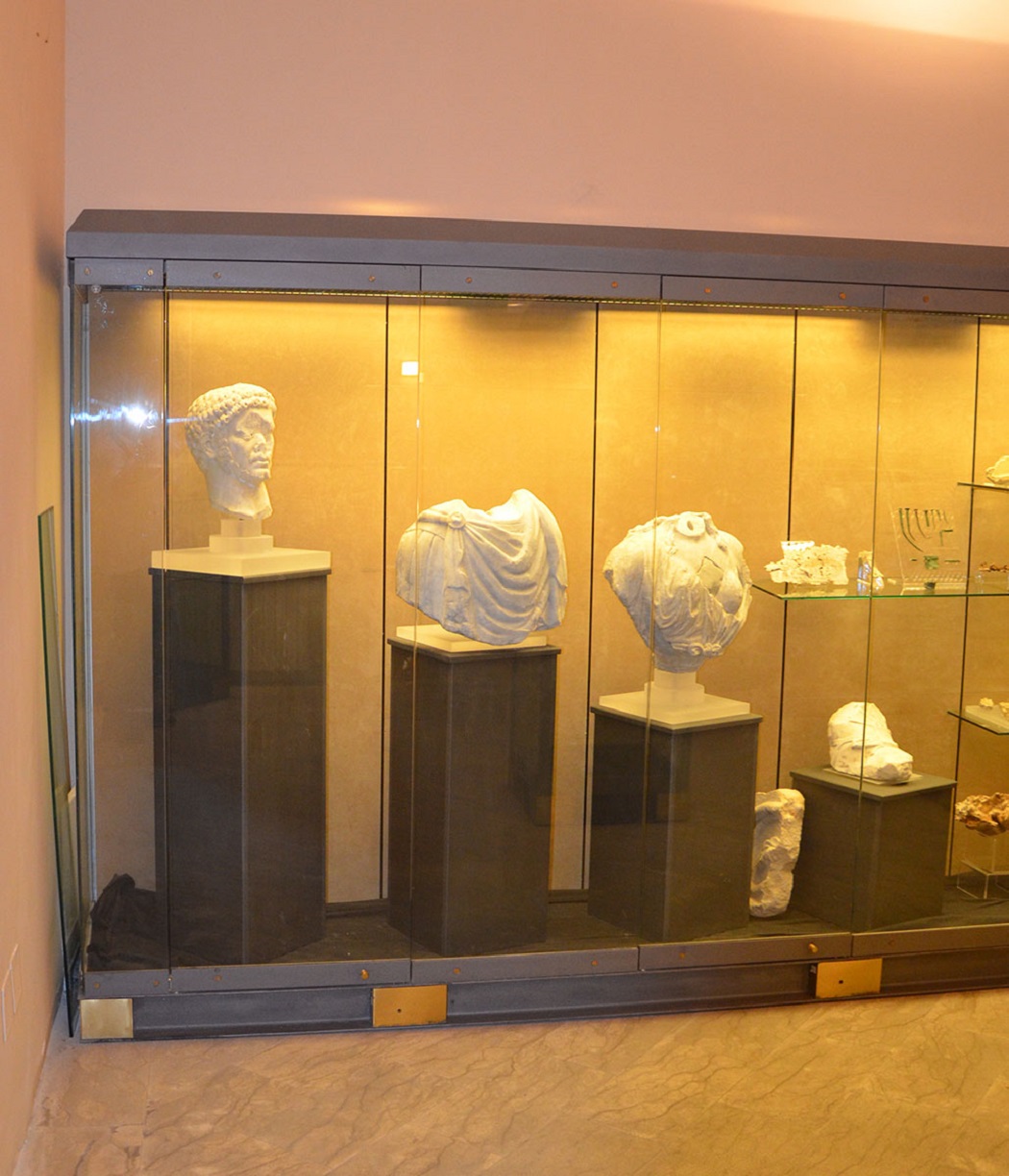
The city museum of Monte Porzio Catone collects fragments of the history of this area gathered as testimony to the past.

It is housed in four rooms of the seventeenth century Cathedral. 

The collection includes some Roman archaeological finds, a medieval papal bull, majolica of XVI-XVIII centuries, seventeenth-century paintings.

Engravings and original documentary material from the seventeenth to nineteenth century Grand Tour are adapted from models and descriptions.

powered by social2s
Casamari Archaeological Museum

The Casamari Archaeological Museum is located inside the ancient refectory of the Abbey of Casamari and tells the whole territory starting from prehistory.

You can admire tusks of elephas antiquus, burials of the age of copper, and archaeological finds that can be traced back to the populations of the Ernici and Volsci.

Then you go to the Roman city of Cereatae, which was active until the barbarian invasions of the fifth century AD.

In the museum are inscribed epigraphs with dedications to the emperors Caracalla and Adriano and a collection of votive objects that includes statues and representations of part of human body for which a grace was required.

The Middle Ages are represented by a detached fresco representing the beheading of Bishop Thomas Beckett, which took place in 1169 in Canterbury.

The museum also includes a collection of paintings by great painters including Annibale Carracci, the Caravaggesco Giovanni Serodine and Francesco Solimena

powered by social2s
Archaeological Civic Museum

The Archaeological Civic Museum of Veroli is located in the town hall building and is dedicated to Hernia and Roman civilization.

One of the most interesting pieces in Veroli's history is a Latin epigraph reminiscent of Gracco, prefect of the smiths, and one that recalls the duumviro Lucio Alfio, which was part of a monument from 197 AD.

Many exhibits have been donated by citizens or come from the various works of arrangement of the cryptoporticus under the palace, a network of passages dated between the I-II century BC under the central square that connect the main buildings of Roman time.

The findings then start from the Roman Republican era and arrive at the medieval one.

A portion of polygonal walls, a reproduction of the Roman calendar, Fasti Verulani, and a collection of precious ceramics complete the museum's collection.

powered by social2s
FOTO CLAUDIO PASQUAZI
Valmontone. Archaeological museum

The Valmontone museum collects the artifacts recovered during the works for the construction of the High Speed Train between Rome and Naples.

In fact, the railway line follows the route of the ancient Roman roads, several post stations with adjoining spas and pre-Roman villages have been found.

Of particular value is a Roman sarcophagus and part of a funeral kit of the 'Maiden of Valmontone' with a wooden comb and a large leather and bronze pendant.

powered by social2s
ph Gavin Tulloch
Ventotene. Archaeological Historical Museum

The Archaeological Historical Museum of Ventotene is located inside the former Bourbon Fort, was born to enhance the Roman remains of the island and several wrecks that testify the obvious link between Rome and Ventotene. At the entrance there is a model of the island in the Augustan age.

Among the finds recovered from the sea: amphorae of different period and type, three strains of anchor, a large dolium and other object. One section is dedicated to the villa of Punta Eolo and the last one has models of Roman cisterns and of the spa facilities of Villa Giulia.

A Bourbon coat of arms and a bust of Tiberio and the visit.

powered by social2s
ph Claudia Bettiol
Segni. Archives of Innocent III

The Archives of Innocent III is located inside the 12th century Episcopal Seminary of the town of Segni, in the upper part of the town where the acropolis once stood.

The building had been built by Pope Eugenius II who had lived there and other popes such as Lucius III, Alexander III and Innocent III, to whom it is dedicated, also stayed here for a short time.

The building was transformed into a diocesan seminary in 1709 and in the nineteenth century it was expanded with a new wing that now houses the Innocent III Archives.

The archives contain all the documents of the church from the fifteenth century: archives of the Chapter, bishop archives, marriage records and civil acts. The archive is very active in promoting the area around Segni through the rediscovery of its history.

For example, an incunabulum was discovered, a book printed with the movable type technique that was used between the mid-fifteenth century and the year 1500, which tells the story of the discovery of the statue of Laocoon.

This date is important because it is at the beginning of the Vatican Museums and in their profile the year of the discovery of the statue in a garden is indicated because from this find the immense collection was donated which can now be visited in the Vatican Museum, among the most important in the world.

The sculpture of Laocoon dates back to the first century AD and was believed to have been found in a vineyard on the slopes of Colle Oppio on 14 January 1506.

In Segni's incunabulum is a copy of an edition of the Naturalis Historia by Pliny the Elder printed in Venice in 1491 by the editor Tommaso de' Blavis, instead, given the discovery on 10 January 1506: gave four days more of life and a birthday for the Vatican Museums.

The story of the discovery with the date in a note next to the text of the book was written by the book's owner, Angelo Recchia de Barbarano (1486-1558) who was a jurist.

He had been in the service of the capitoline magistrature and of the Apostolic Chamber and then of the La Sapienza University conservatories in 1557: he had obtained in 1553 the honorary citizenship of Rome and his grave stone is in the church of Sant'Agostino in Campo Marzio.

powered by social2s
Segni. Archaeological Museum

The Archaeological Museum is located in the ancient Town Hall, which dates back to the 13th century and is located just behind the cathedral in the heart of the historical centre of Segni.

Through a didactic route, the history of Segni is traced from the pre-Roman period, through the Roman and medieval.

The museum has precious statues, sacred and funerary inscriptions and a collection of ceramic material.

The museum helps to understand all the different eras that are found in the historical centre of Segni where medieval buildings were built with parts and decorations from previous Roman buildings.

powered by social2s
Sermoneta. Museum of Ceramics

The Museum of Ceramics of Sermoneta shows the production of ceramics from prehistory to the twentieth century in the various towns where excellent pieces were produced such as Deruta, Faenza and Viterbo.

The collection includes pottery, funerary objects from the necropolis of Caracupa, and votive objects in terracotta. The museum is divided into three rooms.

powered by social2s

Subscribe to Newsletter

Discover a territory through the emotions of the people that have lived it.