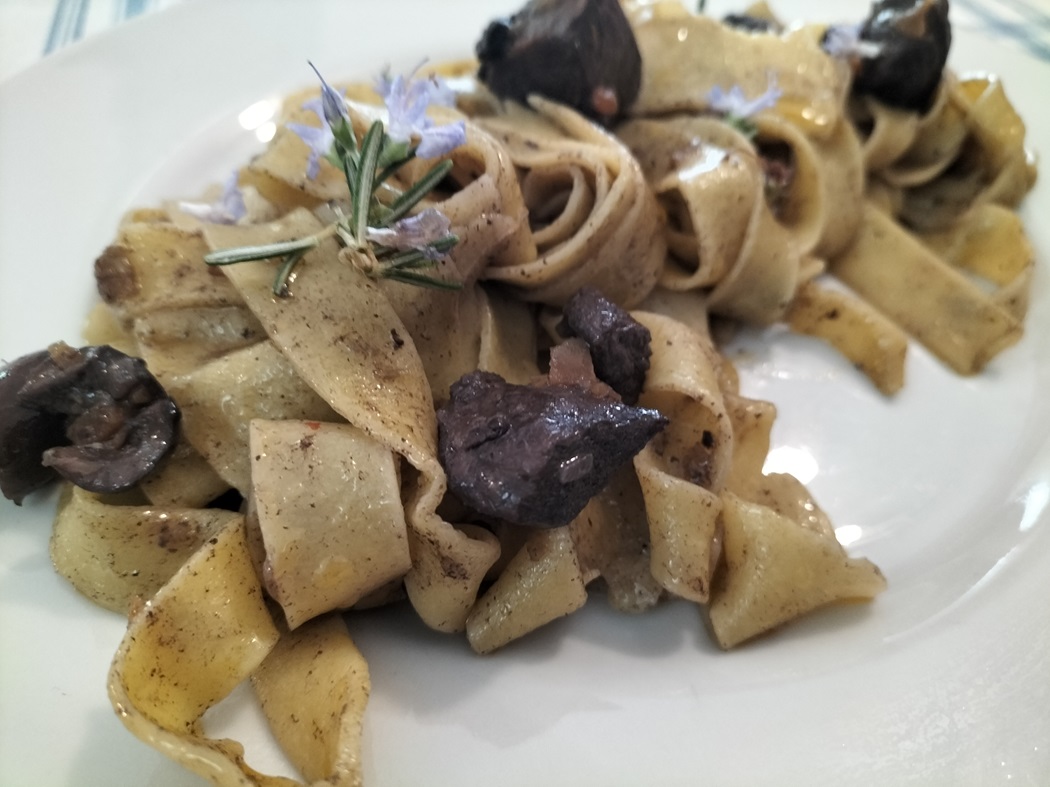
Baccalà (cod) is fish too: baccala croquettes with chickpea soup

I write this story while raising the flag of San Marco, a gift from Saturday morning from Venice. What does the cod have to do with San Marco? It is thanks to Pietro Guerrini, a Venetian merchant of the fifteenth century, that we know these splendid (and above all tasty) products.

This brave merchant in search of new opportunities was shipwrecked in the Lofoten Islands of Norway and was hosted by the people of Røst Island for a year before he could return to Venice. During this period he was able to get to know their cuisine and learn how to treat cod.

I don't know how it was to have to eat cod for a year with the Norwegian recipe ... but his mercantile spirit of a good Venetian made him start a trade with these islands and discover a product that has rightly entered many Italian kitchens.

Without the Norwegian ability to preserve cod, the fish could not have come far from fishing grounds. Of the fastest fish of the Baltic there are two variants of preservation: two completely different products derive from this, never to be confused: stockfish and (baccala) cod.

The first, the stockfish that in Naples is called the "stocco", is obtained by drying the fish in the sun in the strong north wind in Norway and is produced only from February to June. I think everyone has seen at least once in their life the photos of fish hanging in the air like the clothes of Naples on the balconies.

The second, the most widely distributed and produced is baccala, obtained by salting. It seemed the Dutch were hunting for whales in the North Sea, given the abundance of large cod banks, and began to preserve it like whale meat through salting.

However, it was the Portuguese who introduced it to the whole world.

Both preservation solutions have in common the rehydration technique: soaking. And this is one of the secrets of cooking: soaking can last several days, often changing the water, which must be very cold. Now everywhere you can get it already "soaked" but beware, frauds are just around the corner.

I made croquettes from the baccala. Perfect for an aperitif when standing or for a course during a lunch together with a chickpea soup.

Recipe of baccalà croquettes with chickpea soup

First I steam the baccala for a couple of minutes and boil at least one potato. Once it has cooled, I reduce the cod into a pulp and add it to the mashed potato in the potato mash. I recommend: all strictly cold.

You don't need any salt yet, if you want you can add a little pepper. Let the mixture rest in the fridge and then place the baccala balls in breadcrumbs and fry in abundant oil.

We come to the chickpea soup: here too the "soak" is fundamentally important.

In a saucepan start with a clove of garlic and chopped celery, carrot and onion. When they have taken up flavour we add the chickpeas, the water and the salt (the rule is by tasting).

Cook for about twenty minutes and then put everything into a blender until smooth. Serve on the plate, with the croquettes, with a drizzle of good oil and a sprig of fresh rosemary.

I drank a Trebbiano Teramano, a perfect marriage that convinced me. But make sure it is cool!
powered by social2s
Traditional Frascarelli pasta with "Fagioli Solfini" is Tuscia in a mouthful

Tuscia, the land of the Etruscans, the name Tuscia derives from the Latin pronounced ‘tuskia’. We owe much more to the Etruscans than we imagine and sometimes it is nice to taste the flavours of Tuscia and remember the past.

The Etruscans were the only people who, like us, had their two main meals sitting, or rather, they were lying down. Women could also participate in their banquets eating and drinking together, they were innovators.

Tuscia was a very rich region and from the paintings on the tombs we know that grapevines and olives were cultivated, which perhaps Etruscans had brought to Italy, and animals were raised. They had a very rich diet of proteins: they ate game, legumes, vegetables at a time when many civilizations struggled to eat, the Etruscans had plenty of foods.

Today's recipe does not have such deep roots but the ingredients smell of Tuscia. The beans we will use in this recipe are the "solfini" and are the sons of the beans that arrived from the Americas, and not from northern Africa like those used by the Etruscans. The solfini (sulphines) are relatives of the verdelli beans and cousins ​​of the zolfini of the Val d'Arno and have found their habitat in the volcanic soil around Lake Bolsena.

Solfini beans and frascarelli, a traditional pasta of water and flour, are the main ingredients of this soup.

Recipe of the Frascarelli pasta with Solfini Beans

Take the dried beans and soak them overnight in water. The next day boil them for about 1 hour in water flavoured with sage leaves, a bay leaf and a clove of garlic. We will only salt it almost at the end of cooking.

While the beans are cooking we prepare the frascarelli which are a pasta of water and flour that takes their name from the ‘frasca’, a tool that was used to wet the flour. In fact, the flour is placed on a pastry board and with a branch the flour is splashed with a rotating motion. Then the flour is turned over and in contacting the drops of water, will create irregular balls, the frascarelli.

For the soup, in a pan we prepare the base by putting oil and garlic that we brown. Add the beans when ready, and flavour the whole thing. Then we will blend 3/4 of the beans with an immersion mixer while the remainder will be kept for the final dish.

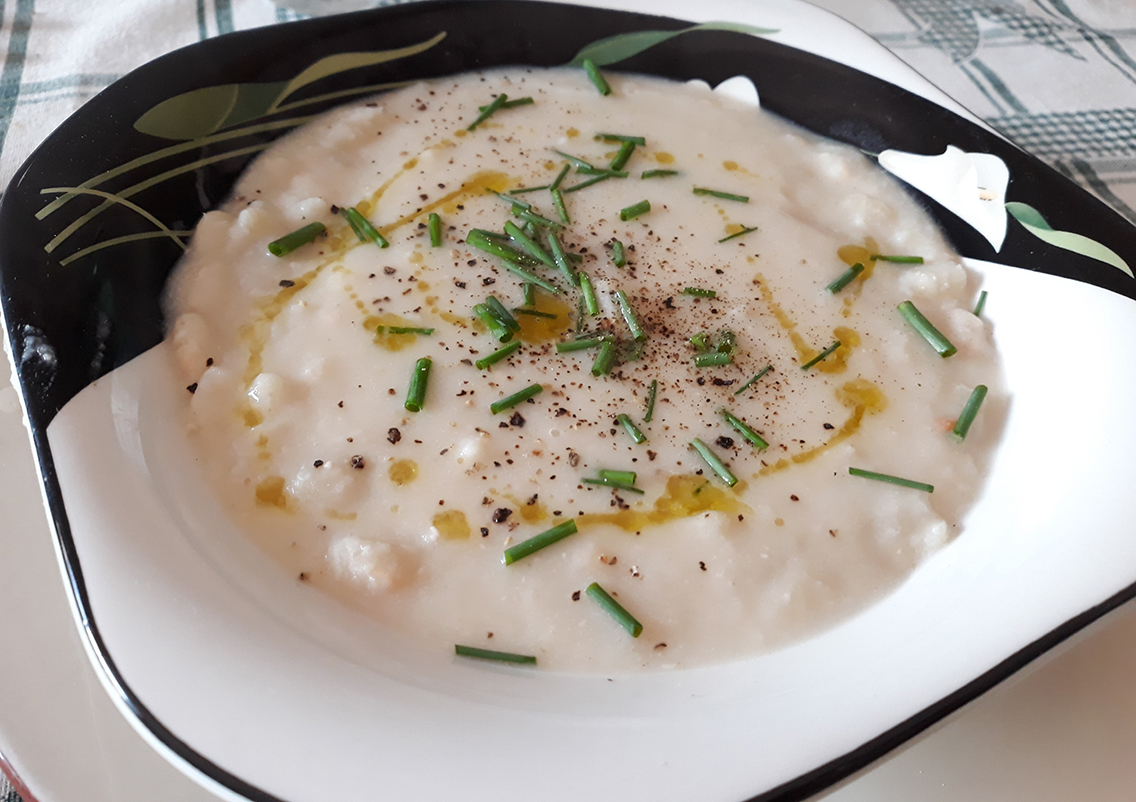
At this point we add water or vegetable broth and bring the water to the boil again in order to cook the frascarelli. When the pasta is cooked we serve it in a deep dish decorating with chives, freshly ground pepper and a splash of oil and some of the whole beans that we had left aside.

The wine? Staying in Tuscia I would say a Montefiascone, a "Luce del Lago" made with Roscetto grapes left to macerate at low temperature to maintain the aromas. Then the grapes are subjected to soft pressing with a maximum yield of 60%. Thanks to this procedure, a delicate wine is obtained exactly like the dish.
Flavours of Tuscia that go so well together as far as giving a good mood.

powered by social2s
U Pisce: Eggplant stuffed with Swordfish

In Sicily the fish par excellence is the (Spada) Swordfish, which for the men of the strait is known only as U Pisce. Like tuna from Favignana, swordfish is the emblem of Scilla and Ganzirri on the Sicilian side of the Strait of Messina.

The strait ... also written about by Homer in the Odyssey that tells the danger of those beautiful waters. Scylla and Charybdis. The Strait has its own unique charm due to the danger of strong currents, the extreme beauty of the Calabrese and Sicilian sides and the many legends that surround it.

The strait is a physical place but it is also a philosophical place, a cultural separation that has allowed the confluence of so many different experiences that have shaped a myth.

Swordfish has been hunted in this strip of sea for centuries following an ancient, almost mystical, old technique, where religion and fishing come together. The first stories date back to the Greek writer Polybius, and this is not surprising because we are in the ancient Magna Graecia.

But the iconic image of fishing for swordfish is that of the felucca, a particular vessel of Arab origin that arrived around 400, characterized by a small tower and a long gangway in the bow where the harpoon rests.

Today this tradition is relegated to a sort of fishing tourism, commoditised, but once this fishing followed almost religious rituals. There was a hierarchy among the 5 crew members and the fight with the swordfish had to respect the courage and strength of this great fish.

Hearing the stories of the old fishermen or reading their stories, it almost seems to be immersed in some passages of Moby Dick, the symbolic book of America that tells the story of the great white whale.

The fisherman had to follow the harpooned fish until it was exhausted and surrendered to the man. At this point, as soon as it was hoisted aboard the felucca, the fisherman made a cross near the gill as a sign of respect.

But perhaps one of the symbols of this fishing is admirably told by Domenico Modugno in his song "U pisci spada" that tells the story of two swordfishes. In fact all the fishermen know that often when they take one of the members of a couple, the other fish does not abandon the companion and follows him until he is captured with him.

This is a story of love and death that makes me cry every time I listen to it again.

Recipe for Eggplant stuffed with Swordfish

Scrape out the aubergines and put them in the oven, covered with olive oil, for 10 minutes.

Cut the swordfish fillet and some tomato into cubes. In a pan put some sliced Tropea onion and a clove of garlic: sauté for a couple of minutes on high heat and add the fish and tomato.

Fill the eggplant with this and cover it with grated salted ricotta. The ricotta should not melt and will make a golden crust. Bake for 20 minutes at 200 degrees.

In this season the oven is a test of courage, I know. But it's worth it.

The wine? A Grillo from Trapani, just to stay in Sicily and enjoy its flavors to the full.

This is a contemporary vine whose place and date of birth we know. In fact it is the result of a cross between Catarratto and Zibibbo made in Favara by the Baron Antonino Mendola and written about in a document dated 1874.

Thanks to the baron and thanks to Sicily for all its fruits that we never tire of tasting.

powered by social2s
Soup of lentils of Ventotene and squid with taste and smell of the sea

The lentils of Ventotene and squid soup reminds me immediately of gozzo boats, those painted in blue that for centuries have crossed the Mediterranean. For those few who do not know it, gozzo boats are those most often blue boats typical of Italian fishermen that can be seen practically in every picture of the past.

The gozzo is slow but it goes everywhere and seems to be part of the life of the sea just like fish. I remember the nights at sea harnessed to an incredible degree because the sea gets into your bones and only a fisherman knows what I say. The wind and the salt that cut like a blade. The memory of a couple of nocturnal sea trips with the Terracinesi (fishermen from Terracina) hunting for squid.

We went fishing between Ponza and Ventotene, in that stretch of sea so rich in history. From the sirens of Ulysses to Ventotene (which are said to be the Berte – small puffin birds, permanent birds of the island) to the sorceress Circe in San Felice Circeo up to the experiments of social urbanism of the Bourbons in Ponza. You can also buy the squid at the fish market, I also talk a lot but I don't go out fishing every day to prepare an aperitif for friends.

What is certain is that you can taste the Pontine also in the dish and the Ventotene and lentil and squid soup contains all the flavour and scent of the sea.

The squid made with stewed lentils, those of Ventotene, is an ancient dish of the old fishermen of all the Lazio fishing fleets. And in Ventotene young organic farmers have now returned to produce the famous lentil. A little revisited, pleasant and easy to prepare, this can be considered a complete dish.

I like to serve it as a simple appetizer in small opaline bowls, but everyone does what he wants. But try to imagine it with the light and colours of the sunset with a glass of fresh wine and tell me if you don't feel like doing it right away?

Recipe of the soup of lentils of Ventotene and Squid

Ingredients: Lentils, squid, garlic, onion, celery, carrot, fresh tomato, tomato sauce, rosemary, red pepper, oil, salt, white wine

I boil the lentils and let them sit, they are so fragrant that I don't add anything else. I mix some of the lentils with fresh tomatoes and cooking water. If you also find the Ventotene tomatoes, don't miss them. They grow with the humidity of the sea and are not artificially watered.

In a pan I add a little bit of garlic, onion, celery and carrot and chili pepper, in very little oil (we will use it raw afterwards). As soon as the aromas are rising, add the squid taking care to put the tentacles in first then the rest. As soon as the squid have dried, I pour out some white wine.

At this point add the lentils and the fresh tomato sauce and cook for two minutes. Then I add a bit of lentil smoothie and stir in a pan for another two minutes.

Serve with a drizzle of raw oil and a piece of rosemary. Beyond the usual aperitif!

It is to be enjoyed with a Biancolella di Migliaccio, the one that tastes of hay, is the best wine for this soup. It comes from Ponza and also smells of the aromas of the Pontine sea.

powered by social2s
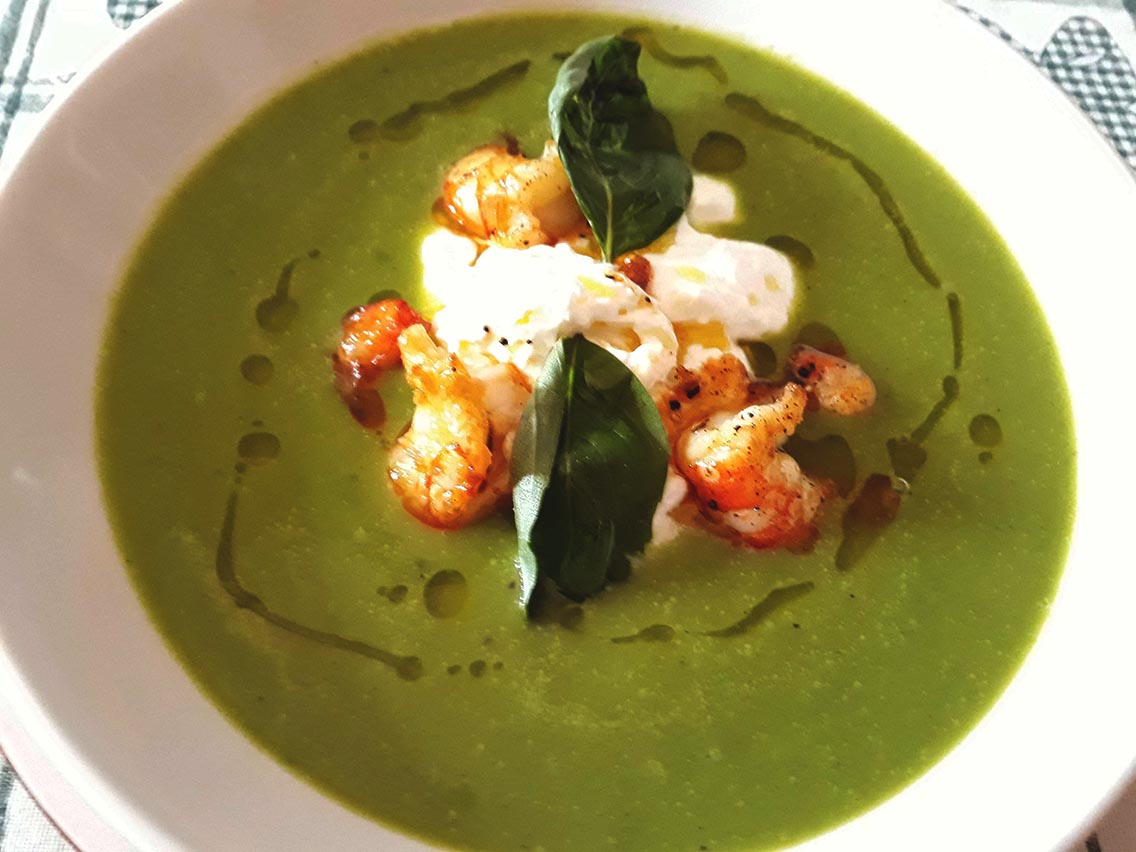
Cream of peas with stracciatella and prawns, let's discover Labico

Rome, Porta Esquilina, from here began Via Labicana one of the oldest Roman roads. Today its ancient route no longer exists, after Porta Maggiore it initially overlaps with Via Prenestina and then via Casilina.

The Via Labicana led to Labicum city of which there is no sure news, we like to believe that Labicum is today's Labico, but it is not so and the misunderstanding was born in the nineteenth century. But it is Labico who brings us back to our recipe.

Here for a very long time it was cultivated what today we would call a gastronomic excellence the "roncola labicana" a type of sweet pea and very small but clearly of very low yield.

During fascism they tried to increase their productivity but without success. Cultivation slowly disappeared until it was abandoned. Today in the Zagarolo farmers' market ancient seeds are recovered and exchanged and there can be found the Labicana pruning knife. With these peas we prepare our cream.

For mozzarella di bufala instead I always go to Amaseno, will it be a coincidence? As is known, in the lower Lazio region in the province of Frosinone buffalo rearing has always existed favored by the conformation of the territory, but the use made of milk was purely family.

It was not until the 1980s that an industrial production began and the Amaseno buffalo mozzarella and all the lower Lazio is completely different from the Campana one: it has a buttery or grainy identity. We will be biased but we like it better.

Pea cream recipe with stracciatella and prawns

Lightly fry a little shallot and a small piece of diced potato. When the shallot is gilded, shortly after, add the peeled fresh peas and let it season for a few minutes.

To get to the cooking, we add some vegetable broth and we cook it until we find the right softness for the peas ‘roncola labicana’. Then, when cooked, we whisk it all together to create a velvety cream.

Simultaneously apart we take the prawns and clean them from carapace and possibly from the black gut on the back. At this point, burn the prawns in a very hot pan for a few minutes and go to assemble the dish.

In a deep dish put the cream of peas, then in the center we put the buffalo stracciatella and on top we put the prawns. The dish ends with a grinding of black pepper and a round of Sabina oil.

The dish is ready and will surprise you. I accompanied him with a Donnaluce a Lazio wine produced by Poggio alle Volpi of Monteporzio. A Lazio malvasia with a little Greek and Chardonnay grapes that gives off an unmistakable scent.

powered by social2s
Small snack of ventresca of tuna, but let's not talk about apericena!

Let’s start with some information. Ventresca is the most prized part of red tuna or yellow-fin tuna, which is usually eaten fresh or packaged for preservation in olive oil.

Summer afternoons? A snack of skewers of tuna and cherry tomatoes is perfect.

What do the Japanese know about the true intense flavour of raw tuna! I knew it at the Egadi Islands and I also use it raw in creations that send my palate into pure joy during breaks.

It's nice to spend time with friends, the real ones, chatting on the terrace waiting for what remains of the Ponentino.

I hate aperitifs, only the ‘apericena’ (an aperitif that is as big as a meal) is worse, and they are barbaric forms of non-dining that I consider hateful, they destroy the expectation of good food.

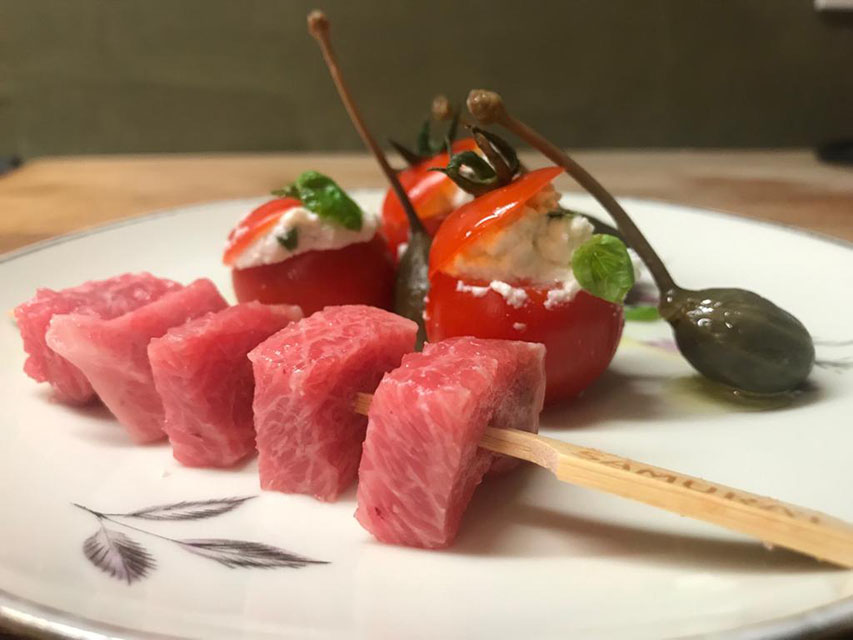
But what to use as a snack? Small pizzas and sandwiches have been beaten up so I have created something original and really tasty. Prepare some skewers with ventresca of tuna, cherry tomatoes stuffed with ricotta and cucuncio.

Don't you know what a "cucuncio" is?

It is the fruit of the caper plant, a small shrub that practically represents the southern Mediterranean. In Sicily the caper cannot be missed in the kitchen.

Normally the buds of the plant, called capers, are consumed and more rarely the fruits, called cucunci, are eaten. Both are preserved in oil, in vinegar or in salt.

Recipe of ventresca of tuna and cherry tomatoes on skewers: with Dario Magno

You always start from the ingredients and choose the ventresca, the tuna belly, the fattest and most noble part of the fish. The ventresca must be utterly raw and killed in a way to prevent surprises for our health.

I learned to appreciate this part of tuna in the Egadi islands, those on the tip of Sicily near Trapani, where they know a lot about it. Here, man has lived alongside tuna since the dawn of time and traces of cave paintings bear witness to this in the Grotta del Genovese in Levanzo.

Pachino (cherry tomatoes that always come from Sicily so that they take their name from the village of Pachino) are sweet like a cherry. I need to stuff them with sheep's milk ricotta, freshly spiced with the dried citron from Naxos, the largest of the Cycladic islands in Greece. We are always in the southern Mediterranean.

One or two grains of salt is enough! The cocunci with garnish. Le Egadi and Favignana, splendid in its sea that smells of its few products of the earth, a fantastic world that I might even die for.

So we have a small snack with a skewer and some cherry tomatoes.

It is enough to accompany a good freshly opened wine, a sprightly, alluring drink. Maybe a Sauvignon Blanc with those notes reminiscent of summer.

powered by social2s
Spaghetti with anchovies, confit tomatoes and...

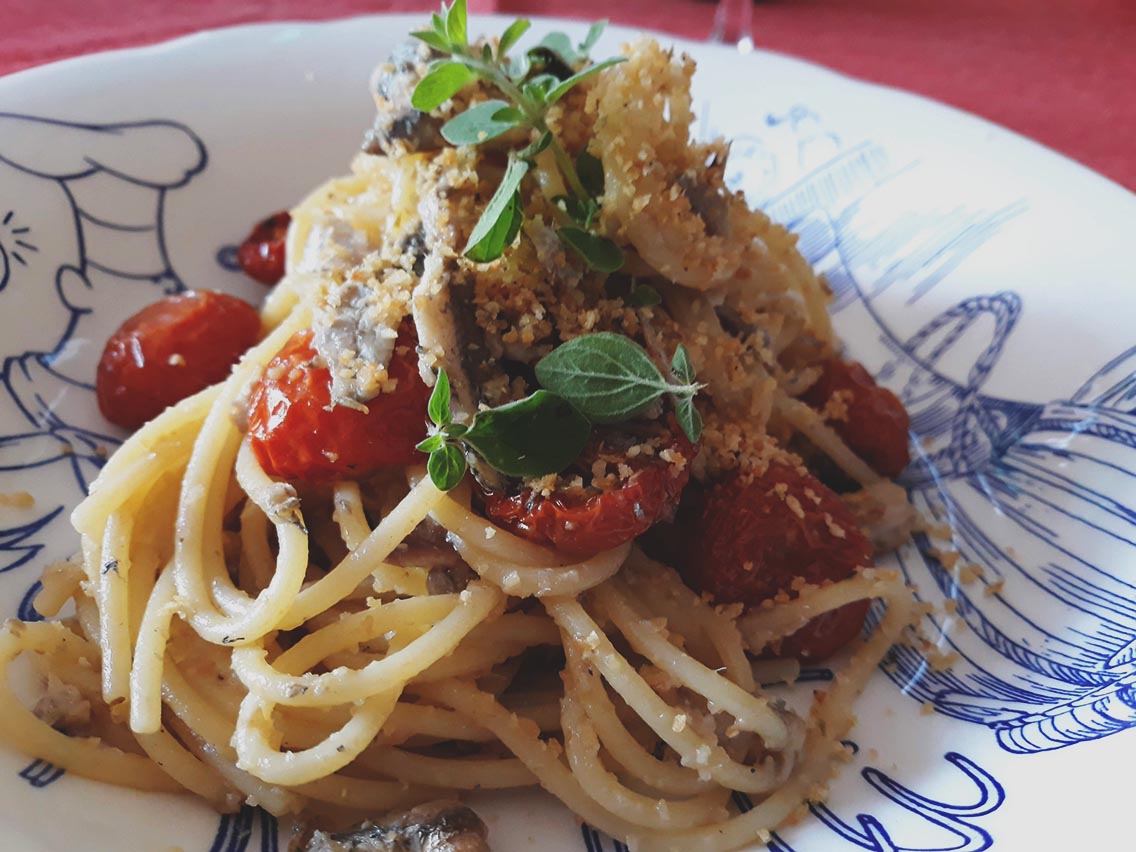
Summer, sun sea colour, even in the kitchen we bring the same sensations with a simple pasta dish, but very tasty: spaghetti with anchovies and confit tomatoes.

In this version I added two ingredients that enhance the scents of the sun and the countryside: confit cherry tomatoes and the breadcrumbs flavoured with oregano. The good oregano, the Calabrese one that tastes of salt on its own.

The confit tomatoes are either cherry or datterini tomatoes, that are cut in half along the length and put in the oven at a temperature of 80 ° - 90 ° for several hours.

In this way the tomato water is removed and its sweetness is concentrated in the bite where we taste and  can find all the summer sun.

And what about the anchovies? The wonderful blue fish with great nutritional value, are rich in Omega 3. Those I chose were from Anzio, perhaps the most beautiful fishing port in Lazio where it is possible to buy fish directly from the boats when they arrive in port in the afternoon.

Spaghetti recipe with anchovies, confit cherry tomatoes

The longest preparation are the tomatoes so we can comfortably do them the night before. So we won't even have the problem of the oven being turned on during the hot summer days.

First you have to choose the tomatoes you prefer and cut them in half along the length. Then place them on a baking sheet facing up and season with a little sugar, extra virgin olive oil, thyme and pepper.

All the oils are good, but I choose Sabina oil and go and get it at the Fara in Sabina oil mill where the oldest olive tree in Europe is also found. At least that's what they tell me at the mill.

Put the tomatoes in the oven at 90 ° and cook them for 4 hours. It seems a long time but the temperature is low and the taste is rewarded.

Then we move on to fish. We have to clean and wash the anchovies which we will then cook in a pan where we have prepared a base of garlic, oil and chilli for a few minutes.

In another pan we put a little bit of EVO oil and breadcrumbs and as soon as it starts to brown we put in the leaves of fresh oregano and make this ready too. Now we assemble the dish.

Drain the spaghetti cooked ‘al dente’ and pour them into the pan with the anchovies where we add a little of the pasta cooking water, the cherry tomatoes and the flavoured breadcrumbs. We sauté everything to flavour and serve adding oregano and little breadcrumbs.

My wine suggestion for this dish is an Etna Bianco, a wine that has inside it all of Sicily and the minerality of the land of its volcano.

powered by social2s
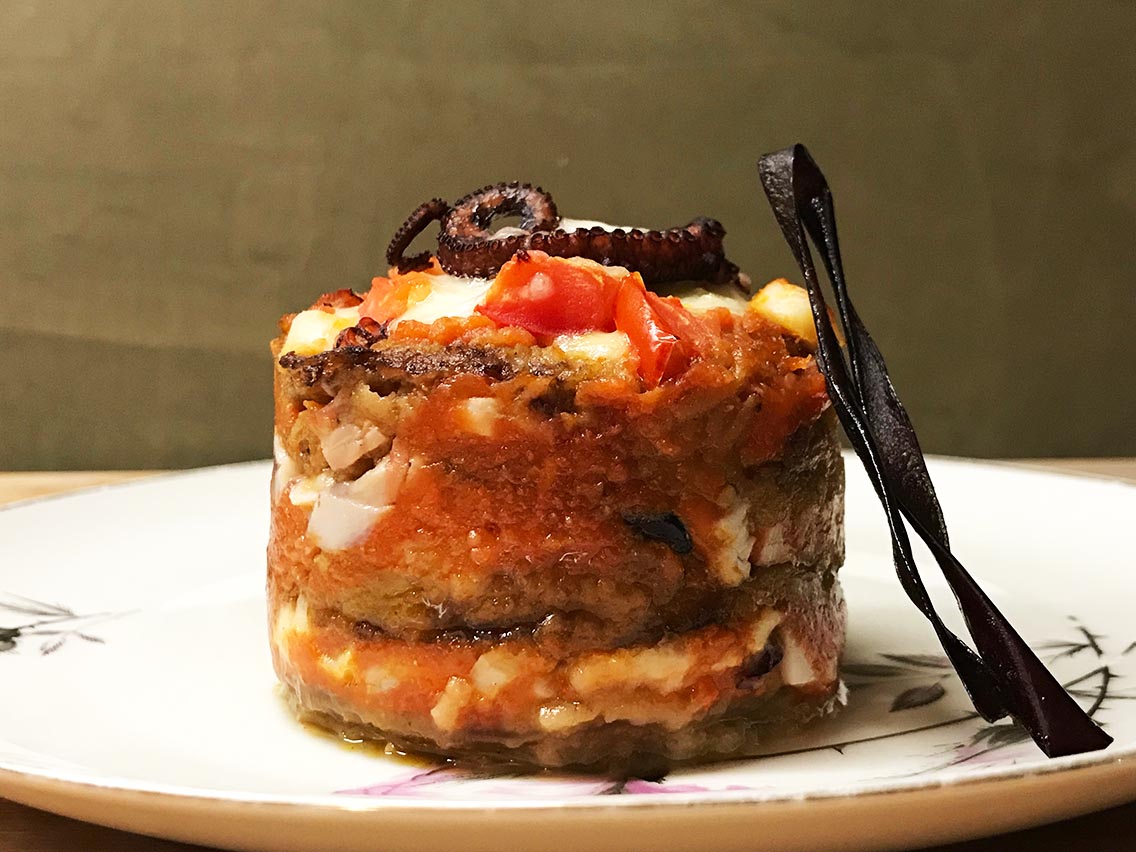
Recipe of Parmigiana with Octopus with a little history

I have a weakness for octopus, an extremely intelligent creature present in all the salty waters of the globe. Remember the octopus called Paul? He was the star of the 2010 South Africa World Cup and seemed to be able to predict the results of the matches.

I did not make an opinion about it, but I know that I have had a passion for fishing since I was a child and the octopus has always been a sought-after prey on afternoons after school. One of the favourite destinations for catching was Torre Astura, a small fortification near Nettuno that seems to emerge from the sea.

Torre Astura is actually a micro-island and can be reached from the beach via an arched bridge. It was built on the remains of a Roman villa and looking at the clear waters of the sea, one can recognize the remains of the fish ponds that emerge from the sides of the bridge. They tell us how the Roman fish lovers already bred the octopus.

Not far from here, a little further south, Emperor Tiberius raised his morays in his Sperlonga villa. The legend tells that they were fed with the remains of slaves. That was my favourite fishing ground, bream, sea bass, octopus in the caves.

It seems that Torre Astura was a villa of Cicero and probably Augustus, Tiberius and Caligula stayed there. The construction of the Tower dates back to the Middle

Ages to defend the port from Saracen raids.

In 1268 the young Corradino of Svevia, nephew of Frederick II, was captured at Torre Astura. With him the story was at a crossroads and could have taken a completely different direction.

It was then a fortification of the Caetani, lords of the Pontine marsh and those of Pope Boniface VIII. In some papers Astura is cited as a station on the Via Appia. Today Torre Astura is a splendid place with a pine forest by the beach, Mediterranean scrub, perfectly preserved because it is located inside a military area.

I also remember some scenes of the 1972 Pinocchio drama, directed by Luigi Comencini and with Nino Manfredi and Gina Lollobrigida.

Once our visits were like, clandestine. But perhaps it is better not to tell too much the bravado of a time that you did not share ...

Returning to the recipe, I found this combination interesting, and I must say that after trying it, the result is amazing. Select the best octopus at the market, fishing is a struggle !!

Recipe of the Parmigiana with the Octopus

Take the octopus and clean it by emptying the head and removing the beak. At this point it should be boiled, but first you need to do a treatment to make it softer and here tradition comes to the advantage. With the meat tenderizer it should be “massaged” properly for 5 minutes to break the ribs so that it will be more tender.

Another simpler and more modern option is to keep it 2 days in the freezer. But in this case you can no longer tell friends "I got it fresh, fresh ...".

The first method therefore gives me more satisfaction.
After boiling in the pot remove it from its cooking water only when the water is completely cold. Then the octopus should be cut into thin rings.

At the same time, aubergines are prepared that are put under a slab so they drain and are sweeter. Coat the aubergines with flour and fry them.

In another saucepan, prepare a thin tomato and basil sauce.

At this point we are ready to prepare the parmigiana and proceed to the assembly alternating the ingredients on a regular basis: eggplant, octopus and mozzarella layer all covered with the sauce. I recommend: the mozzarella should be drained first otherwise it makes everything watery.

Bake 20 minutes in the oven at 170 degrees.

The wine to accompany the Parmigiana with the Octopus? Definitely a white with a good acid structure: a Trebbiano.

powered by social2s

Subscribe to Newsletter

Discover a territory through the emotions of the people that have lived it.