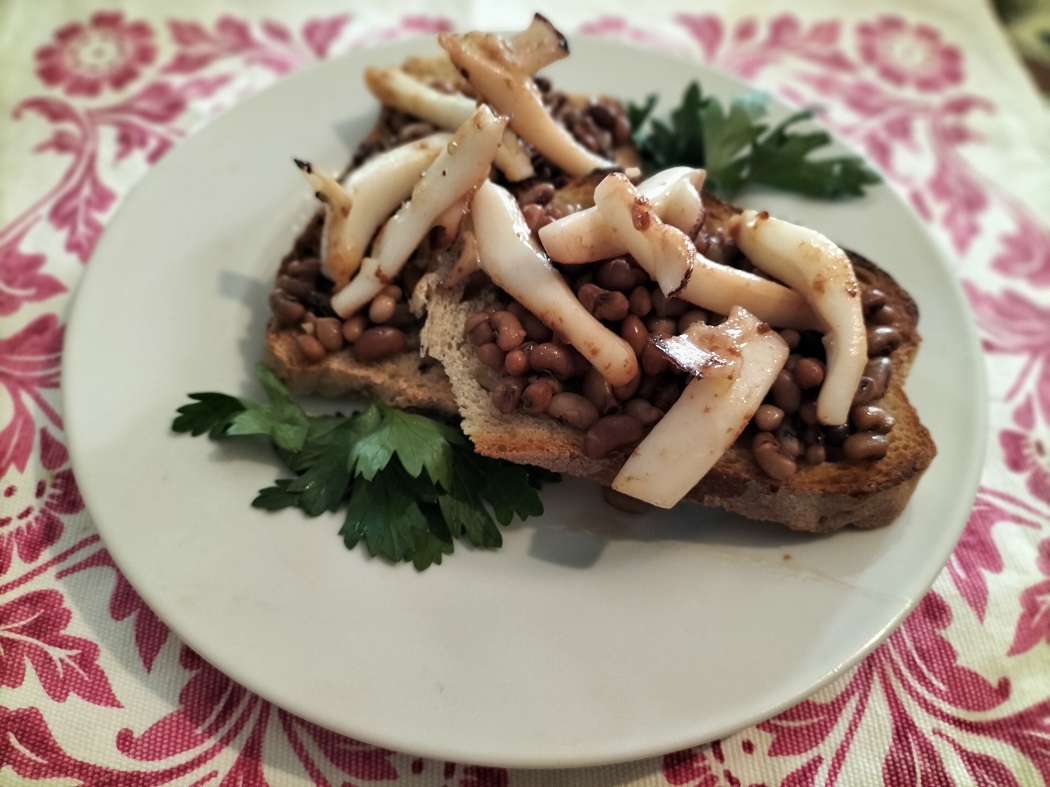
U Pani cunzatu, the Sicilian seasoned bread

‘U Pani cunzatu’ is the memory of a family tradition, a treasure that came to me "hand picked" from the sea.

I come from the sea ... I come from summer mornings awake at dawn ... early, very early for fear that my dad wouldn't wake me up to take me to work with him. I was small and "female" ... and the marina was not the ideal place for a child.

But I've never had problems of this kind.

I come from dawn with a view of the Coda della Volpe, the rock under the viewpoint of the thermal baths where we all stop to enjoy the view of the sea during the beautiful days.

I come from the voices of the sailors who "abbanniavano" (shouted) from the quay the "size" of the anchovies and the cost. They call it auction, but it was a big mess to me ... people screaming for fish.

Once bought, the fish was followed by a phone call to the "salty warehouse" (now called the canning fish industry hall) and an organizational machine of no small importance was set in motion.

"Li fimmini" (the workers) who "waited for the call" went to work in the blink of an eye or waited for the van to pick them up.

In the meantime, the anchovies arrived at the warehouse, were unloaded and immediately placed in the tubs with the brine so that the fish "ntostava" (stiffened). The story of this hard work, of their people and a tradition of Sciacca relives in one of the experiential tourism projects.

It is the story of 4 generations ... starting with my great-grandfather Nicolò Barna, who was made a knight of labour by King Vittorio Emanuele on January 15, 1932, then my grandfather, my father ... up to me.

Tales that from the sea of ​​Sciacca reach far ... very far.

The workers (li fimmini) during the winter months when the already mature anchovies were filleted to put them in oil, used to have lunch with "pane cunzato", seasoned bread.

It was a tasty and ingenious way to save in times of economic hardship. So the worker only bought bread in the morning before going to work.

When it was time for "lintari" (to disconnect from work for the lunch break), she took some of the freshly processed anchovies with her to the canteen, she added a little oil from that area and a little salt.

She came up with one of the best delicacies of Sicilian poor cuisine "u pani cunzatu".

Many times the workers, even if they only had that piece of bread, used to share it with "i salatura" (the men who managed the warehouse and the processed product).

Because?

Because in a small community of "salt warehouse" one did not feel like colleagues but part of a family.


powered by social2s
'Zocchi' and the Fini Fini, pasta made in Torre Cajetani's homes

Nowadays, food and wine have great prominence on all media. There is no TV or newspaper channel that at least once a day does not talk or "tell us" about a dish.

After all we are in Italy, world’s best in this field. Each town has its own peculiarities, and we at Torre Cajetani also stand out from the others.

Many times when we talk about Lazio cuisine we refer mainly to the dishes of the Judeo-Roman cuisine but hardly ever do we talk about the rest of the areas near the capital.


Even the Amatriciana and the Gricia, dishes from the Rieti cuisine, at least until recently were combined only with the cuisine of the capital.

We have a culinary curiosity about Torre Cajetani when talking about zocchi: a type of pasta made with water and flour and cut narrower than the most common sagne (long fresh pasta).

Sagne is perhaps the most characteristic dish of Ciociaria and is mainly used for soups, in fact, given their shape, you never knew how to eat them, whether with a fork or spoon. They are also prepared with tomato, or made into soup with beans and cut into large squares.

Also among the pasta made with water and flour there are ‘cecamariti’, a sort of long dumpling.

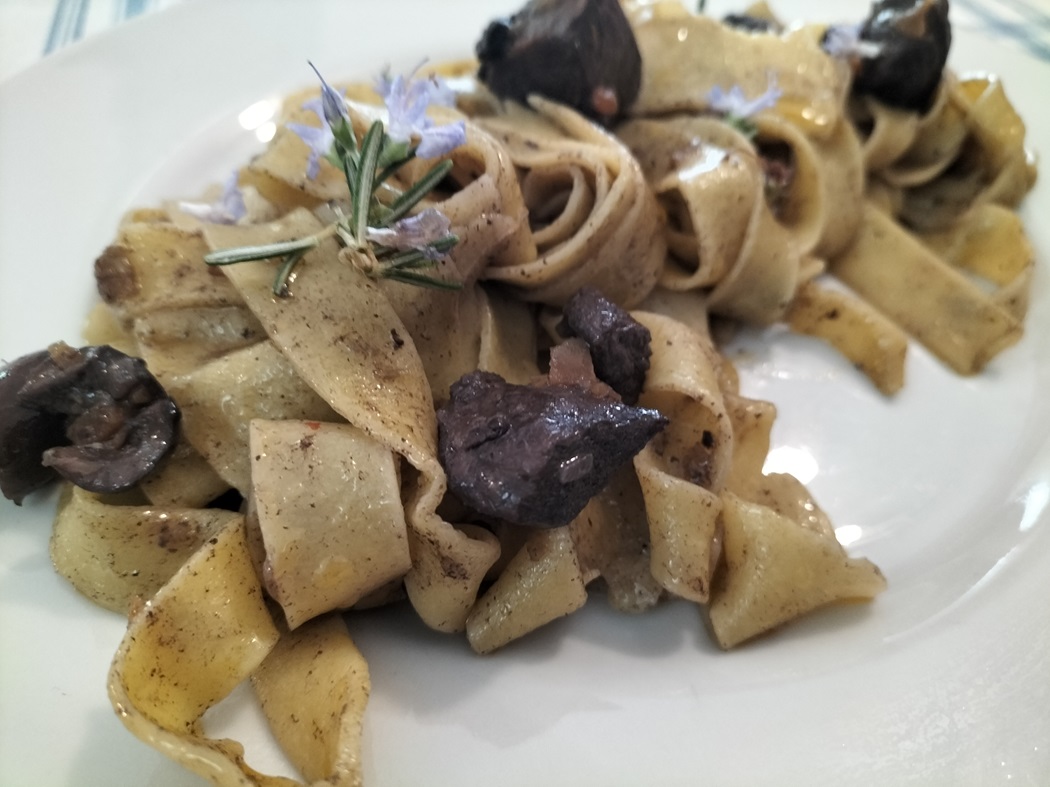
But speaking of the world of home-made pasta, we must also mention the famous egg pasta such as fini fini or taglierini seasoned with simple sauce or in a broth and macaroni, a little larger than taglierini and which are seasoned with chicken giblets.

Then among the first are the fettuccine, timballo, frascategli, stracciatella (egg) with chicken broth, and soup with bread underneath.

Finally, we recall the famous potato gnocchi seasoned with tomato sauce or with other delicacies.

In our land, the use of onion and garlic in cooking is widespread and when these dishes arrived in our towns they were no longer pure: they had the  addition of onion. Many of us remember that even in the Matriciana, Gricia and Carbonara, our grandmothers used to add the red onion.

It is curious to see how by moving only a few kilometres, the dishes have differences that follow the uses and products of that land.

So here is the

Recipe for Zocchi of Torre Cajetani

  • Flour
  • Lard
  • Aromatic herbs
  • Garlic
  • pecorino cheese

Mix the flour (even wholemeal if you want) with as much water as is necessary to obtain a very hard dough. Work vigorously, incorporating more flour if necessary and then roll it out with a rolling pin until you get a fairly thick round pastry.

Allow the pastry to dry, then flour it and roll it up.

With a sharp knife cut with cross cuts of 3 mm to obtain a pasta similar to "maltagliati". After this operation, pass them between your hands so that they break apart.

Cook in abundant salted water and remove the pasta from the heat when, after boiling, it will come to the surface.

Make a bar of lard (mixed with garlic and some herbs), brown and once the mixture has melted, add the preserves (or tomatoes) and water appropriately. Cook for some time.

Once ready, add the freshly prepared soup to the zòcchi and serve with pecorino.


powered by social2s
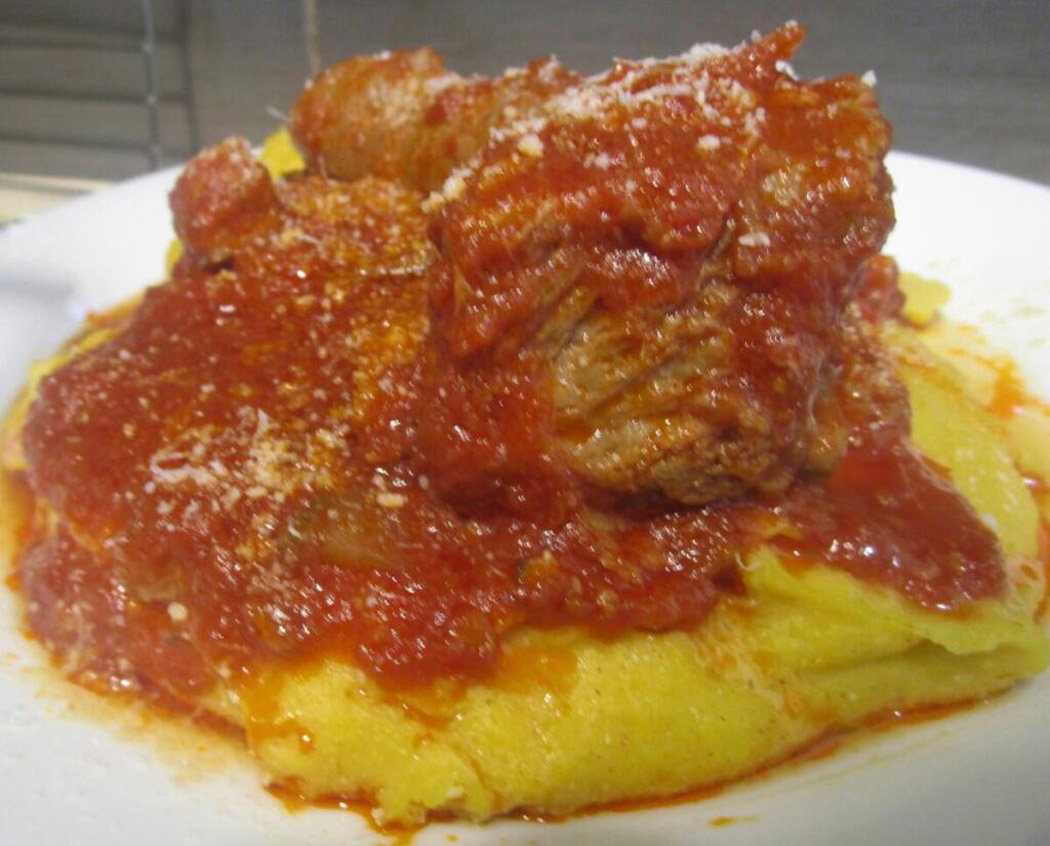
Winter and Torre Cajetani Frattaglie Polenta

In winter everyone's diet changes and the cold leads us to choose hot dishes. We in Torre Cajetani have our traditions and obviously we cannot forget polenta.

It arrived in our region thanks to Guglielmo Caetani, one of the descendants of Pope Boniface VIII to whom the name of our town refers. Guglielmo returned to our region and specifically Sermoneta in 1503 after being  exiled to the north, bringing with him the corn seed from Mantua.

During his stay in the duchy he saw that the local lords used the yellow flour obtained from corn to feed the labourers who worked for them (with the addition of water we have polenta) and very quickly it spread in the area of ​​today's townships Pontino and Ciociaria.

Today it is certainly one of the main dishes of the tables of our towns during the winter period to eat surely in company. A table with polenta is a table with joy (https://storicamentetorre.wordpress.com/2021/01/26/dagli-zocchi-alla-polenta-i-primi-torrigiani/).

Ricetta della Polenta con Frattaglie o con Spuntature 

Ingredienti per la Polenta:

  • 1 kg di farina di granturco (meglio quella a grana grossa),
  • acqua 3 lt
  • sale grosso q.b.

Ingredienti per la Salsa:

  • frattaglie (fegato, polmone, ecc.) o spuntature di maiale 500 gr
  • vino bianco 1/2 bicchiere
  • spicchi d’aglio 2-3
  • passata di pomodoro 700 gr
  • sedano
  • 4 cucchiai di olio di oliva
  • sale, pepe
  • peperoncino

Mettere l’acqua ed il sale grosso in un paiolo di rame e fare arrivare l’acqua ad ebollizione. A questo punto versare a pioggia la farina, molto lentamente per non creare dei grumi. Con un mestolo di legno mescolare in senso orario e, se la polenta si addensa troppo aggiungere acqua calda.

Cuocere per circa un’ora e vi accorgerete che la polenta sarà cotta quando si staccherà facilmente dalle pareti del pentolone.

Per fare la salsa, fare imbiondire nell’olio l’aglio e aggiungere le frattaglie tagliate a pezzetti e il sedano. Dopo qualche minuto unire il vino e fare evaporare. Condire con sale, pepe e peperoncino secondo il proprio gusto, aggiungere un bicchiere d’acqua, e cuocere a fuoco lento fintanto che l’acqua non sia evaporata, unire quindi la passata di pomodoro e cuocere ancora per mezz’ora.

Quando è tutto pronto si deve stendere la polenta su un piatto, possibilmente di legno, e versare sopra la salsa. Aggiungere pecorino o parmigiano secondo i gusti. Noi a Torre Cajetani avevamo il pecorino nella tradizione, il parmigiano è arrivato relativamente pochi anni fa in tutta Italia.


powered by social2s
My Sfincione of Pioppo, in the mountains near Palermo

Sicily is a land of sun and sea, I don't deny it, but also of mountains. Yes, of mountains sometimes neglected even by the islanders themselves, but which hide the true essence of Sicily, at least mine.

My village is Pioppo, a fraction of Monreale that houses the most beautiful church in the world. It is located in a valley between two mountain chains that opens onto the sea forming the Conca d'Oro.

From Pioppo you can see the sea and, on clear days, even the Aeolian Islands. In winter there is snow and until the first half of the last century on Mount Pizzuta there were the neviere snow stacks that became ice and where the ice was kept throughout the summer which was then used for ice creams in nearby Palermo.

I lived in the village until I was 26, then I moved to Milan for work.

I hated the town and loved it with all my might.

Sometimes I think of it with nostalgia, other times with so much anger at all its contradictions that, as an ancient engraving on the Palazzo Pretorio in Palermo says, Genius devours him and feeds strangers.

But the village always remains within me. And that land can offer many culinary delicacies. I could fill pages with our local specialties: carduna bruricati, u semifreddo ru zzu Teteddu, cacocciuli a viddanedda, mulanciane ammuttunate, pasta or furno, spitini ra signorina Maria ... but here I am obliged to choose only one.

Torn between my aunt's baked pasta (she doesn't take offense mom, but nobody does it like her aunt) and the sfincione (thick pizza) that the family knows how to make in an exquisite way.

I chose the latter, for a very simple reason: I know how to do it too and I do it very often in my adoptive town, but still mine, Milan.

What is sfincione?

A pizza, or rather halfway between a pizza and a focaccia. I immediately specify that sfincione is not an exclusive from Pioppese and exists throughout the province of Palermo and beyond (it also exists in Catania (LINK) where it is not a pizza but a dessert).

But they are all different versions: the "main" sfincione is from Palermo, the city that I love, and it is thicker and spongy and much greasier.


Here I will talk about the Pioppese one, yet not a Pioppese one in general but the version made by my family. Because you know, local recipes are never precise and every good mom has a version of her that she likes and that becomes a dish of the heart.

I begin by saying that the sfincione is for get togethers and celebration, or rather on the eve. In fact, it is often eaten on Saturday evening and it is certainly present in all tables on 7 December, the eve of the feast of Mary Immaculate (the most heartfelt feast in Pioppo), and at the dinner on 24 December on Christmas Eve.

On these occasions it is accompanied by the typical battered and fried vegetables. First of all the bruricated (buried) thistles, that are  buried and made to grow for several days underground to give a particular sweetness and tenderness.

It is a "hasty" dish, in fact even bakeries do it and you can go and get a pan if guests suddenly arrive, but it must be eaten strictly with your hands.

Recipe of Sfincione

But let's get down to business, ready to get your hands dirty?. The amounts are what I use for 3 very hungry people:

  • 500 g of re-milled durum wheat semolina, preferably Italian, even better if Sicilian
  • 450/500 ml of water, preferably pioppese but it does the same
  • 2 g of dry powdered brewer's yeast (this is my innovation, mum and aunts in fact use 7 g, the whole sachet, or 25 g of the fresh one, and let it rise 2/3 hours, I prefer 2g and I keep it for 24 hours to rise)
  • Salt to taste
  • a pinch of sugar
  • Extra virgin olive oil
  • Rustic tomato puree, or peeled tomatoes
  • A lot, a lot, a lot of onion (it is added to taste, for example my mom doesn't like it and makes a little flan dish for herself without it but I call that an affront)
  • Oregano to taste
  • Breadcrumbs, preferably rustic
  • Fresh pioppese Caciocavallo cheese, which is very similar to Ragusa
  • Anchovies in oil.

Some people also add some olives, in my   opinion it doesn't matter.

Mix the water, flour, yeast and a pinch of sugar, until the dough is slightly less liquid than a batter, trying not to make lumps. The trick is to knead with your hands adding the water little by little, making it absorb by the flour from time to time.

In the final phase you have to knead by beating the dough as if they were eggs using your hand whisk.

After having "beaten" the pasta for at least 10 minutes, add the salt and continue to beat for another 5/10 minutes to mix well. I recommend: always taste the dough.

At this point let it rise for an hour and a half at room temperature covered with a cloth and then give it a second stir. Cover again and leave to rise for 18/20 hours at a not too high temperature: in winter I leave it out with the heating at minimum, in summer I put it on the top shelf of the fridge.

After about 16 hours, if you have put it in the fridge, you take it out to settle. After the 18/20 hours mentioned above, it must be poured into the pan, but first it is necessary to put a large amount of oil in the pan.

Attention: it must not be greasy, the sfincione must float in oil. Pour out the dough, roll it out with greased fingertips, cover with a cloth and let it rest for another 2 hours.

Now you can go to the dressing. Fry the onion with EVO oil, a lot, a lot of onion, cut as you like (usually in wedges), then add the tomato and let it cook.

After two hours, grease the dough from the pan (provided that it has not already been greased with the oil from the pan during the spreading) and put in the caciocavallo cut into cubes. You have to press it on the pasta so that it "sticks", then put the anchovies with the same technique, then sprinkle the whole surface with breadcrumbs (some people also put a sprinkling of grated aged caciocavallo).

On the breadcrumbs put plenty of tomatoes and onions that you have prepared in the meantime and a nice sprinkling of oregano on top.

Meanwhile, preheat the oven to maximum temperature and, when it is hot, bake the Sfincione on the middle shelf and immediately lower the temperature to 200°. You can use a ventilated or closed oven, as you prefer.

When it starts colouring on the top it is almost ready, but I always recommend checking the bottom with the help of a spatula. Time depends on the oven but not less than half an hour.

Enjoy your meal and if you like, visit Pioppo!


powered by social2s
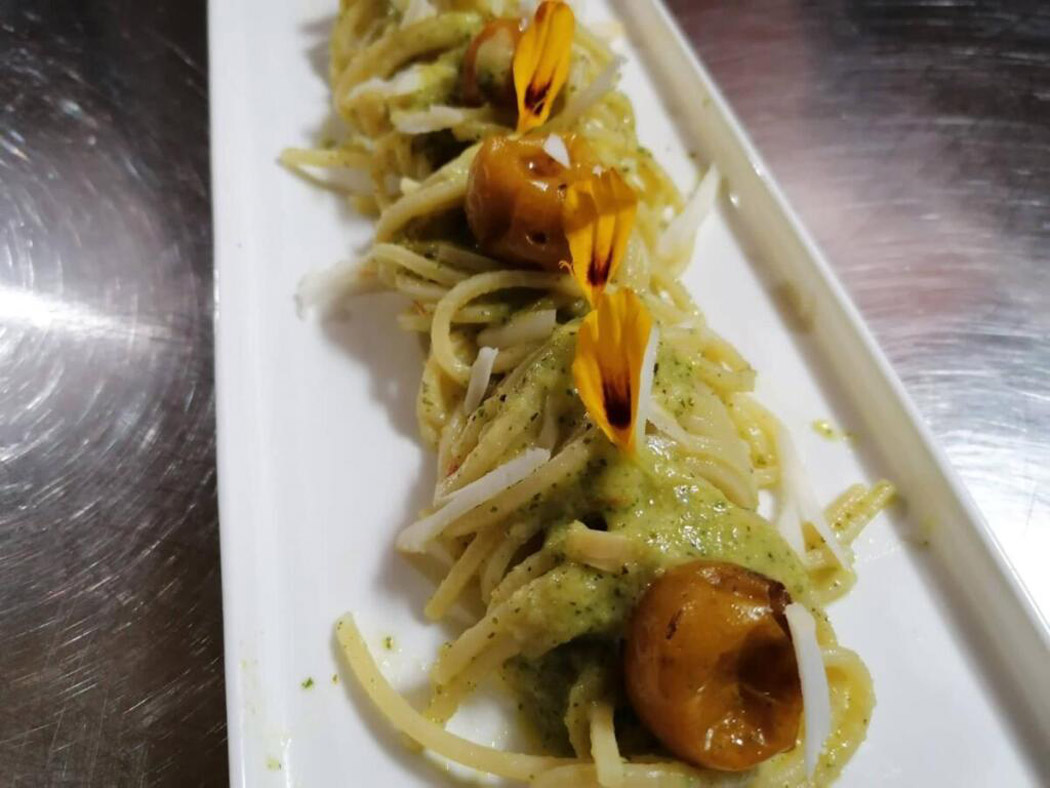
Spaghetti with wild spinach pesto and buffalo ricotta

The recipe for spaghetti with wild spinach pesto is a modern reinterpretation of how to use one of the oldest wild herbs: it is very fast and it is a really nice discovery.

Tasty and fragrant like the most famous Genoese pesto, it is a light and tasty condiment and I added some yellow tomatoes, preserved in glass, to give a touch of acidity. But the wild spinach pesto is also a nice sauce to spread on croutons.

There are spontaneous plants that have given nourishment throughout history such as the "wild spinach" also called Buon Enrico (Chenopodium Bonus Henricus), a vegetable rich in iron, magnesium, calcium and vitamins: A, C and B9.

It is called Buon Enrico in honour of Henry IV, king of Navarre and then of France (1589-1610), protector of botanists and agriculture.

It blooms in summer from July to October in Europe and the more tender leaves can also be eaten raw in salads, while the harvest takes place throughout the winter months.

In past centuries this plant was considered precious and all parts were used, the seeds are edible and a flour used since the time of the Aztecs is obtained. While in Maremma it is traditionally used for the preparation of tortelli.

In our area, we are located in the ancient Samnite territory of Morcone between Campania and Molise, it is used together with other wild herbs in the marinade soup and to prepare various soups based on cereals and legumes.

We define it as a spontaneous transhumance (migration) vegetable, the seasonal movement of stock from the summer pastures of the mountains of Abruzzo, Campania and Molise to the winter pastures of the Tavoliere delle Puglie.

In these mountain pastures, wild spinach was found and cooked because it grows from 500 to 2500 meters above sea level and was found along the entire path of the sheep tracks, the paths declared World Heritage Site by UNESCO.

The sheep tracks have been used by shepherds and their cattle for millennia and when I imagine those grassy expanses covered with sheep and mules loaded with household goods it is as if I were taking a trip back in time.

A way to understand the true essence of these magical places.

Recipe of Spaghetti with wild spinach pesto and buffalo ricotta

Ingredients for 4 people:

  • Spaghetti made with old grains 320 gr
  • 100 g of baby spinach
  • pecorino cheese
  • grated cheese 50 gr
  • buffalo ricotta 50 gr
  • pine nuts 50 gr
  • extra virgin olive oil
  • cherry tomatoes in natural glass 120 gr
  • 1 clove of garlic
  • Salt and Pepper To Taste.
  • fresh oregano to taste - alternatively, fresh parsley will also work.

First of all we prepare a garlic oil by putting the clove of garlic deprived of the centre in a glass together with the extra virgin olive oil and put it in the microwave oven at maximum power (mine reaches 1000 watts) for 1 minute. The oil will not become very hot but will aromatize naturally and in a short time. Let the flavoured oil cool completely and remove the garlic clove.

At this point, put a pot of water on the stove and, once it comes to a boil, cook the spinach for 20 seconds. Then we cool them with water and ice to keep the colour ‘alive’.

Once cooled and squeezed, put the spinach in the bowl of the mixer along with the pine nuts and grated cheese. We salt and pepper to taste and finally pour the flavoured oil. Then we whisk the mixture until all the ingredients are combined and our creamy and tasty pesto is obtained.

Cuociamo quindi la pasta di grani antichi per il tempo indicato sulla confezione. Intanto in una padella stemperiamo la ricotta, qualche pomodorino ed il nostro pesto, con mezzo mestolo di acqua di cottura, a questo punto versiamo gli spaghetti al dente e amalgamiamo.

Il pesto di spinacino selvatico si può definite un pesto invernale e ho voluto fare una dedica a questa pianta selvatica con una ricetta veloce per non dimenticare la sua storia e la biodiversità.

Dovremo imparare a prenderci cura delle nostre biodiversità, della molteplicità di specie e organismi che con le loro relazioni creano il meraviglioso equilibrio e il miracolo della vita sulla Terra.

We then cook the ancient grain pasta for the time indicated on the package. Meanwhile, in a pan, dissolve the ricotta, a few tomatoes and our pesto, with half a ladle of cooking water, at this point pour the spaghetti al dente and mix.

The wild spinach pesto can be defined as a winter pesto and I wanted to make a dedication to this wild plant with a quick recipe so as not to forget its history and biodiversity.

We will have to learn to take care of our biodiversity, of the multiplicity of species and organisms that with their relationships create the wonderful balance and the miracle of life on Earth.

Because after all, the Earth is our home!


powered by social2s
The Sicilian sweet of the smile: the Cassatella (Cassateddra) of Montevago

I don't know about you, but it happens to me every time I have non-Sicilian guests: everybody, after a few minutes from their arrival, tells me that they would like to taste the cassata and the Sicilian cannoli.

And I, as always, reply that Sicilian sweets are the eighth wonder of the world, they can be admired and tasted.

 It is a hot afternoon in late September and I am returning from Punta Raisi airport. A couple of friends from Holland, Jan and Paul, decided to visit the west coast of Sicily.

We drive along the motorway and near the junction for Trapani, Paul begins:

- Tomorrow morning I want to have breakfast with cassata and cannoli. Maybe I eat two cannoli.

I pretend astonishment:

- Come to Sicily with a fixed thought, gorge yourself on sweets.

- Of course, we have come to visit this wonderful land, but also to taste your delicious sweets.

- When you taste our desserts, you meet history. Never forget it.

The next morning, Jan and Paul are ready early and I tell them that we will visit Selinunte, but first let's go to Montevago. Paul's eyes widen:

- And when do I eat cassata and cannoli?

- You won't eat cassata and cannoli today. Today I will let you taste the Cassatella di Montevago. Yes, to taste, because that is a dessert that must be tasted slowly. Cassatelle sfigliate, dear Paul, I'm sure you'll eat more than two.

By car I take care to call some Montevaghian friends, expert admirers and supporters of cassatella: Francesco, Giuseppe and Michele. Moved by curiosity, Jan asks me about this dessert.

Cassatella is a double pasta sheet filled with ricotta topped with sugar, chocolate, cinnamon and then fried in the good oil of this area. It is a dessert that the people of Montevago never miss to have on their tables during the holidays, especially during the feast of the Madonna delle Grazie.

The story goes that cassatella made its appearance in Montevago thanks to the Gravina family, and more precisely with the arrival in the monastery of an abbess of a noble family from Trapani and apparently of a French mother.

We are in Montevago and stopping in the large and beautiful square in front of the town, we hear the roar of the water from the fountain. Pleasantly surprised Paul begins:

- What a fantastic place, it's an oasis of peace.

Upon arrival of the Montevago friends, we immediately go to the restaurant of one of them. As soon as we enter the kitchen we see two ladies, who on a wooden shelf, with their skilled hands, after having mixed the ingredients, first knead some sheets. Then they roll them up, cut them into chunks and finally roll them out with a rolling pin to obtain disks about ten centimetres in diameter.

I look at Jan and Paul who, in silence and very attentive, follow the various stages of processing. After a while behind us we hear the sizzle of oil. In a large pot Francesco was frying some cassatelle.

Once the frying is complete, he places them in a baking dish and covers them with sugar. Our hands, at first uncertain, then, quickly take the still steaming cassatelle and we taste them in total silence.

Paul comes to stand next to me:

- Can I have more, are they fantastic?

One of the ladies answers for me – in Sicilian dialect:

- Manciassi, manciassi, sunnu so duci genuini, cà a Montevago avemu tuttu bonu (Eat, eat, they are genuine sweets, here in Montevago we have everything good).

Paul accepts the lady's invitation and takes two cassatelle which he eats immediately as happy as a child:

- Paul, didn't you want to eat two cannoli?

- Yes, but I haven’t finished Montevago's cassatella sfigliata yet!

Saying this, he bursts into a joyful laugh that involves everyone.

- Do you understand now why I have always called cassatella sfigliata montevaghese the sweet of happiness?

- Yes, I understand, because when you eat it, it is so good that it makes you joyful.

- Paul don't forget: cassatella sfigliata is unique, it's history, it's a serious matter.


Montevago cassatella sfigliata recipe

  •  Flour 300 gr
  •  a spoon of sugar
  •  a pinch of salt
  •  melted lard 80 gr
  •  an egg
  •  grated orange peel (lemon)
  •  some old wine (Marsala)
  •  ricotta 300 gr
  •  chocolate in small pieces
  •  sugar 150 gr

Mix the flour with a spoonful of sugar and a pinch of salt, then add the melted lard, an egg, the grated orange peel (lemon) and a little old wine (marsala) as much as the dough itself asks for.

After working it, it is flattened and rolled three times, after which it is left to rest in a cool place.

In the meantime, the filling is prepared, with the ricotta, previously passed through a sieve, chocolate into small pieces and add the sugar and mix everything together.

Take the rolled up dough, cut it into chunks from which small discs of 10 cm in diameter will be obtained with a rolling pin.

Put the ricotta filling on one half of each disk and then fold the other half by making the edges adhere, so as to form half-moons.

Fry on both sides in hot but not boiling oil, drain on a sheet of absorbent paper and sprinkle with sugar and cinnamon.


powered by social2s
Pasta al Forno Palermitana like my aunt does

"What do you want to have to eat?"

This was the phrase that Sicilian parents say most often in the days preceding the return of their emigrated children. And my parents also asked me those few times that from Milan I managed to return to Sicily.

All this until my baby was born, which since then the phrase has turned into "what does the baby want to eat?", Grandparents are known to have a soft spot for grandchildren!

Ask "have you eaten?" or "what do you want to eat?" I believe it is one of the highest forms of taking care of someone. I must say that it took me a long time to be able to understand it, but in fact there is everything inside: the worry, the care, the cuddle, the wanting to nurture, the loving, the wanting to feel good , sacrifice...

To this question, I have sometimes answered, attracting my mother's ire: "I want baked pasta", and so far it was fine, if it weren't for the addition "but aunt's baked pasta".

In fact, I don't want anyone in the family to rmake, baked pasta like my aunt does, nobody knows how to make it. Not surprisingly, whether it was Christmas, Easter, or New Year's Eve, if you had to make pasta in the oven and your aunt was there, they made her make the pasta in the oven.

You know, everyone personalizes the recipes in his own way, and to my aunt this customization of baked pasta was very successful. Even when my beloved wife gives it to me and asks me if I like it, I answer that she is very good, but that the aunt's ... it's that of the aunt (risking to spend the night in the cellar!)

The baked pasta I'm talking about is the classic Palermo baked pasta, one of the many meat-based dishes of Palermo (which I prefer to those of pasce, but they are personal tastes).

It is made with pasta of the anelletti format that outside the province of Palermo becomes almost a luxury to find and always comes to me with the package from below. I always like to say that it is pasta in the shape of a wedding ring, which is combined with so many ingredients that from a first course they turn it into a super-greedy single dish that when you do it to someone not from Palermo you knock it out.

For many of us baked anelletti ise the dish of the holidays at home, those days when the whole family gathers to have lunch together and then play cards or bingo. It is the dish that is always made more than "if you stay, you can eat more tomorrow" and that in the afternoon when we bottomless kids got hungry we went to nibble directly from the pan in the oven.

To me it always arouses many pleasant memories, and it is so for many people who come from my latitudes. Baked pasta is so long to prepare that you only make it to those you love so much.

Recipe Pasta al Forno Palermitana from my aunt

Ingredients:

  • Anelletti pasta
  • Tomato puree
  • extra virgin olive oil
  • carrot
  • onion
  • celery
  • peas
  • salt and pepper
  • minced beef mixed with minced pork to make Sicilian sausage with fennel
  • Ham
  • salami
  • fresh mozzarella or caciocavallo from Palermo in cubes
  • Parmesan and aged grated caciocavallo
  • hard-boiled eggs cut into pieces.


The traditional Palermo recipe also includes diced fried eggplant and toasted breadcrumbs. The doses obviously depend on feeling and in my family as for me feelings are very abundant.

First you need to prepare a Palermo ragù: brown the carrot, onion and celery in extra virgin olive oil, add all the mince and brown well. Add the tomato puree and cook over low heat for a very long time. When cooked, add the peas and allow the peas to cook for the necessary time.

Then the pasta is boiled, which must not cook completely because it will complete its cooking in the oven.

So you need to season the pasta with a good part of the meat sauce and then put it in a pan alternating layers of pasta and layers of all the aforementioned ingredients as if it were a lasagna, someone instead makes a 'mix' of all the ingredients.

The important thing is to set aside a lot of ragù to completely cover the surface of the pasta. This serves not only to look good but also to create a moist "cap" that makes cooking easier

Place in a convection oven at 180 °.

At this point, to avoid spending the night in the cellar, I want to say that my wife, before putting the pasta, lines the pan with slices of fried eggplant and then puts pasta and seasonings inside.

At the end of cooking, then, she lets it cool a little and overturns the pan to obtain a timbale coated with aubergines which in addition to offering a beautiful aesthetic effect also has its own because in terms of taste.


powered by social2s
Pantesca Beef Tartare Recipe (Pantelleria)

The island of Pantelleria is famous for its landscapes but also for its cuisine and its symbol is the cultivation of the sapling vine, which is listed among the intangible heritage of UNESCO, and capers.

To savour its capers, I prepared a particular salad that is also one of the gastronomic symbols of Sicily: the Pantelleria salad. I absolutely recommend the Passito di Pantelleria wine produced with Zibibbo grapes, tasting it with cheese or desserts, but it is not with this recipe.

I also recommend going to visit Pantelleria, closer to Tunisia than to Italy, a splendid thermal island that can be recognized with closed eyes for the intensity of its aromas and the flavours of its cuisine.

It is an island to enjoy that owes its name to the wind that blows and whose name "Daughter of the wind" (Bent el-ariah) was given to it by the Arabs who stayed there for a long time.

In this dish we combine all the classic aromas in a beef tartare that is topped with ingredients found in Sicilian cuisine, such as anchovies, olives and tomatoes.

Pantesca Beef Tartare Recipe

Salad ingredients:

  • 200 gr Cinisara beef rump
  • 20 ml Lemon juice
  • 10 gr Finely chopped capers
  • 5 leaves Finely chopped parsley
  • 10 gr Extra virgin  oil
  • 10 drops Anchovy sauce
  • 1 Egg yolk

Ingredients for toppings:

  • 1 Boiled egg
  • 5 Shelled broad beans
  • 1 Red onion
  • 100 ml Red vinegar
  • 20 gr Sugar
  • Salt of Trapani
  • 2 Anchovy in oil
  • 5 Whole capers
  • 1 Cherry tomato
  • 1 Green tomato
  • Turmeric powder

To prepare the sweet and sour red onion, bring vinegar and water to the boil in equal parts with 20% sugar and a pinch of salt. We cut the onion into strips and cook them for 5 minutes in this water, then drain and cool. The liquid can be reduced to a syrup that we can use to garnish the tartare with a few drops.

For the preparation of the Tartare: we cut the meat carefully with a knife, as they say in Sicilian 'Capuliare'. To the shredded meat, add the lemon juice, a raw egg yolk, the chopped capers, parsley, oil and colatura  (sweet and sour sauce). We mix well and let it rest.

And now let's move on to a not secondary aspect to make all diners enjoy: the presentation of the dish.

We put the tartare in a mold and press well to flatten. We garnish with the ingredients in a creative way: we cut the green tomato into slices and place it around the tartare disc, while we lay everything else on the tartare as if it were to decorate the dish.

Sprinkle with turmeric powder and a generous drizzle of extra virgin  oil.


powered by social2s

Subscribe to Newsletter

Discover a territory through the emotions of the people that have lived it.