Una versione originale dello Gnocco al Cavolo Romanesco e Pecorino by Daniele Zito

Go to Filettino and fall in love! Oh yes, it happened to me, but in a metaphorical sense: I fell in love with a taste, that of the Roman Cabbage.

I had already tasted it at other times, more or less similar, more or less good. Yet here, at the inn “La Galleria", from the expert hands of the cook Maria, an elderly lady but still more than spry, I fell madly in love with the flavour of the Roman cabbage paired with Roman cheese, all seasoned with a fantastic handmade dumpling!

The day was perfect in Filettino, the highest town of Lazio at 1,075 meters above sea level, surrounded by tall beech trees and the lush nature of the Simbruini Mountains Park.

Here arises the Aniene, the second river of Rome, and everything smells clean. You can sense the aromas of the earth and you can taste vegetables of high altitude that are among the most tasty.

What is there to say? Thanks to the local restauranteurs with the best abundant taste experience, coming from real taverns, that now we hope to be able to live up to the task in a personal version of the ‘Gnocco with the Romanesco Cavolo and Pecorino’ (Dumpling with Roman Cabbage and Pecorino Cheese)!

Of course I cannot help but add a personal touch with a few anchovies that combine very well the pecorino with Roman cabbage and that mitigate the sulphurous smell of this kind of vegetable.

For the recipe: the preparation of the dumplings:

Boil the potatoes (or put them in a pot with cold water and let it boil) until they are soft enough to insert a fork easily, about 30 to 45 minutes after boiling.

Remove from the water and peel them  while they’re still hot and mash them with the help of a potato masher or a fork, inside a bowl. Now add a pinch of salt, a teaspoonof it  and an egg for each kg of potatoes and 100g of flour, knead until you get a homogeneous, compact and soft paste.

Check if it is advisable to increase the doses of the flour or the egg, but remember to not knead too much as you could make them harder in cooking.

Let the mass rest for 15/20 minutes in the fridge, then remove the pieces and roll out on a pastry board with some flour, making the cylinders about an inch in length. Put them back in the fridge for another 15/20 minutes, so that they are compact and keep their shape during  cooking.

You could find an excellent ally in rice flour, add about 20g per kg of potatoes, to give a stronger structure to the dough.

Roman cabbage cream

Blanch (drop in boiling water and remove when it starts boiling again, or at most a few seconds or minutes later) the tops and the stem of the Roman cabbage making more than 2/4 pieces from base of the Cabbage, the larger ones.

The stem takes a few minutes longer, therefore, cut into small pieces, put it in boiling water 5/6 minutes before the smaller and green tops.

Once blanched drain and put aside a quarter of the tops, among the most beautiful, the rest mix with 10/12 anchovies, helping with a little cooking water and extra virgin olive oil then adjust salt (be careful that the anchovies are already salted).


Pecorino wafer

Put two good handfuls of pecorino romano cheese in a fairly large and hot non-stick pan and wait until they change colour and get a golden colour, turn it over and finish a few seconds or a few minutes on the other side. Keep aside and let it cool. In total it will take 3/4 minutes maximum.

Dishing Out

Remove the dumplings as they float to the surface and mix them in the pan with the Roman cabbage cream, that must be very hot but with the fire off, then take precautions to reheat it.

Add a little olive oil and grated pecorino cheese, stir with a ladle and maybe add a little cooking water. Once you have reached the desired consistency, finish laying the tops that were aside, place for a few minutes in the pan on a high flame with garlic, chili and a little oil.

Add a few pieces of anchovy just drained from their oil and some seeds of fennel if you like!

Finally crumble the pecorino wafer and serve.

powered by social2s
IMG_20171213_200431-300x300.jpg

Panpepato has always been part of the table set for Christmas Eve and for Christmas lunch.

In our area of ​​Lazio Christmas cakes have always played the most important part, because they anticipate the opening of gifts and consequently we always dedicated ourselves to eating them in an atmosphere combining conviviality and serenity typical for these holidays.

When it came to Panpepato, enjoyment was assured: a ‘taste explosion’ of dried fruit, candied fruit, chocolate and above all the strong and decisive taste of the must from wine, all cooked in the tradition of Anagni!

An absolute delicacy, fruit from the wise hands of grandmothers and mothers who were rarely mistaken when it came to surprising our taste buds!

The tradition of must (or wort) is typical of Anagni, the city of the popes of the Middle Ages that gave birth to as many as 4 popes. The city of the famous slap of Anagni given to Pope Boniface VIII and the city whose cathedral hides one of the absolute masterpieces of art, a frescoed crypt considered the ‘Sistine Chapel of the Middle Ages’.

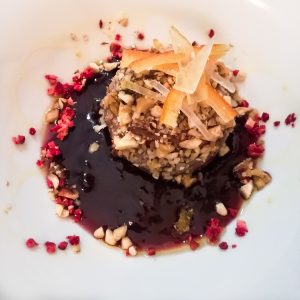
Today I propose a Panpepato I have recreated, in the form of mousse, suitable to be part of any type of lunch or dinner, especially during the Christmas period when you can surprise your guests by giving them a new Panpepato with a great result!

PREPARATION (for 6 people)

Mousse Sphere: take a half-sphere silicone mold, (if you have to buy one, it costs just a few Euro and has many other uses). Now melt in a metal saucepan (or basin), 300 gr of 70% dark chocolate together with 270 gr of water.
As soon as it is melted place the saucepan in another containing water and ice, and begin to whisk by hand or with the electric whisk, until it is peaked (it will change colour, it will lighten). Form half spheres (balls) of mousse in the mold.

- Breading: get hazelnuts, walnuts, raisins, candied orange, pine nuts and almonds, make a mince reducing everything to a grain small enough to be able to bread the balls of mousse.
Bread the balls of mousse only after having cooled them for at least 3/4 hour, and grease them with oil in such a way that the crumbs of dried and candied fruit will adhere more easily.

- Cooked Must of wine (for 1 lt): place 150gr of flour and 150 gr of sugar in a pan, and heat at the minimum setting.
Start to mix the ingredients with the help of a whisk to avoid lumps. Once the sugar has melted, add the grape must slowly to avoid lumps.
Cook everything for about 10/15 minutes, until the must simmers. After reaching boiling, turn it off and your must is ready.


PREPARATION & SERVING

Get a deep dish, even if any other type of dish would be good, the effect with a deep dish is more satisfying. Pour a good ladle of 
wine must on the bottom of the plate, perhaps after slightly warming it.

Place a half sphere of mousse, or, if you have the time and above all you see that your guests are still very hungry, place two half spheres overlapped so as to form a ball (Panpepato Ball).

Now sprinkle a little nutmeg and pepper, preferably white pepper that will not be too intrusive, drop a handful of chopped dried fruit and garnish with candied orange cuttings.

powered by social2s
IMG_20171110_151311_703-300x300.jpg

Octopus is an ingredient that cannot normally be combined with any other marine food. It is in fact the only product of the sea that is cooked to its best in its own liquids, in "its" water.

There are several schools of thought about cooking octopus and today thanks to new technologies we have a large number available, all appropriate for the purpose of containing weight loss.

This is in fact a problem that in octopus that tends to manifest itself in a very obvious way: has anyone happened to buy an octopus for a recipe and see at the end of cooking that your main ingredient has been reduced by half, and that consequently your guests may have to consume more sweets or more wine than expected to overcome this inconvenience?

In any case, now we are going to use a technique in vogue since the times of pre-imperial Rome: cooking in a terracotta pot (if you are not provided with this pot, a little in disuse now, it will be fine to use a pot of stainless steel).

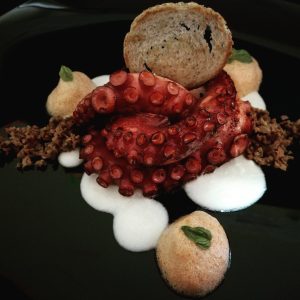
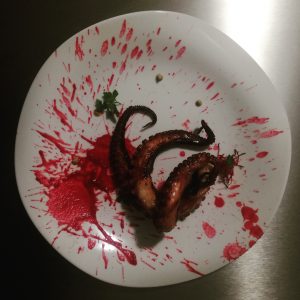
For this octopus we have combined a seasonal ingredient such as red turnip, to which we add some chili and a mayonnaise of anchovies that enhances the flavour with a taste of the sea that goes well with the octopus.

The red turnip we chose comes from Monte San Biagio, a village in the Ausoni mountains not far from the sea, which is famous because the second Punic war was fought here around 219 BC, the one that saw the Romans against Hannibal of Carthage.

Monte San Biagio was crossed by the ancient via Appia and for many years was the customs site between the Papal States and the Kingdom of Naples and in its fort in Passo Portella have stayed princes and sovereigns. Perhaps for this reason to be between different states and cultures Monte San Biagio is a territory where particular products are grown that have unique backgrounds.

RECIPE:

For the octopus: grease the pot with olive oil, heat and brown the octopus together with a potato. The potato is intended to release starch that will serve the octopus to cook without flaking losing its skin and colour.

Once browned, after about 5 minutes of flame, cook with a dash of red wine and add a full glass of water. Put the heat to minimum and cook for 40 minutes for an octopus of medium size (800/900 gr) and then turn off and let the contents cool.

Once cooled, cut off the tentacles and the head from which you should remove the spout located at the bottom.

For the cream of red turnip and chilli pepper: after peeling the red turnip cut into cubes of 1/2 cm on each side and sauté in a hot pan with a little oil, add the chili as you like (check if spicy oil or dried chilli), then continue cooking on a gentle flame with a little water.

When it is soft, after approximately 15 minutes, blend it, adding a little water and oil to reach the desired consistency.

For mustard drops: dilute a teaspoon of mustard with greek yogurt, deciding the quantities according to personal taste.

powered by social2s
Ancient Cake with modern Glass

The cheesecake is an ancient cake, a cheese tart with its roots in time. It is thought to have been enjoyed by the athletes of the first Olympic Games in 776 BC Delos (Greece) who were fed on a cake made with pasta, cheese, honey and bay leaves.

This ancient cake tradition was later adopted by the Romans who made it one of their favorite dishes. Today, both raw and cooked versions are found in virtually every country but with several different interpretations and various ingredients.

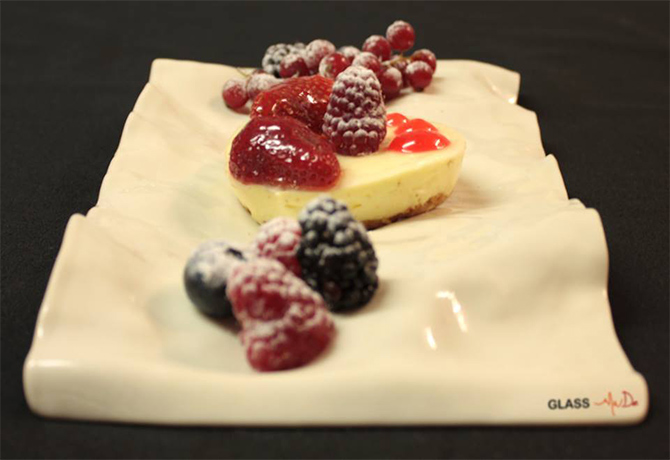
The ancient cake is a perfect dish to conquer the guests, especially when served in one of the finest dishes of design specially created by Glass Made. Here we propose an Italian version of the ancient cake, our cheesecake with raspberries, a recipe easy to make. Follow me in its preparation.

Recipe ingredients:

For the base
300 grams of biscuits (or digestive type crunchy biscuit)
160 g butter

For filling:

500 g cream ricotta cheese
120ml whipping cream
100g castor sugar
10 g gelatin sheets (isinglass)
3 tablespoons milk

For the piece de resistance, raspberry jelly:

300g raspberries
2 tablespoons sugar
8 g gelatin sheets (isinglass)

Preparation:

Soften for 10 minutes the gelatin in cold water. Crumble the cookies and place in a bowl with the butter. Stir until mixture is smooth.

Line a baking sheet with parchment paper and spread the mixture on the bottom of cookies, pressing down with the help of a spoon.

Meanwhile, boil the milk and add the gelatin.

In a bowl place the ricotta, sugar, milk with gelatin, whipped cream and stir well until the mixture is creamy. Pour the mixture into the mold previously prepared, level the surface of the cake with the back of a spoon.

Then blend the raspberries and pour everything in a pan with the sugar. Cook, on low heat, for 3-4 minutes, adding the gelatin once the heat is off. Let cool then pour the raspberry jelly on the surface of the cheesecake. Let the cake stand in the refrigerator for 4-5 hours before serving.

To present this new model of the ancient cake in its finest style, it is important to choose the right dish on which to serve. After all it is "a work of culinary art". We have chosen a modern design, a dish made by a pair of glass artisans of Limana (near the Dolomites), Maya Lapp and Denis Perera . Their crafts enterprise Glass Made  specializes in artistic productions for the table.

powered by social2s

Subscribe to Newsletter

Discover a territory through the emotions of the people that have lived it.