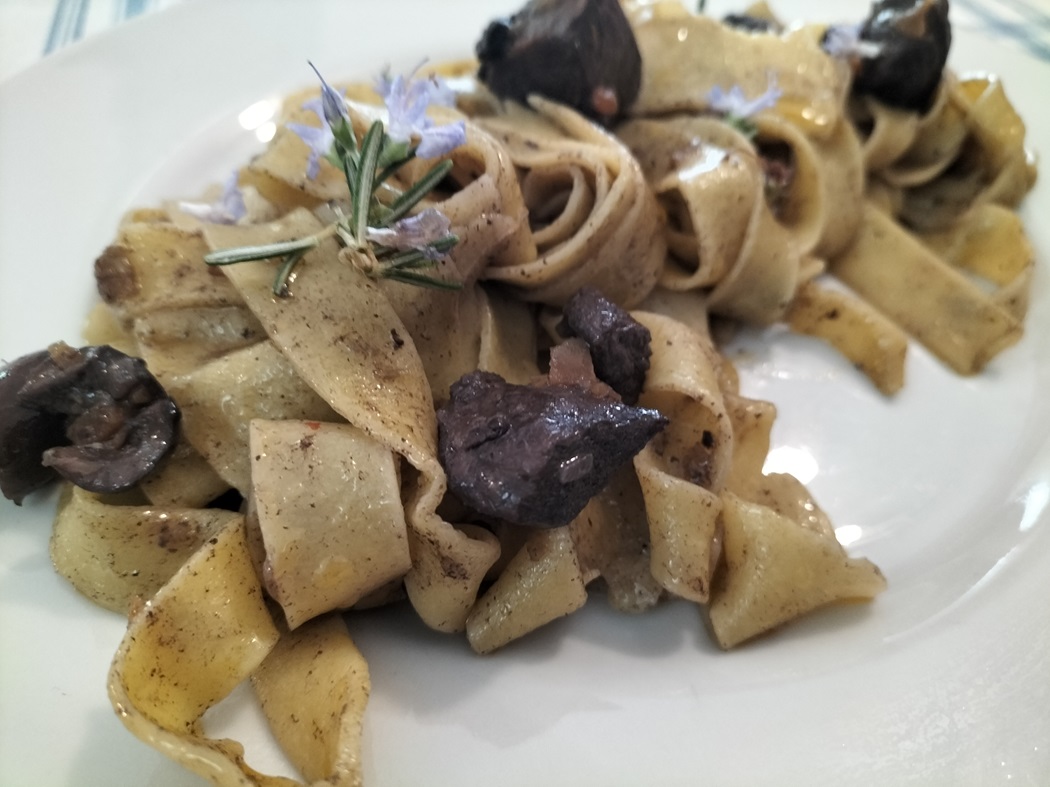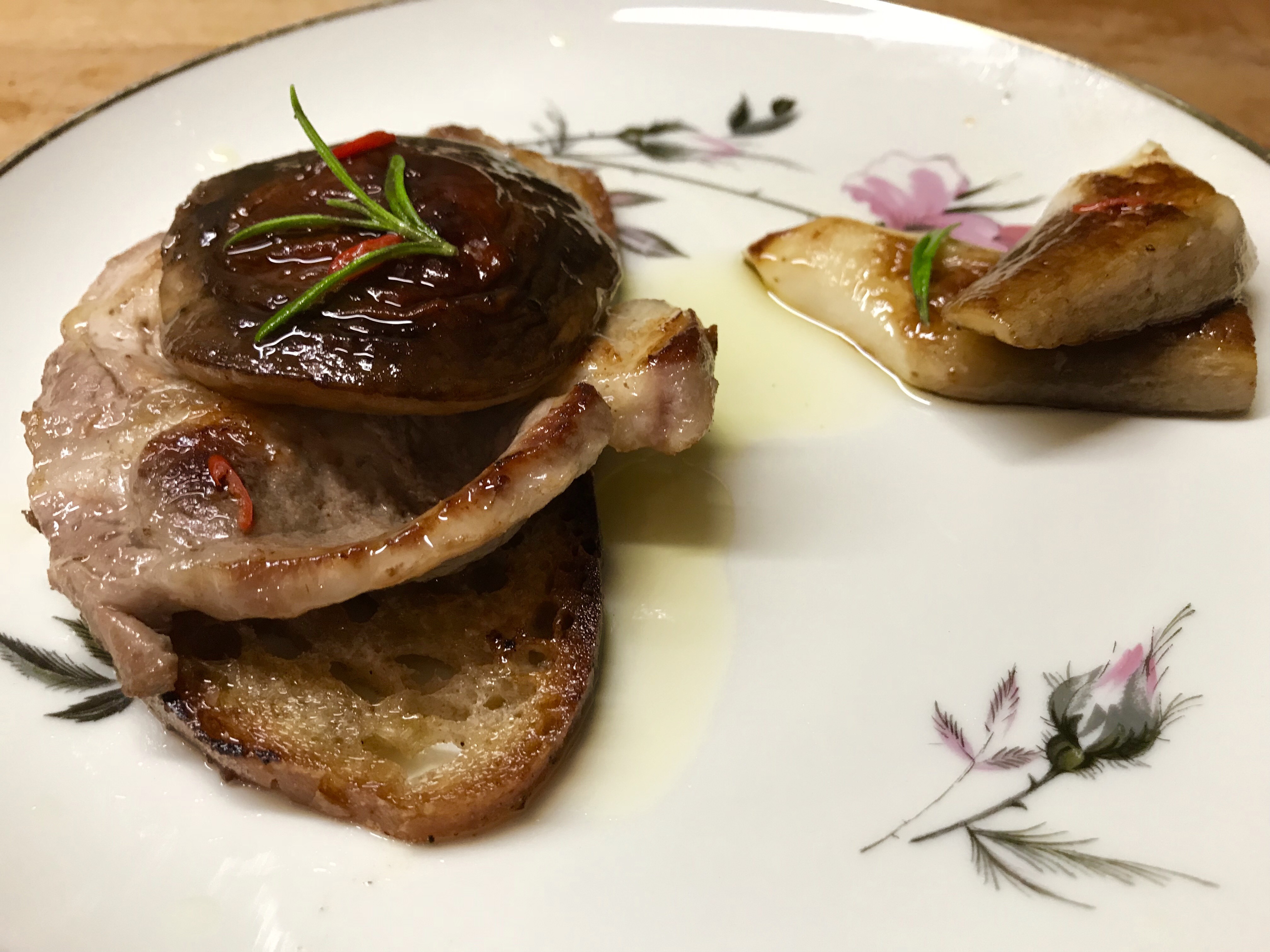
Prelude to Autumn: pork chop with porcini mushrooms

When autumn arrives, it comes ... and we enjoy it with all its delicacies.

The woods this year have been as generous as ever. The prince of the undergrowth has finally arrived, almost overbearing.

The boletus, the magnificent porcini, perfumed as it has not been for some time, thanks to the water that finally arrived in copious amounts. Too much maybe, but chance (and Jupiter Pluvio) we do not control.

I chose a nice cut of pork from Caprarola with an intense flavour in which you can smell the fragrances of the Cimini Hills wood.

Everyone knows Caprarola for the magnificence of Palazzo Farnese, it was the centre of a duchy that Pope Paolo III Farnese had desired and created for his son Pier Luigi. A 16th century building that is actually also an urban experiment.

The ancient medieval village was 'cut' to pass a spectacular straight path that begins at the foot of the hill and rises, through the back-filling of valleys and thanks to 2 bridges, until it reaches the square in front of the imposing Palazzo Farnese.

But Caprarola is something more and its nature is just as lush as its architecture.

It is located within the Natural Reserve of Lake Vico that with the waters of the lake, the swamp and its approximately 1,000 hectares of beech and oak forest is a paradise on earth. Not to consider that there are another 1,000 hectares for hazel groves and chestnut trees that we all enjoy every day without knowing it.

And this is where in September the collection of porcini mushrooms begins and where I come to pick them up when I have to prepare something special for my friends.

And this time I thought of preparing them a nice pork chop, all cooked in my Lyon pan, the iron pan. My grandmother did not even know where Lyon was, but that doesn’t matter.

Use the same pan for meat and caps of the mushrooms to make the flavours interpenetrate. Simple ingredients to bring out the taste of the forest. Oil and garlic, of course Cimini oil. And salt all the caps without ruining them.

Simultaneously toast some bread without adding anything else. Then, when the chop is cooked, put the slices of bread bruschetta for a moment in the cooking oil.

Put the chop on the crusted bread just softened by the cooking oil, garnish with a sprig of rosemary and some fresh Italian peperoncino (the tropical chili left to the Tropics).

I recommend a little rosemary: you must experience its scent but it must not be too obvious. The Prince of Autumn is fresh porcino!

A simple but vigorous dish that deserves a respectable wine: a Syrah from the middle Liri. Palazzo Tronconi di Arce offers just about the best.
powered by social2s
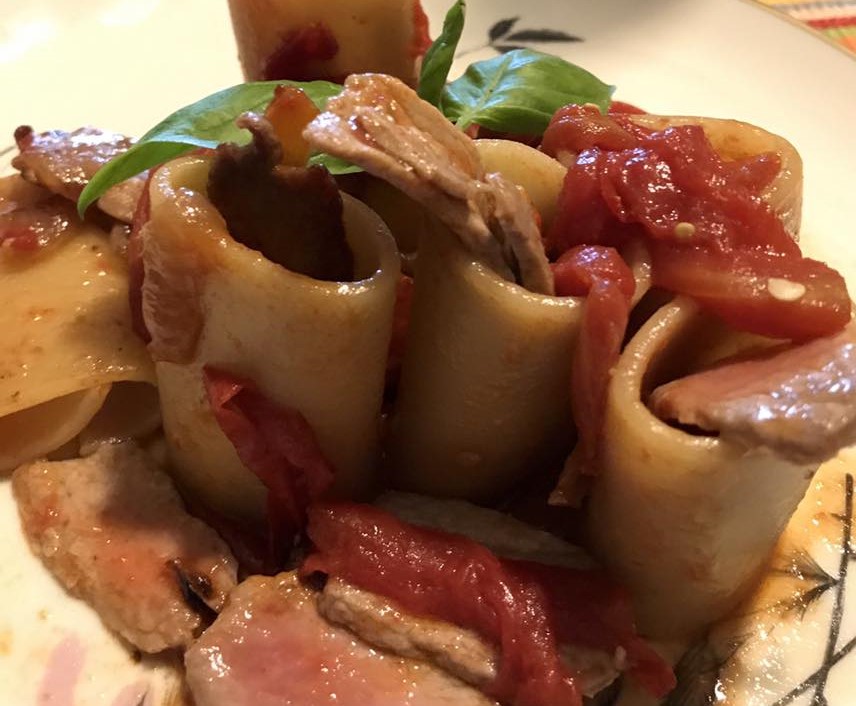
Sea pig with pasta: paccheri with tuna belly

In Favignana they call tuna: the 'pig of the sea'.

The tuna is stupendous fish that once came in sizes today unimaginable because of too much fishing. It has fed the islanders since the dawn of time and they have made a true culture of conservation and processing of tuna.

Tuna nets dot the coast of southern Italy and are an element of recognition. Today they are often transformed into all-round centres of culture: culinary, artistic and musical. In this way culture has no boundaries and the arts in all their forms are those that make us feel good.

Until the 19th century also Ponza had its tonnara (tuna nets) and the Ponzani, the real ones, are masters in the processing of this beautiful fish. The real excellence is the oil and one of the traditional dishes is pasta. A tradition that can be experienced on the island, but it is better off in the season to fully enjoy the experience.


Although tuna is versatile and can be cooked or stored in many ways, I like to use the fresh underbelly for a paccheri plate with the simplest tuna underbelly.

For those few who do not know it (and perhaps the readers of this article in English), paccheri are a short pasta, shaped like giant macaroni, widely used in the south and one that is part of the Neapolitan tradition.

The ingredients for these paccheri are very simple, I would dare to say Mediterranean, but the taste depends on where, from the ground, the sun and the scent of sea that the tomato takes its flavour when it grows on the shore of the salt water.

Garlic, oil, San Marzano tomato slices and fresh tuna belly, the fattest and most noble part of the fish.

The underbelly is that which surrounds the abdominal cavity where the fat around the muscular bundles makes the meat softer and tastier. A delight for connoisseurs!

Procedure: cut the belly into small slices and set aside. Brown the garlic with a few pieces of cartilage that can be left over and then remove them when cooked. Add the tomato.

The blending must make the pasta ‘marry’ with the sauce: during this phase add the slices of raw tuna belly and the slices of San Marzano.

If you like you can also add a tip of fresh chili, there are those who cannot eat without chili.

What to match this dish? Few people know this but in Ponza an excellent white wine is produced which is produced from vines that originate from Ischia.

Ponza was in fact in the private possession of the Bourbon kings and was founded directly by the royals with an innovative social experiment bringing people from Ischia and offering them land and a home.

The area of Le Forna, however, come from Lazio and that is why the rivalry between the two parts of the island has never been dormant. Those who ruined the social experiment were the French soldiers following Napoleon ... but that's another story.

The settlers from Ischia brought their vines, biancolella, which had adapted to the Mediterranean climate of the islands and ‘learned’ how to give off their unique scent.

An ancient Bourbon winery has been present on the island since 1734. Pietro Migliaccio takes the vines from nearby Ischia and began this magnificent adventure.

Let's drink one of his Biancolella!

powered by social2s
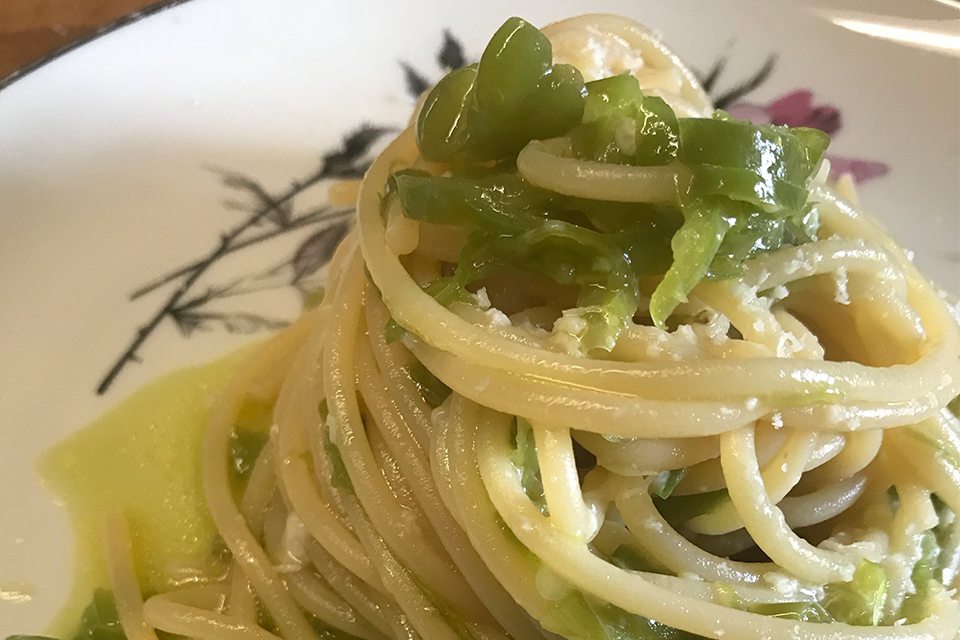
Spaghetti and the frigitello, the tiny pepper symbol of southern Italian cuisine

A difficult morning, the scorching city summer temperatures, and not enough motivation to go to the market.

I’m still in the city, but by looking on social media at my friends’ pictures at the beach I can immerse myself in their world, just for a moment. Summers in Rome are hot, but it adds all the more charm as a city lent to tourism for these few summer months.

Luckyly the fridge never lets me down. I’ll make pasta with the frigitelli bought yesterday, a simple and easy recipe, one you’d take to the beach. 


Are you asking yourself what Frigitelli are?

You’re not alone...they’re long green peppers, 6 to 8 centimeteres at max, a staple for any southern Italian table. The name comes from the fact that they are usually fried in a pan, and eaten straight out of the pan.

Their sweet taste makes them stand out from all other peppers that are found in Greek, turkish and Spanish cuisine, similiar in shape but extremely spicy.

But be warned: do not mistake frigitelli with the friarielli of Naples, a kind of radish, much more bitter than the Roman variety (but nonetheless as delicious and intriguing, especially for certain recipes).

Spaghetti with Frigitelli Recipe

To start the dish, take the frigitelli peppers and take out the seeds. Cut them in thin circles: keeping attention on the thinnes of the cut might seem useless but it’s useful to make the pepper sauce be one with the pasta, and enhance the flavour of the overall combination.   

Sautè the frigitelli in a pan together with white onion and a pinch of black pepper, but don’t cook them too long, and without guanciale this time since it’s too hot. After all not everything has to be a “Gricia”. The pecorino is also on vacation this time, but you can choose to sprinkle some anyway. It’s summer, let’s leave the vegetable to conquer our tables!

I follow the phylosophy of the pilgrim Artusi.

Once drained, cook the pasta with the frigitelli sauce, and incorporate some of the water you used to cook the pasta in. Serve immediately. I know it’s summer but it’s better to eat tis pasta as soon as it’s ready to enjoy the flavours to the fullest.

And the wine?

A Falangina dei Campi Flegrei would be perfect, the aroma of ripe fruit pairs well with the slight bitterness of the frigitello. The scent of cooked frigitelli and wine that race with each other takes us back to a summer spent in alleyways and chraming squares of Naples. I also had a Frascati Superiore, suits the plate extremely well too. A good frascati always has its reasons...

powered by social2s
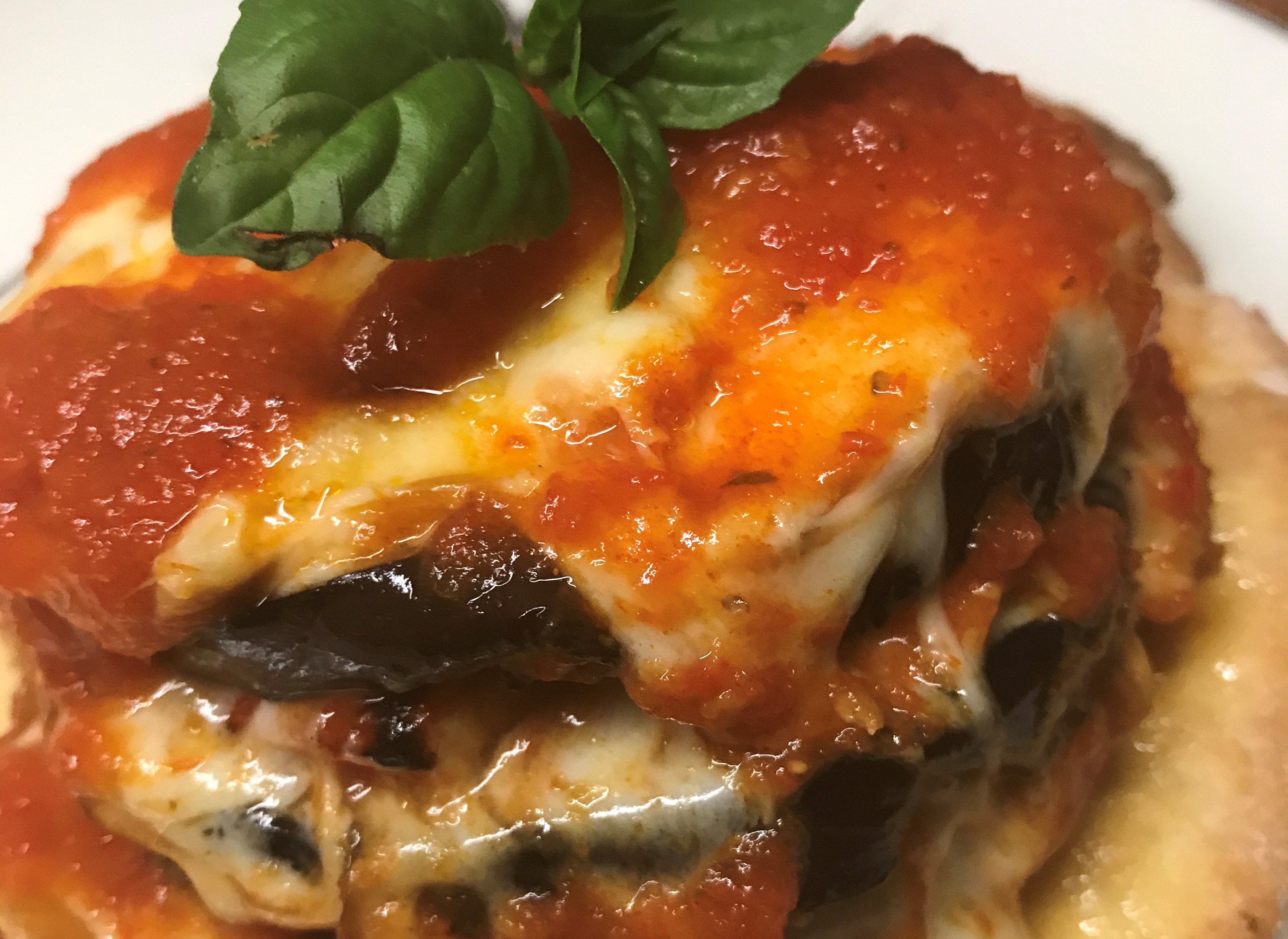
Summer is the aubergine parmigiana (parmigiana di melanzane)

The queen of the summer is without any doubt the eggplant parmigiana, an ancient dish whose origin is disputed between Sicily, Naples and Parma, one because the presence of the aubergine (melanzana), one for mozzarella cheese and the other?

The aubergine comes to us from the Arabs who from Asia have made it a staple ingredient and one of the emblems of Mediterranean cuisine from the eighteenth century onwards. Basil, aubergines, tomatoes, oil and cheese ... perfumes and colors reminiscent of the Mediterranean, in Turkey and Greece there is a similar dish made instead with pecorino cheese, called Moussaka.

But it is not such an ancient recipe: we remember that the tomato comes to us from the new world after the discovery of the Americas and we come to the conclusion that for a long time people did not eat the aubergines considering them to be harmful for ones health.

This dish has about a couple of centuries, well worn I would say if it is still in the dreams and tastes of millions of people. A young man!

And what does Parma have to do with it?

Let's go by order: those who say that the dish comes from Sicily refer to the Sicilian word 'Parmiciana' which indicates the thin horizontal wooden sticks of the Persian window which, in turn, recall the layers of the eggplant parmigiana. And even calling this dish 'eggplant parmigiana' instead of 'parmigiana eggplant' reinforces this assumption. Initially in the recipe pecorino was used as in the Turkish and Greek versions.

According to the Neapolitans, however, the eggplant parmigiana is a Neapolitan dish because it was described earlier in the cookery text 'Il cuoco galante' by Vincenzo Corrado at the end of the eighteenth century then, also told in 1837 by Ippolito Cavalcanti in the book 'Casareccia cooking in Neapolitan dialect . In this text the word parmigiana indicates the Parma cheese.

For the Parmigiani there is no story since the word “Parmigiana” indicates their cheese (Parmigiano)!

But now let's look at a lighter version of the aubergine parmigiana that best suits the lifestyle we now have in our bustling world. A different idea: it’s always fun to play with tradition.

Make a sauce of fresh tomatoes and basil.

Fry (grilling eggplant is heresy!) the aubergines and drain them on absorbent paper. Then add the aubergines, mozzarella and fresh tomatoes stacking them up to build layers. Put your Parmigiana in the oven for a few minutes: just enough time for the mozzarella to melt on top.

In Rome there is a kind of crunchy pizza that in dialect is called the ‘scrocchia’ (cricket) because of its crunchiness. Put the aubergines on the pizza as soon as they come out of the oven and sprinkle them with tomato sauce

Let's drink a strong wine. A red, a Nero Buono, an ancient grape from the Monti Lepini is also good. Even drinking it a little cold is not a crime, and Marco Carpineti is an excellent producer of the Nero Buono.

powered by social2s
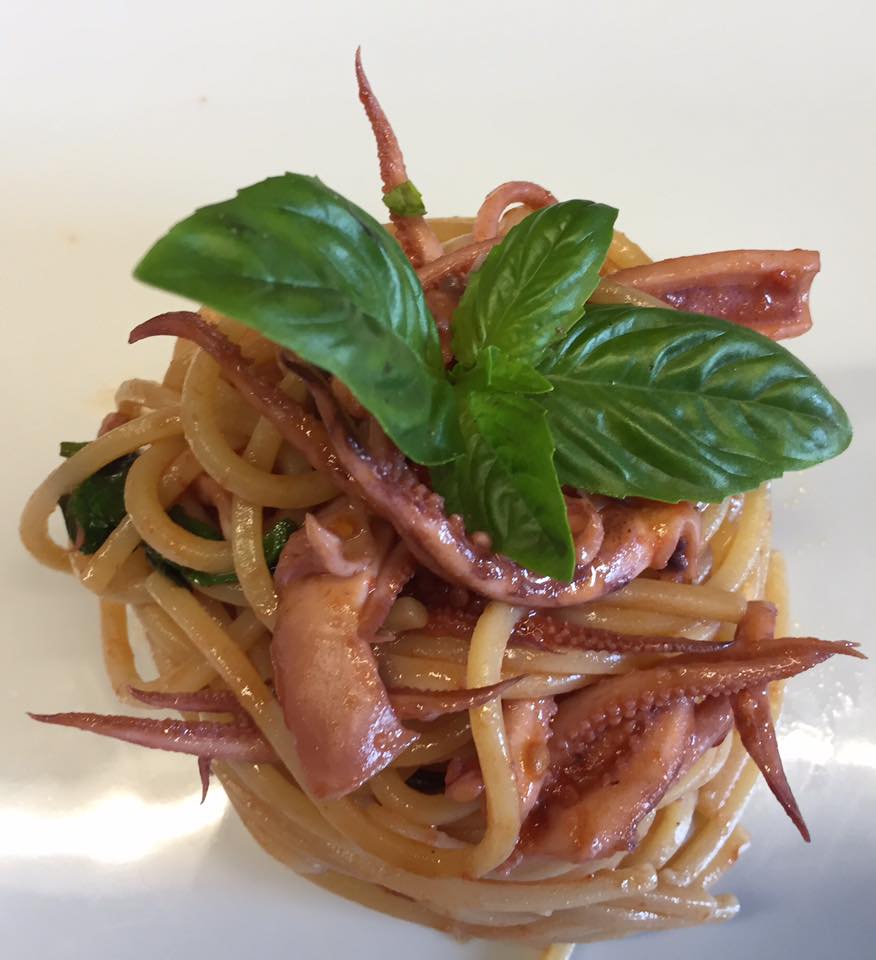
Spaghetti with Squid: an experience that starts at the Anzio fish market

What to do when you want to cook a fish dish? Everyone knows that much of the success depends on the product and its freshness so where do we start?

If you really want to prepare the best dish Spaghetti with Squid, the right place for you to find the perfect squid is at the port of Anzio, at the time of arrival of fishing boats from the sea.

The history of Anzio, founded by the Volsci, then ennobled by the Romans, is lost in the times. Here emperors Caligula and Nero were born, and Nero chose it as a summer residence and it was already famous for its port that connected the entire Mediterranean. The remains of Nero's villa are still visible and impress with their extension: they are located near the ruins of a theatre.

More recently Anzio ended up in all the history books because here the Allied landing took place during the Second World War.

Today it has an important seafaring livelihood and its catch is an excellent feature of the Lazio coast. The first processing companies were born here and their quality has reached the level to be defined as an Italian centre of excellence.

But back to the port, which is located right in the centre of the town, with the fish market. On the tables I chose the freshly caught squid. Less noble than other squids because they are slightly leathery: but what a taste!

The recipe is very simple: I put the squid in a pan with very few things: garlic and oil. But the good oil, what I'm going to get from those who can do it. For this recipe I chose an oil made with Itrana olives (or Gaeta from the name of the port from where the loads of olives were shipped). The oil is made from olives harvested from the tree at the beginning of vernalization (when the olive is changing colour) and cold worked at the mill.

The squid cook in a few minutes, and I let them blend with Cacchione, an ancient wine like the city of Anzio and grown right on this stretch of the Lazio coast.

The spaghetti are drained when ‘al dente’ and complete the dish by being boiled quickly. Serve immediately on the table and taste the dish with the same wine in the glass.

Today many wineries have re-evaluated this Cacchione grape and I have chosen a company from the nearby Nettuno, Bacco, the only one that grows this grape ‘piede franco’. This means that the plant has not been grafted and that the roots and trunk are of the same type. It seems like a nuance but for those who love wine like me it is an important detail.

At this point everything is ready for presentation at the table. I chose to enrich the visual experience by giving a ‘colour note’ with a basil leaf. It is just a garnish but fresh basil is one of the symbols of summer.

powered by social2s
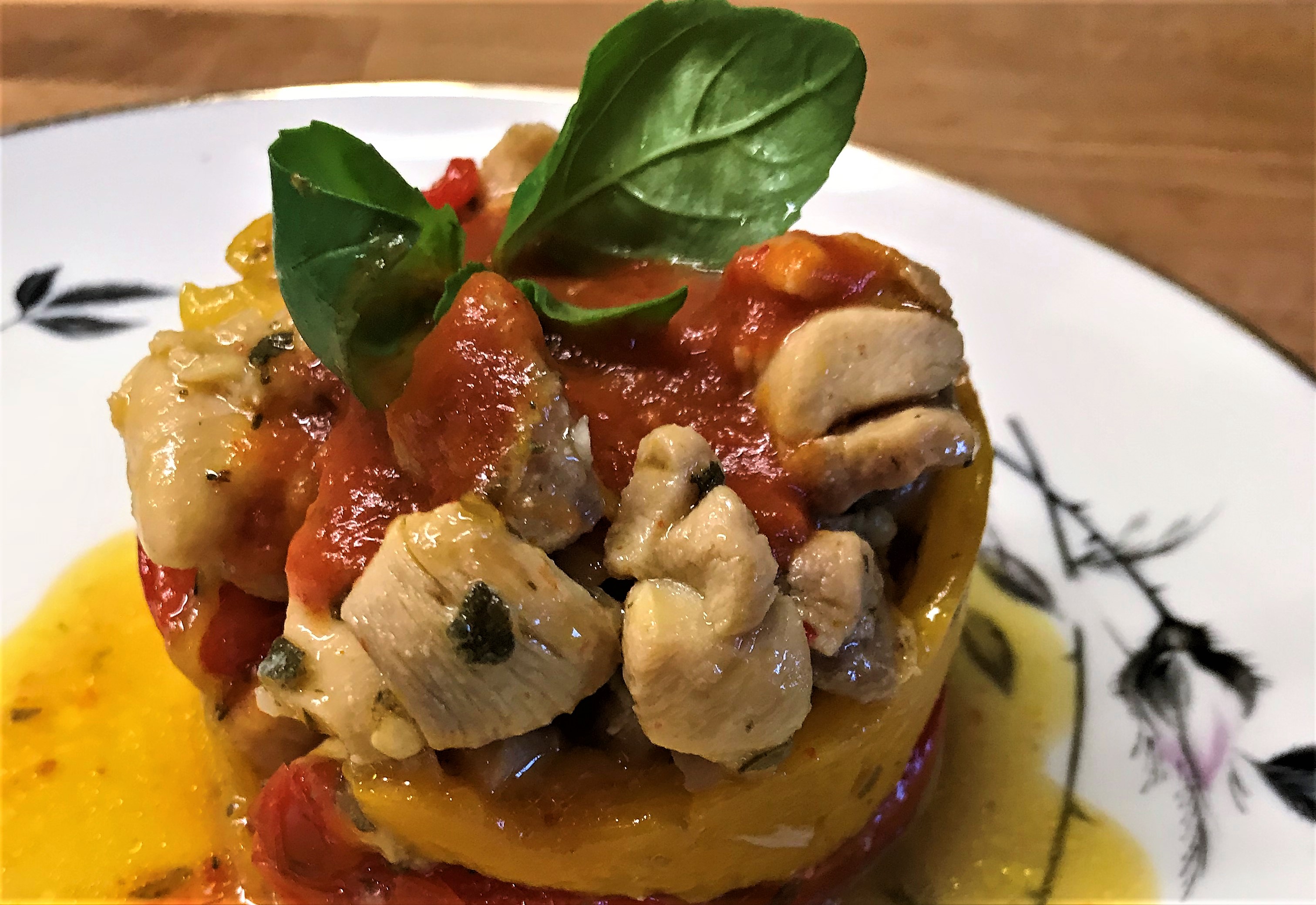
What do you eat in Rome and in the countryside at Ferragosto? Chicken with peppers

If you are in Rome or its nearby countryside during  summer and if you enter one of the typical country trattoria you will catch a particular scent that is very familiar to all the locals: chicken with peppers.

The decision to dedicate a story to chicken is not casual, in fact chicken is the traditional dish of August in the Roman countryside and the key ingredients are very simple. Chicken with peppers is a dish that evokes the Roman countryside, there is all summer in it.

With or without Tomatoes? Over the centuries these variations have characterized the different areas and Italian towns.

One place to taste it is to go to Isola del Liri, the incredible village near Frosinone where the Liri forms a waterfall right in the centre of the village, and taste it during the Festival of chicken with peppers. The event is in July on the occasion of the Feast of the SS. Crocifisso.

Alternatively, in Ravello, on the Amalfi coast, chicken with peppers is the traditional dish associated with the patron Saint Pantaleone and is eaten on July 27th. It is said that the recipe has been handed down since the 1700s when it was cooked with the addition of quince.

Recipe of Chicken with peppers

The recipe that I offer is revised and lightened for modern tastes with the eye on the scales.

Remember that for a good dish you have to choose the right ingredients and in this case the best chicken is the free range that can be found in the butchers where the butcher will tell you where it is sourced. Often butchers like to talk a lot but this is a way to learn a lot of things and spend a good time, a wait that will increase the pleasure of the dish.

The peppers? I recommend those in the open field a little 'more unsightly’ but good to die for with the yellow and red giving colour to the potYou begin by boning the chicken and cutting it into small pieces. These are then sautéed with oil and herbs from the field blended with wine. But what are these 'herbs'? Chop the ends off a fresh spring onion and put together with marjoram and a sprig of rosemary, then add garlic and fresh chilli.

The peppers are prepared separately with the traditional process in which they are lightly cooked in the oven and peeled to be more digestible.

Chicken and peppers come together only at the end for a short blending together in the pan in which you cooked the chicken.

Serve it using a pastry cutter ... and garnish it with a basil leaf. Unfailing in the summer!

Which is the best wine I recommend for an unforgettable combination? A biodynamic white wine and my choice is Fatia of Palazzo Tronconi with Malvasia puntinata and Trebbiano grapes for a combination of rare elegance.

The vineyard and the winery are located in Arce, also in Ciociaria near Frosinone, a village whose history began before the Romans and a village that is establishing itself as one of the centres of Ciociaria popular music. Do not miss the Ballarella Festival in May.

powered by social2s
dav
Sausage and Broccoletti: Coriander sausage from Monte San Biagio and chiacchietegli broccoli from Priverno

Grandma's sausage! Indeed, this recipe for Sausage and Broccoletti is one of the workhorses of all the grandmothers of lower Lazio, from Latina to Frosinone to Cassino.

Historically it seems to have been born between Monte San Biagio and Priverno where two typical products are produced and recognized as true gastronomic excellences: the Coriander sausages of Monte San Biagio, which dates back to the Saracen raids, and the Broccoletti of Priverno, known in this area as "chiacchietegli".

Before describing the recipe and its reinterpretation we make a brief reference to the beauty of the places where these excellent products come from.

Monte San Biagio is inside one of the last cork oak forests where pigs were once raised. It has a very ancient history and this place was where the Romans defeated Hannibal, the famous Carthaginian general who wanted to conquer Rome.

Through Monte San Biagio the ancient Via Appia passed and it was a border town between the Papal States and the Kingdom of the Two Sicilies: one can visit the Portella, the ancient customs house. In the village many stories still circulate about the brigands who lived on these mountains.

A festivalis dedicated to the sausage on the first Sunday in March.

Priverno, in the Amaseno valley, is one of the most pleasant villages of Lazio. The ancient pre-Roman and Roman city is located in the plains while the medieval village is located on a nearby hill. This was the home of Queen Camilla of the Volsci fights against the Trojans of Aeneas according to the story told by Virgil. The many historical finds are located in the splendid Archaeological Museum in the main square of the ancient village.

On the plain there is one of the masterpieces of sacred art: the Abbey of Fossanova with its intact medieval village. The church was born on a Roman villa and was consecrated around 1200 and entrusted to the Cistercian monks.

Broccoli is cultivated near the Amaseno: and a festival is dedicated to these vegetables in February.

The simplicity of success, in the case of our reinterpretation, lies in the fact that it is based on fast cooking and very few steps.

RECIPE

- Sausage: fry the outer part of the sausages until browned and then blend with white wine. Lower the heat to a minimum and cook for 10 minutes with the lid on. Check in case you need to add a little water.
- Broccoli: bring a pot with 4 fingers of water to the boil and dip in the well washed broccoli. Cook 5 minutes, then drain and cool with a little cold water.
- Cream of potato with black pepper: stew a potato until it is very soft and whisk it helping if necessary by adding a little oil or a little water to give it the right consistency, plus add black pepper to taste.
- Sauce of cooked sausages: reduce the cooking liquid of the sausages to the thickness of icing.
- Cream of broccoletti: blend the broccoletti with the help of adding a little oil or a little water to give it the right consistency.

SERVING

On a flat plate, lay out the three sauces with the help of a teaspoon, drawing them in circles from a height of 5/6 cm high. Add the sausages and the broccoli according to taste.

powered by social2s
IMG-20180206-WA0000-1024x768.jpg

For me carnival has always been a long-awaited day, and the wait grew exponentially with the approaching date of the festivities.
The reason why a person, especially as a kid, loves this day of celebration is soon said: it is a day of pure joy and fun where almost all worries are cancelled out, to make way for a whole day of carefree celebrations and fun. But in addition to colors, jokes and costumes, there is another memory, another peculiarity of this day of celebrations that has always made me love carnival.
The sweets.
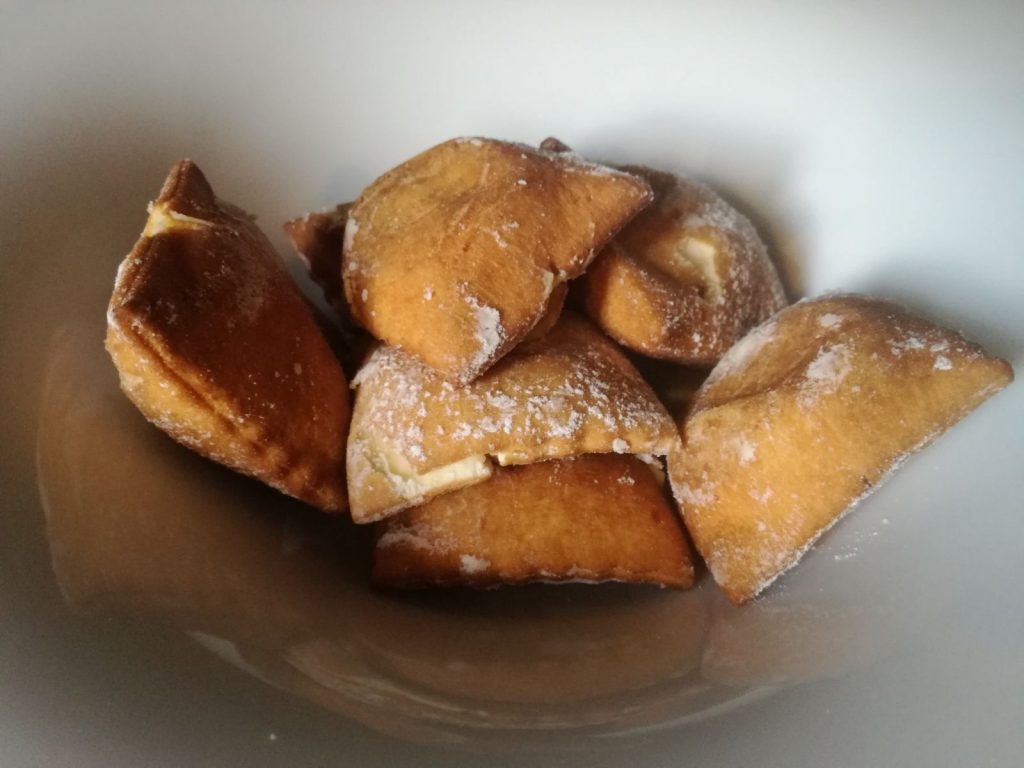
The desserts that have always accompanied me during this day are the chatter (or frappe as they are called in Rome), a light and tasty pastry, sweet and crunchy, so good that you could eat more than one serving. Along with the plain kind, there is also the stuffed variety, where you can indulge with the filling. Today I propose these two recipes, just as we handed them down from parent to child for countless generations.
Have a good carnival, and remember: at carnival every joke is fair game!


For the Chiacchiere recipe (chatter) 


First of all, put 40gr of butter out of the fridge and let it soften at room temperature. Now mix 500gr of “0” flour together with 5gr of baking powder in a large bowl. Help yourself during this part of the process by mixing with a fork to make sure that the yeast is properly combined with the flour.
Now add 80g of sugar and 4 eggs (3 whole and one egg yolk) and a teaspoon of salt.
You will have to reach a smooth and soft consistency, to the point where you can easily press tour thumb in the dough.  Let the dough rest in the film at room temperature (not above 22 °, otherwise the butter could separate and make it difficult to spread the dough) for 1 hour.
After this time divide the dough into 5 portions and pull it with a rolling pin as thin as possible, until it reaches a thickness of 2/3 mm.To pull the dough, sprinkle a smooth work surface with a generous amount of flour (a wooden pastry board would be ideal) and flour the rolling pin too.The ideal would be to use an adjustable dough strainer.
Once the dough is cut, cut the rectangles with the toothed wheel (5x10cm for example) and let it rest for about ten minutes. Meanwhile, fill a small pan with frying oil (peanut or high oleic seeds are the best, since they have a high smoke point) and bring to 150/160 degrees.
Now you can dip your dough rectangles and fry them for 3 minutes (be careful not to immerse too much or it could overflow the oil), then drain them on absorbent kitchen paper and finish them by sprinkling plenty of icing sugar.


For the Bugie (stuffed chatter) 


Using the same dough mixture from the recipe for the chiacchiere,

divide it into 5 portions and roll it up to a thickness of 2/3 mm.
Now, divide it into squares of 8x8 cm and on a half put a spoonful of custard (or the filling you prefer, jams or creams).
Fold the square of dough and pass the toothed wheel on the 3 "open" corners.
This way you will have a cream filled rectangle with three serrated sides. Let your sweets rest for ten minutes in the fridge and then fry them in hot oil (150/160 °) for 3/4 minutes, until they change to a light copper shade.Place the filled chiacchiere on absorbent kitchen paper and then sprinkle some powdered sugar.
powered by social2s

Subscribe to Newsletter

Discover a territory through the emotions of the people that have lived it.