Sciacca and Pasta with Sardines… And ended up with pasta cui saddi

When in Sciacca and you want to express the fact that someone is working for personal interest, you say "e finou a pasta cui saddi" (it all ends in pasta with sardines).

These are popular sayings that reflect feelings better than any other word and are often typically dialectal expressions. For me the most beautiful and folkloric take their cue from the table and combine the values ​​of gastronomic traditions with those of everyday life.

Sciacca, my town, is a seaside town and smells of sea and salt. It has always tasted of minerality and has grown with the sea in these three millennia of history.

Blue and white fish and pink shellfish from the sea and olives, almond trees, wine and citrus fruits from the land. All united at the table in a mixture of olfactory and taste sensations that are our richness and food and wine culture.

The sardines of Sciacca have always been a driving force for the growth of my town and with its industries they have "fed" the economy of the people of the port.

And the "sciacchitana" pasta with sardines (from Sciacca) is the dish that unites the sea with the countryside, represents Sciacca and differs from the Palermo version with tomato preserves.

The sardines taken in the months with the "R" are tastier, as they say, but in truth they are good and available all year round, especially from spring to autumn when wild fennel is also rich in fragrance and flavours.

The pasta with Sciacca sardines draws inspiration and variation from the so-called "Pasta a Milanisa", where Milan was understood as "u continents".

It is said that due to the first large migratory flows from south to north in the late 1700s the "southerners from Agrigento" tried to find their original flavours by preparing pasta with sardines and / or salted anchovies (cui saddi a mari (salted sardines), because fresh sardines were not available), sautéed onion, tomato sauce and, when they were also found in the Po countryside, wild fennel.

To these ingredients often carried in cardboard suitcases, others were added such as raisins and pine nuts that recreated in the mouth that proximity to their land of origin and that gastronomic game of sweet and sour, reminiscent of the culture of Arab origin.

When they returned to Sciacca from the "continent", the emigrants brought back the "Pasta a Milanisa" which over time became the name with which pasta with sardines alla saccense (from Sciacca) is generally still used.

"And ended up with pasta with sardines".

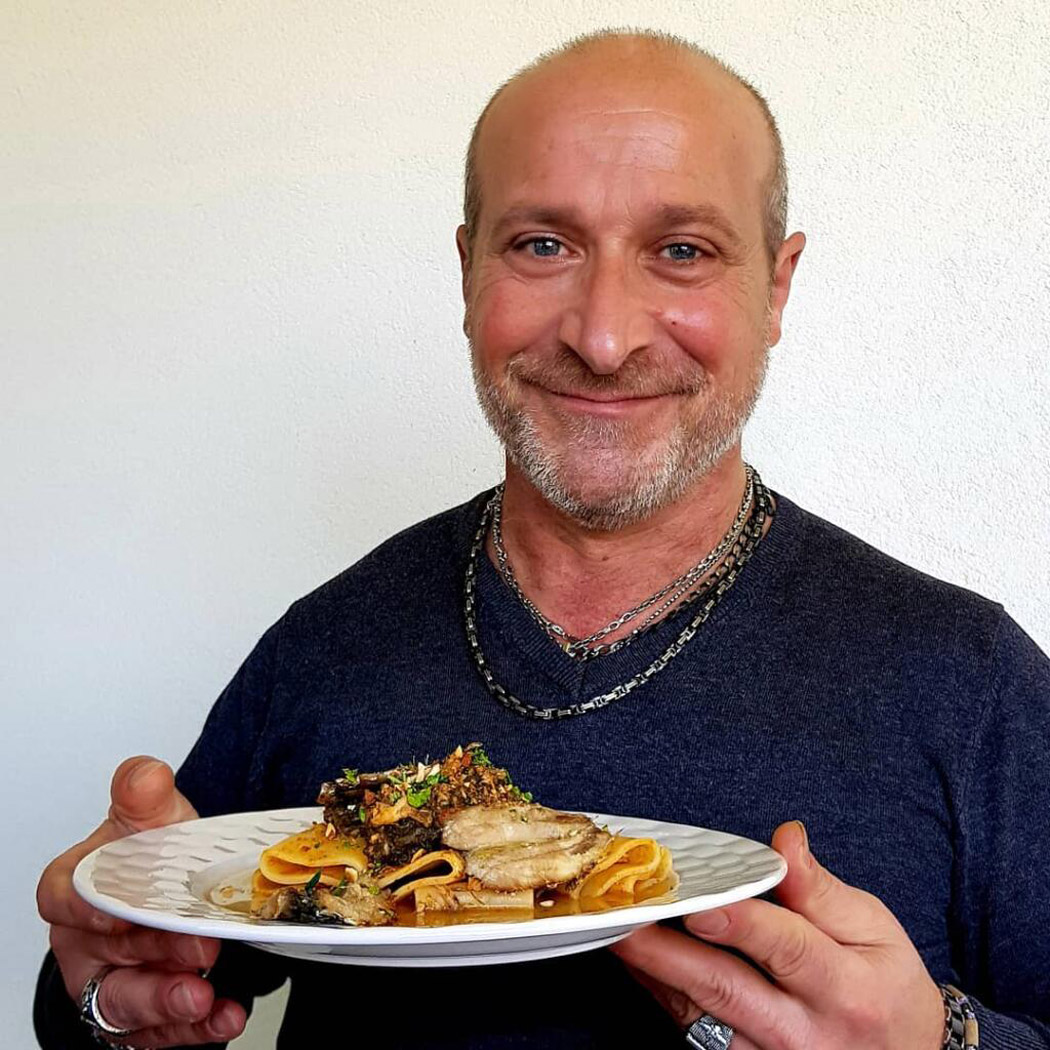
The epilogue of this story is my version of "Pasta con le sarde alla saccense" = ‘pasta with sardines from Sciacca’, reinterpreted and enriched by another excellence of the Sciacca sea: the pink shrimp. Its sweetness and the play of textures pleasantly grace the strong flavour of fresh sardines and desalted anchovies.

Recipe of "Pasta with sardines from Sciacca and pink shrimp from Sciacca"

Ingredients for 4/5 servings (depends on the belly)

  • durum wheat pasta 400 gr
  • fresh sardines cleaned (weighed clean) 500/600 gr
  • whole pink shrimp 1 kg
  • wild fennel 500 gr
  • double concentrated tomato paste 70 gr
  • 5 netted and boned desalinated anchovies (otherwise 10 desalted anchovy fillets in oil; or, for a more decisive and salty flavour, 5 desalinated sardine fillets or fillets in oil)
  • 2 white or golden onions (otherwise 1 onion, 2 small shallots and 1 clove of garlic)
  • 1 glass of white wine (Catarrato, Trebbiamo, Grillo and Insolia)
  • 20 g of pine nuts and 30 g of raisins found in white wine, 1 tablespoon of white wine vinegar
  • 1 sprig of parsley
  • 1 bay leaf
  • extra virgin olive oil
  • salt and black pepper
  • peel of one lemon
  • lightly toasted breadcrumbs with chopped almonds 50 gr

Wash and de-bone the sardines and peel the pink shrimp. With the heads and shells, make a broth by combining the parsley stalks, a bay leaf and a pinch of salt.

Wash well and select the most tender parts of the wild fennel, both the stems and the most aromatic and green leaves.

Bring plenty of freshly salted water to a boil, add all the selected fennel and cook for about 5 minutes. Leave the fennel still al dente and drain it well from its water. Keep the cooking water of the fennel: we will need it to cook the pasta.

In a saucepan, fry the julienne the onion (or the other combination) and fry on a base of EVO oil and then add a ladle of the shrimp soup. Let the onion simmer and brown for a few minutes.

Add the desalted anchovies (or alternatives), the soaked raisins, the pine nuts and, shortly after, just over half of the clean fresh sardines.

A few more minutes and pour the glass of white wine and the spoonful of vinegar.

Let it evaporate over high heat and add the previously blanched fennel that you have coarsely chopped. Pour a ladle of the fish broth and let it simmer again.

When everything is still liquid enough, add and disperse the tomato paste. The mixture should be soft and already coloured red. If too dry, add another ladle of shrimp broth.

Let it simmer, with the lid half open, for about 20 minutes and taste to season with salt and black pepper.

In the meantime, drain and filter all the shrimp scraps from their soup. Reduce the broth over high heat, adjusting it with salt and adding a drizzle of extra virgin olive oil. It will need to reach a slightly denser consistency.

Bring the cooking water of the fennel back to the boil, season with salt if necessary, and lower the pasta to taste.

Heat the sardine and fennel sauce, add the fresh peeled shrimp and the fresh grated lemon peel. Combine all the ingredients well.

For the other half of the fresh sardines, put them into a pan with a drizzle of extra virgin olive oil and cook until roasted.

Drain the pasta while still al dente, add it and stir it in the sardine and fennel sauce, then let it rest, covered, for about 5 minutes. Just enough time to cut the parsley finely and to toast the breadcrumbs with a drizzle of extra virgin olive oil and chopped almonds.

Now we compose the dish

Serve a light stock of reduced shrimp broth, then arrange the pasta by pouring over part of the sardine and fennel sauce. Garnish the sardines cooked in a pan on top of the pasta.

Then add a sprinkling of parsley and breadcrumbs flavoured with almonds and finally, a drizzle of extra virgin olive oil and a sprig of fresh wild fennel for decoration.

Here is my very personal interpretation of the “Pasta con le sarde alla saccense with pink shrimp from Sciacca”.

Comu finished? (how did it end?) Obviously: "we ended up with pasta cui saddi!".


powered by social2s
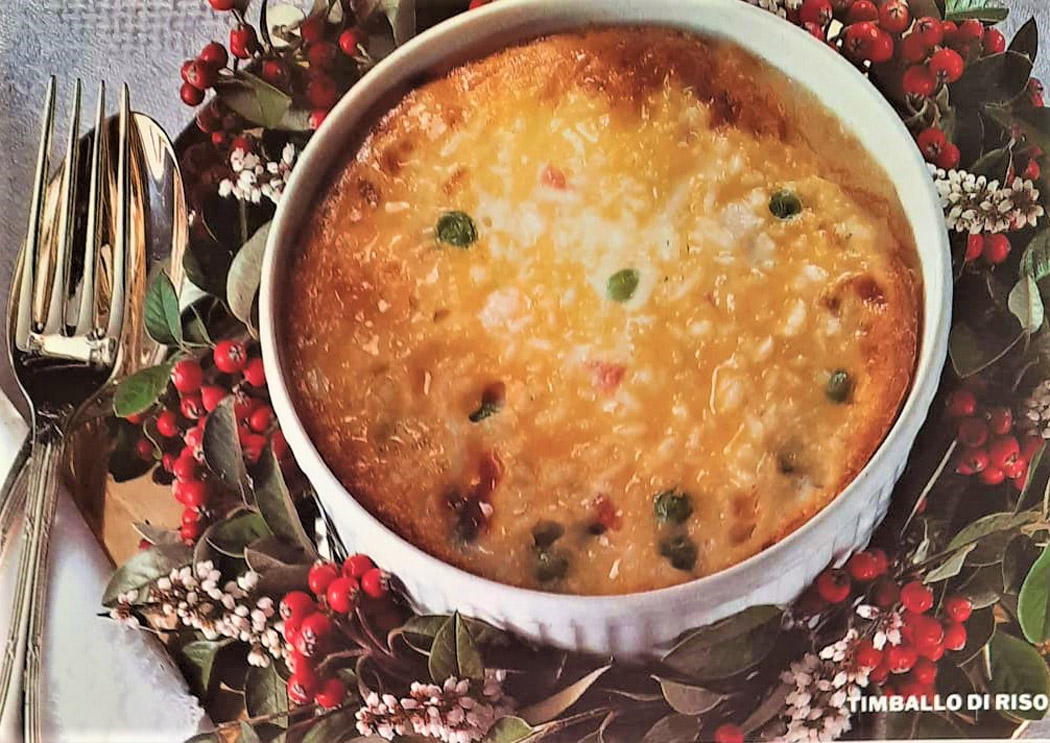
Rice timbale, from Acireale for all celebrations

This recipe has been handed down in my family from generation to generation.

I think it is a typical dish of my city: Acireale, a true pearl of Sicily.

An ancient city, embellished with Baroque architecture, and called the city of a hundred bells. It is located on the slopes of Etna which with its majesty dominates it to the west while a sea of ​​a thousand shades cools it on warm summer evenings.

It is in fact located at three hundred meters above sea level which can be admired splendidly from the beautiful balcony of the Belvedere villa, from which the vista sweeps up to Taormina and beyond.

Until the last century it could boast for its culture that it was imparted together with a rigid education in the various colleges run by nuns, Jesuits and Christian brothers.

But let's get to the recipe, in my family the rice timbale was usually prepared at Christmas and needed a preparation that lasted about two days.

In my memories of when I was a child, the scents and frenzy of that period of expectation and joy remain unchanged.

Rice timbale recipe

  • Rice
  • chicken broth
  • bechamel
  • peas
  • pecorino cheese
  • baked ham
  • butter
  • parmesan
  • eggs

The recipe begins with the preparation of the boiled chicken (naturally free-range) and the broth which we will then use to cook the rice. Once cooked, the boiled chicken is cut into small pieces which we will then put in the timbale.

Separately prepare the bechamel which is used to mix everything, the peas, the fresh pecorino cheese cut into strips and the chopped cooked ham.

Cook the rice in the broth and when cooked, season it with butter to taste and grated Parmesan.

At this point, the rice is carefully spread in a previously buttered pan. Then it is covered with all the ingredients listed, mixed to spread the flavour, and then covered with the remaining rice. Flatten the dish with a spatula and bake.

But it is not finished yet, because separately the eggs are beaten with the parmesan and when the rice is a warm the pan is taken out of the oven and the timbale is covered with the Parmesan and the eggs and put back in the oven until when it is golden.

Now, it is ready to be served. Enjoy the taste !!?


powered by social2s
Pasta with squid ink (Cu u niuru di siccia)

It is a dish that at first glance does not appeal for its colour and texture, but once tasted you can never forget its delicate and intense flavour that does not disappoint.

Pasta with squid ink, or as they say in my area "Cu u niuru di siccia", has entered the menu of many chefs on tiptoe and now has a place of honour among the gourmet ingredients of the Sicilian maritime tradition .

A dish with a sincere aroma and a deep taste of the sea that many may not like, but which must be tasted at least once in order to change your mind. I tie it to my town Sciacca, the most beautiful in Sicily. (Read Also)

The “cu u niuru di siccia” pasta has peasants origins, although today it is in competition with another highly sought-after dish such being pasta with sea urchins. The ink secreted by the cuttlefish was once used by sailors and fishermen exclusively as the only condiment suited to cuttlefish.

But over time someone has seen fit to also make a delicious sauce for spaghetti or linguine, pasta shapes that blend well with the velvety and sticky consistency. Especially in the lips that and teeth that get darkly smeared.

This fact sometimes leaves you a little worried before choosing this dish from the menu, especially when you are away from home and in contact with other people. Only the waiter who served you can understand your uninviting smile.

And believe me I am living proof of this fact!

Many times I wanted to order 'pasta cu u niuru', but I wondered how I could make myself visually presentable afterwards. And so I always seemed to  lean towards something else.

The pleasure of tasting this pasta, but also of being able to dye my lips and my whole mouth black, sometimes I take it off in the kitchen of my house, also satisfying the greediness of my husband who in this respect is a good fork .

But a story that reminds me of a child also binds me to cuttlefish ink.

At an early age I was not very inclined to eat fish, especially those of the soggy type that made me, as they say, a little sense ... (this also happens to kids and adolescents today).

My father, who liked to cook, to entice me to eat this pasta that represented and still represents for many a unique dish, as it is said "Si ti manci è pasta ti tinci u mussu" (if you eat this pasta you dye your lips).

I, a girl who had a father who wore the uniform for years and who answered many of my requests with a peremptory "No", let's say that it was difficult for me to believe that I could only put on lipstick if I ate pasta.

I was very amazed and I wondered if my father was telling the truth or was it just a way to make me eat pasta, or to make fun of me.

- Ma Papà veru mi fai tinciri u mussu?! (Dad can I really put lipstick on)

- Un solo ti metti u russettu ma un si leva chiu’!  (not only do you wear lipstick but it will take off more).

And so my father succeeded in his intent to make me eat his pasta with that slimy fish while it seemed to me to be putting lipstick on me like adult women.

This is my experience with squid ink.

Recipe of pasta with squid ink

Ingredients:

  • Pasta
  • Cherry tomatoes (or rather a little tomato paste)
  • Garlic
  • Parsley
  • Bags of Black

For its preparation, the recipe is very simple. It always starts with a sautéed garlic, cherry tomatoes (or rather a little tomato paste), parsley and the famous bags of black.

Extend with a glass of white wine and as needed with a little pasta cooking water.

Once the pasta is ready, pour it into the saucepan and mix everything.

Garnish with a sprig of parsley, and the black dish is served !!!!

powered by social2s
The exquisite Strawberry of Sciacca and Ribera

When I talk about food, I talk about memories.

Almost all the ingredients I grew up with are related to some memory or person, but I think this happens to everyone. It is called the 'food of memory' thanks to smell and taste, the only two senses connected to the hippocampus, that is, to long-term memory. They are indelible memories.

But what is the food of memory?

It is that smell, that image that overwhelms us and suddenly upsets us, taking us back in time to moments full of joy, childhood memories or particular episodes of our life.

My food of memory today is the Fragolina di Sciacca. (Strawberry Jam)

And immediately I sense the spring days, the Sicilian sun, the sweet and intoxicating scent of the strawberry, I see the rows of low bushes stained by these small and sweet berries.

I remember going to my uncle’s who had a strawberry field to help them pick. It was actually my parents helping, I and my cousins were there for the free tasting.

Whenever I talk about the strawberry, this image returns vivid and vibrant in front of my eyes. The admonitions of adults not to step on the plants, to bend down to collect these delights.

More than 3 decades have passed, but every time I enter a strawberry field that image pervades me.

But what about the strawberry that is called the "capricciosa".

Delicate and fragrant, small and graceful, it is a delight for the palate, perfect if used for jams or granitas, but the best way to savour it is with your hands picked directly from the fields.


The strawberry of Sciacca and Ribera is very soft, with globular red fruits melting in the mouth and is called "capricciosa" because its cultivation is complicated and laborious. The plants are kept low in small plots of land enclosed between tall leaf plants to stop the destructive action of the wind.

On our coasts the Sicilian wind is the Scirocco, arid and sterile that easily destroys crops and ruins the strawberry plants in a few hours.

I remember June 10 this year, fortunately at the end of the harvest season, a sirocco wind came and taking a trip to my friends' fields I noticed that the plants were all burned, as if a flame had roasted them. the leaves were all brown, the fruits withered. The harvest could have lasted another 15 days, but it was over for that year.

The Sciacca and Ribera strawberry is a Slow Food Presidium product and is recognized by the Sicilian region as a Traditional Agri-food Product (PAT).

But you were wondering how the wild strawberry arrived in Sicily?

Certainly it is not native to our area and a legend tells that it was brought to Sicily by two soldiers at the time of the Great War. Two soldiers collected the plants from the undergrowth of the Alps, wrapped them in a bundle and transported them on foot to Ribera.

Here they transplanted them into the Verdura Valley, between the two towns of Sciacca and Ribera, where the strawberry found the sun and the fertility of the Sicilian land and became perfectly acclimatized.

Since the 1930s they have been cultivated in the shade of the famous orange groves in the Verdura Valley, which guaranteed shelter from the wind and created a humid and shady environment just like the great forests of the north.

Over the years many of the plantations were moved inland, always sheltered from the sun among the centuries-old olive trees of the 'Chiana' district or in the hills of Caltabellotta, where an association of farmers has created "The goddess of perfume" a cooperative that manages various fields scattered throughout the territory.

And it is precisely there that my knowledge of the strawberry began at the age of 7 in the fields of the 'Chiana' district of Sciacca (which means plain), a large flat area with fertile soil rich in centuries-old olive groves. And always from there my story as an adult and as a lover of Sicilian food continues.

I love to use strawberries in desserts but I can also use them as a savoury element in hot dishes, transforming it into a sweet and sour sauce that goes very well with a risotto with caciocavallo cheese and broad bean ragout.

The recipe for Strawberry Jam

  • Sciacca strawberries 500 gr
  • Granulated sugar 100 gr
  • Peel of 1 \ 2 lemon
  • A few drops of lemon juice

Mix all the ingredients and mash with a spoon. Leave to macerate for 2 hours.

Cook the mixture over low heat for 30 \ 40 minutes. Place in sterilized jars, close the lid and turn them over with the lid down on tol cool.

Enjoy your meal with Sciacca strawberries.


powered by social2s
How to make the "Arancina", Palermo style!

Perhaps few people have noticed that the most famous and most popular Sicilian dish both on the island, but also outside, is not a fish dish but a meat dish.

1 to 0 for me and my tastes as a "mountain" Sicilian!

Arancina, or arancino for Camilleri enthusiasts and the inhabitants of Eastern Sicily, is in fact found everywhere: from Palermo to Catania, from Milan to London and from New York to Moscow.

In the Palermo area, an entire day is dedicated to the arancina. It was a popular religious celebration organized by the people devoted to a miracle performed by Saint Lucia, to express thanks.

It was 1646 when a great famine tormented the whole province which had just recovered from the plague "of Santa Rosalia" which occurred a little over twenty years earlier. The chronicles of the time report that every food supply, already rationed for some time due to the very scarce harvests, was practically exhausted and, especially in the city, the people suffered from hunger.


On December 13, when the arrival of winter in those conditions and with no food supplies predicted a real extermination, instead Venetian ships loaded with wheat and various cereals, including rice, landed in Palermo.

The population came and as they were hungry they did not wait to grind the wheat to make pasta or bread but began to eat wheat and rice boiled like this, without even seasoning it.

December 13 was the feast of Saint Lucia and since the ships came from Venice where the body of Saint Lucia rests after being stolen from Syracuse, the people attributed the miracle to the saint. Everyone vowed to fast every year on 13 December without eating flour and derivatives but only boiled cereals.

But it is known that we Sicilians have a fantasy equal to the colors of the carts, and therefore that vote with the passage of time was maintained and still remains today but instead of boiled rice arancine were born and instead of boiled wheat the CUCCIA (which maybe some other time I'll talk about).

I love to say that on December 13 the people of Palermo are divided into two categories wherever they are in the world: those who make arancine and those who buy them.

I have always been definitely among those who make them, first with my mom in Pioppo, and now here in Milan with my wife.

Arancina recipe

Ingredients:

  • risotto rice
  • bay leaf
  • saffron
  • salt
  • black pepper
  • mixed minced meat (beef mixed with pork)
  • extra virgin olive oil
  • peas
  • celery-carrots-onion
  • tomato puree
  • water
  • flour
  • bread crumbs
  • sunflower oil

In the beginning, therefore, it was rice, a fairly starchy rice (like that for risotto) that is boiled with a bay leaf (someone adds a knob of butter).

While the rice is cooking, a Palermo-style ragù must be prepared (see post on my aunt Sara's baked pasta) which, however, must be made to shrink until it becomes almost solid.

At the end of cooking the rice must be added, but only in Palermo, the saffron to make it of the classic yellow color, then it must be allowed to cool (possibly it must cook absorbing all the water so as not to disperse the starch when it is poured).

At this point you need to prepare a fairly liquid batter of water and flour, and a bowl with breadcrumbs.

Now comes the fun part.

It involves taking a nice handful of rice, pressing it in your hands, until you get a firm ball, then piercing it, creating the hollow with your fingers, putting the sauce and a small sprinkle of black pepper in it, then closing it well and make sure that the ball is without cracks (which otherwise opens in frying), then roll it in the batter and then pass it in the breadcrumbs.

I tell you right away that it is not easy at all!

But luckily for you, technology comes in handy and there are molds (such as hamburger presses) that simplify the job making it clumsy-proof.

They exist both in the round Palermo version and in the Catania "volcano" version. In fact, the latter together with the ragù also put some cubes of stringy cheese, but not in Palermo!

I recommend letting the arancine rest in the fridge for a few hours and then frying them in plenty of sunflower oil until they are golden brown.

So enjoy your arancini, if possible with a good Sirah wine.


powered by social2s
Broad beans and chicory from Puglia

I was born in one of the most beautiful regions in Italy ... Puglia and I live in the province of Lecce, the one known throughout the world for its stone and the superb but delicate Baroque decorations of its churches and palaces.

The town where I live is called Castrignano dei Greci, a small town and a quiet town of traders which was founded by the ancient Greeks. On the other hand, Greece is just beyond the sea, we share the same air and scents.

My land is rich in aromas and flavours and I want to tell you about a typical dish of the area that all true Apulians know: broad beans and chicory.

This dish has origins in ancient times when people ate what the earth offered and families used to often consume legumes.

Chicory grows spontaneously in the countryside. I collect them in the wild, but you can occasionally buy them in fruit and vegetable shops. The beans are the local white (peeled) ones at from home and I prefer them to other types because they are sweeter.


The town where I live is called Castrignano dei Greci, a small town and a quiet town of traders which was founded by the ancient Greeks. On the other hand, Greece is just beyond the sea, we share the same air and scents.

My land is rich in aromas and flavours and I want to tell you about a typical dish of the area that all true Apulians know: broad beans and chicory.

This dish has origins in ancient times when people ate what the earth offered and families used to often consume legumes.

Chicory grows spontaneously in the countryside. I collect them in the wild, but you can occasionally buy them in fruit and vegetable shops. The beans are the local white (peeled) ones at from home and I prefer them to other types because they are sweeter.

Even the oil is extra virgin from Castrignano dei Greci because we are lucky enough to still have the farmers who collect the olives that are then cold pressed in the mills to obtain an excellent product.

Our oil is a little pungent in the mouth but goes perfectly with the preparation of this traditional dish. A complete dish in its simplicity, timeless that can always be offered with the guarantee of success.

It is a recipe with cheap ingredients but it is rich in taste and is served both as a first course and as an appetizer.

Broad beans and chicory recipe from Puglia

Ingredients:

• white peeled broad beans 400 gr

• wild chicory 400 gr

• Stale bread to taste

• Salt to taste

• Water to taste

• EVO oil to taste

• Chilli pepper to taste

• Garlic to taste

After soaking the beans in cold water overnight, drain them and leave them to cook coveredwith cold water. Slow cooking will take about two hours.

Meanwhile, clean and wash the chicory, blanch it in salted water and sauté them in a pan with garlic, oil and chilli.

Season the beans with salt and purée them with a blender or vegetable mill.

Fry a few slices of bread in EVO oil.

Serve the bread topped with broad beans and chicory accompanied by good wine.

I hope you enjoyed it


powered by social2s
Cavatelli alla Ventricina, the Queen of Molise

I am a kitchen chef and I would like to bring to your attention the VENTRICINA, a typical salami of my territory.

I am in Montenero di Bisaccia, in the province of Campobasso in the surprising region that does not exist: Molise.

Ventricina is a cured meat produced throughout the Trigno River Valley, both on the Molise side and on the Abruzzese side. I remember that before these two regions were a single region with the compound name of Abruzzo and Molise.

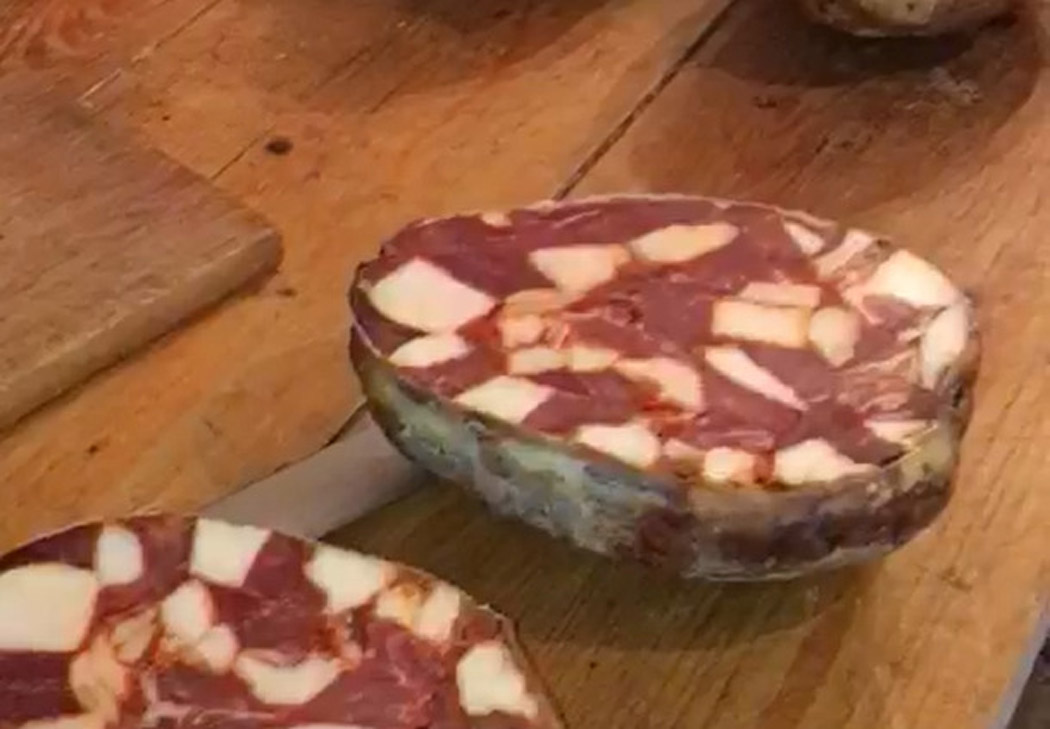
For us locals, the VENTRICINA is defined as the Queen of Salami and we produce it with the noble parts of the pig cut into chunks ranging from 2 cm to 4 cm: ham, loin, shoulder and bacon (which is the fat part that must never exceed 35%).

All these parts are then spiced with salt, sweet and spicy paprika, wild fennel seeds and other little secrets that no one will ever lt be known.

Then the mixture is stuffed into the bladder or into the larger intestines of the animal from which its name derives. In fact, it was originally stuffed into the stomach from which it also takes the name "belly-china".

At this point it is to be put out to dry and is seasoned in an olive wood bowl with three branches called perfecchi.

Ventricina can be consumed in various ways, as an appetizer or sliced as a dish. Tradition has it that it is eaten peeled with the hands in large pieces.

The first dish that can be considered the symbol of my town is the Cavatelli (which we call cuzzhtill) with Ventricina sauce, while the second dish is the grilled skewers.

Ventricina Cavatelli Recipe:

Ingredients for 4 people:

  • Cavatelli 600 gr
  • Ventricina 400 gr
  • Chopped (Brunoise) of celery, carrot, pepper and two cloves of garlic dressed
  • Tomato puree (lu sctratth)
  • Two bay leaves

Brown the vegetables in three tablespoons of EVO oil and then sauté the Ventricina, cover with a lid and seal for a few minutes.

Deglaze with half a glass of red wine (Montepulciano) and half of white wine (Trebbiano) and then cover with two bottles of passata, a little water and bay leaves.

Let it go over a very low heat for at least 1 hour and, when the sauce is well reduced, cook the cavatelli and then toss them with the sauce and sprinkle them with pecorino from Molise.

The first is ready to be served -  good appetite!

powered by social2s
A dish dedicated to Ferdinandea Island, the island that doesn't exist

Ferdinandea Island… from the first moment we founded the Ferdinandea Island Food and Wine Association in 1996, the idea and the impulse to transform the island into a gastronomic product was born in me.

I then thought of a dish that contained within itself the conformation of the island, then I reread the chronicles of the time when it emerged from the sea like a cap of sparkling wine in July 1831, with puffs, lapilli and related algae that were brought to the light.

Then the French who in turn demanded the island by putting their flag and called it Isola Giulia (from Juliette: July in French).

Finally the Bourbons, reigning in that period rightly made it theirs and called it Ferdinandea Island, after Ferdinand II of Bourbon!

The Island that does not exist was then defined, as after about six months (therefore in January) it descended under the surface of the water. Today with calm sea it can be glimpsed at less than 7/8 meters deep.

Over time, underwater observers have discovered a much larger volcanic bank than Etna and baptized it "Empedocle".

Returning to the idea of ​​creating the dish, I was reminded of the various fish that gravitate around it: the sailors of Sciacca boast when they fish in that site, defined for them: "ù ... bummulu"! (the terracotta container where drinks were kept cool) for the particular taste of the fish thanks to the algae and their habitat.

Several claimed the dominion of the Island, the British attacked their flag and called it Banco di Graham as the admiral who placed the flag was called.

Then the dish takes up the particular fish that characterize the sea of ​​Sciacca and combines them with the colour of the lava with the tomato.

While the algae are simulated with fresh raw rocket and green courgette cut into matchsticks and then fried in crispy extra virgin olive oil.

All sprinkled with toasted breadcrumbs that gives the image of lapilli and pumice and placed so that the sense of crunchiness appears on the palate.

Wherever I have prepared this dish, I have always received expressions of appreciation and good taste.

Therefore, using products from our territory, the island came out on the plate with simplicity and love. All types of pasta can be used, but to simulate "ù ... bummulu", it is necessary to use long pasta, to be able to wrap it and put it upright.

You can see the preparation in this link https://www.youtube.com/watch?v=RAJMx7xJ_zw&feature=youtu.be

Good tasting paired with a good Grillo di Sicilia wine!


powered by social2s

Subscribe to Newsletter

Discover a territory through the emotions of the people that have lived it.